#26: Bruce Elder's Lamentations

Lamentations (A Monument to the Dead World)

The Innis Film Society showed this epic film in the sprig of 1986, as a two-parter where audiences saw Part 1 at Innis and Part 2 at the AGO (before I worked there but our first collaboration with them). I sort of view it as the first real screening of the version of the Film Society that would see us through to almost a decade of adventurous artists’ filmmaking: historical works, filmmakers in person with their works, critical evenings, inter-disciplinary programs, and the occasional Hollywood classic, Euro/Japanese art film, or documentary to keep things interesting.

Bruce Elder’s film really felt like “now, someone is finally doing something bold with cinema. actually responding to the possibilities of the medium and treating it like an art form on par with great poetry, painting and musical composition.”

It was truly a great evening for the film itself, but also because I really feel like the Film Society came was born that night (Kate MacKay was in first year, and attended; Paul Della Penna was there; Mike Zryd; Susan Oxtoby; Bart Testa; Jim Smith; Mike Cartmell; Tom Thibault; Ellen Ladwosky; and many others).

I wrote the following piece for TIFF’s Canada On Screen website and you can still read it in its original presentation there (http://www.tiffcanadaonscreen.com/experimental-film-and-video/lamentations-a-monument-to-the-dead-world).


Bruce Elder’s Lamentations (A Monument to the Dead World) belongs to a film cycle, The Book of All the Dead, which comprises the bulk of Elder’s filmmaking from 1975 to 1994. In ancient Egyptian culture, the Book of the Dead consisted of religious texts intended to help preserve the spirit of the departed in the afterlife — but in Elder’s reading, that comforting idea of continuity takes on a rather darker cast. Over the course of its 35 hours, the cycle suggests that the era where humans had an authentic bond with God has definitively passed; in modernity, we are each left to our own devices, deprived of divine guidance.


In a controversial manifesto, “The Cinema We Need,” that was written while making Lamentations, Elder elaborated this view to propose a new philosophy of film aesthetics, taking aim at narrative in general and the “new narrative” movement that some critics said was emerging at the time in particular. Drawing on the Canadian philosopher George Grant’s Lament for a Nation, and in turn the thought of Martin Heidegger, Elder characterizes narrative and realist representation as “rituals that have become meaningless and empty. And just as rituals must be changed when this happens, so must the form of cinema, if it is to help us rediscover our wonder at the gift of things.”


Following on from this proposition, Lamentations is comprised of a complex and disparate patchwork of audio and visual elements: a philosophical meditation superimposed as text throughout the film; a voiceover narration and more additional philosophical texts; and vignettes featuring a comical but disturbing Franz Liszt, an angry, deranged man in an alley, and an arrogant psychiatrist. While Elder does not exile narrative entirely, he continually counterpoints it with non-narrative elements — most significantly the many beautiful, kinetically shot and edited images of landscapes, bodies and technology — or undercuts it, as when an intellectual debate between Sir Isaac Newton (David King) and George Berkeley (Tony Wolfson) is accompanied by Bill Gilliam’s avant-garde electronic soundtrack and repeatedly interrupted by white frames. In the second part of the film, Elder turns his attention away from the narcissistic characters of Part One and sets out to find salvation in the forests of British Columbia, the American Southwest and Mexico’s Yucatan — but there is no escape from the decadence of modernity.


A major influence on many artists and writers both locally and internationally — including Richard Kerr, Bruce McDonald, Izabella Pruzka, Stephen Broomer and Erika Loic — Lamentations also earned Elder the praise of avant-garde legend Stan Brakhage, who said of his fellow artist: “I feel closer to this epic-maker Elder than to any other living film-maker: and yet I feel an aesthetic opposition of such intensity that I'm certain I'll be the rest of my life working Uphill to off-set this grand haunt.”


#25: Carolee Schneemann's Fuses

For those of you haven't seen the film, I highly recommend you pause and check it out now. http://www.ubu.com/film/schneemann_fuses.html. Schneemann made Fuses partly primarily as a response to Brakhage's Loving. According to Schneemann, Brakhage made Loving because he was obsessed with the erotic relationship between her the composer Jim Tenney. And yet, she always felt that he failed to capture it adequately so she set out to make Fuses. In Millennium Film Journal 54, David James argues: “Dissatisfied with Brakhage's representation of her sexuality in Loving (1957) and Cat's Cradle (1959), the films he made about her relationship with James Tenney, Carolee Schneemann made her own vision, one that addresses the phallocentric imbalance of even Brakhage's best attempts to share authorship with a lover in the profilmic space. In doing so she was able to address the repression in culture generally of what she understood as the female principle. Her film is, then a polemically female representation of heterosexual eroticism, one that demonstrates its difference in almost all the phases of its production.

“Schneemann's intimate and graphic representation of sexual intercourse was historically anomalous; its explicitness appeared anti-feminist in the contexts of feminist attempts to differentiate erotica from pornography, and its fascination with the male as much as the female body was unusual outside homosexual pornography. As in Brakhage's participation films, this egalitarian representation follows from the lovers photographing each other during lovemaking, though Schneemann also photographed herself and used camera stands to photograph herself and Tenney together. The editing was entirely Schneemanns own work, but otherwise labor was not divided in the production of the profilmic nor in its recording. Thus reproduction of gender in power relations in the profilmic or in the control of the apparatus was avoided, as was phallocratic distribution of roles - the male as the scopophilic subject and the female as its object. The film so thoroughly interweaves shots of Schneemann and shots from her point of view, shots of Tenney and shots from his point of view, and of the two of them from no attributable point of view that narratorial positioning is entirely dissolved. The only stable persona implied is a black cat, its manifest sensuality is a purring correlative to the action, reminding us that in the textual plurality of the film's enfolding, it illustrates the pussy's point of view. “Within this plurality, the organizing telos of the male orgasm - the end that orders the narrative and representational systems of contemporary pornography - is shunned. The montage does not insert the shots into the rhetorical figures of orthodox narrative economy, but rather disperses authorship and subjectivity as generalized functions of an indeterminate erotic field. Emotions are legible on the participants' faces and their existence outside sexual passion is fragmentarily glimpsed (but then only in contexts that feed back metaphorically into the iconographic field - she running on the beach and he driving a car), but these do not articulate psychological dimensions of character. The lovers are not unified, discrete subjects within the erotic activity, so much as the vehicle of an eroticism that possesses them.” James’s account of the film in Millennium is one of the more helpful descriptions and, though there has been significant recent writing on Schneemann by women, I apologize for foregrounding a male take on the matter. Not just one, but two, for Bruce Elder’s response to James further illuminates the nature of Schneemann’s radical project in Fuses:

“While it is certainly true that Schneemann believes the female principle is repressed in our culture and that a large part of Schneemann’s art is devoted to making explicit what such repression bars from our consciousness, it is not so clear that ‘phallocentricism’ is what is statke between herself and Brakhage on the matter of representing the erotic relationship she and her lover Tenney shared. For Schneemann seems less eager to deny men their expression of sexuality than to claim for women the right to express theirs. Schneeman has an abiding curiosity about ‘primitive’ thinking (forms of thinking that our culture of instrumental reason has marginalized by ascribing to them the status of infantile modes of awareness or superstitious and pre-scientific ways of understanding the world.) She has even taken on the ask of exploring her fascination (and, may we suppose, that of other people) with the spell the phallus exercises in the consciousness. Plumb Line, as we have alredy seen, attempts to plumb the depths of the erotic spell with which a lover from whom she has just split had held her, virtually enthralled – and the film associates this erotic spell with her fascination with the phallus.”

In case you’re interested, you can watch an online representation of Plumb Line here: http://www.ubu.com/film/schneemann_plumb.html. Schneemann never says explicitly what she finds lacking in Loving, and how she’s addressing that in Fuses. Elder proposes, somewhat speculatively, that she felt that for “a film to be true to her sense of lovemaking, it could not be so scoptic as the formidable power of Brakhage’s imagination causes his to be. I believe that Schneemann wanted to capture the sense of the tacticle/kinaesthetic body, rather than the body observed externally; this is the implication of her remark concerning her motivation for making Fuses, ‘Since my deepest expressive and responsive life core was considered obscene, I thought I had better see what it looked like in my own vision. I had never seen any erotica or pornography what lived sexuality felt like.’” (Bruce Elder, Bodies of Vision). A few asides. Fuses was also a response to Brakhage’s Cat’s Cradle, in which she and Tenney (and Stan and Jane) also appear. https://vimeo.com/40928474.

Carolee basically felt that Loving, as well as films Cat's Cradle and Window Water Baby Moving, were inadequate representations of the female experience, romantic and phallocentric I've never quite found the words to describe it, and I sometimes think I'm completely missing the point, but Fuses is just more erotic to me. When I was in my 20s and 30s and discovering this film, I really did focus on the formal elements. The film took me to that zone occupied by Pollock, Rauschenberg, Brakhage, and others (mostly men ). The drawing on film, superimpositions, rapid montage, and color palette all seemed more significant to me than the documentation of sexual activity that was going on. I find this unfathomable now. Was it because I knew the couple on screen (especially Jim)? Was I such a formalist that I was blind (and comatose)? I’m not sure, but it all seems so bizarre now.

There is much more I’d like to say about Schneemann, but this is just about one film in a rich career that intersected with the Viennese Actionists (https://www.youtube.com/watch?v=Fw_wW2v45eI), Fluxus, John Cage, Claes Oldenburg, the Minimalists, several generations of feminists (including influences like de Beauvoir), Yves Klein, Kusama, Paik, Moorman, Yoko Ono… and dozens and dozens of other collaborators and influences. I’d like to talk about the International Experimental Film Congress/Innis Film Society/AGO appearances, her extraordinary influence on younger artists (performance, film/video, and otherwise), the parody of her performance persona in The Big Lebowski. So I’ll leave it that.

“I never thought I was shocking,” she says. “I say this all the time and it sounds disingenuous, but I always thought, ‘This is something they need. My culture is going to recognize it’s missing something.'” (Carolee Schneemann, 2014, The Guardian)

download.jpeg
1-FUSES.jpg
AD05105_0.jpg
67c663501f4a860b6304448bd6c7a8c5.jpg
download (1).jpeg

#24: 100 Most Played Songs (by me) in 2018

According to Spotify, this is what I listened to mostly in 2018. Seems right, seems odd and at times embarrassing, but on the whole I’m intrigued by my patterns, obsessions, and the tension between my sense of adventure and my sentimental conservatism.


I’m not sure if the 100 are in any order, because I have a hard time imagining that I played “Issues” by Julie Michaels more than anything, but perhaps I didn’t. “Feel Like Going Home”, “The Passenger”, and “Mother of Earth” are convincingly in the top 10.


Issues (Julie Michaels)

Feel Like Going Home (Charlie Rich)

The Passenger (Iggy Pop)

Mother of Earth (The Gun Club)

Somebody to Love (Queen)

Quand on n’a que l’amour (Jacques Brel)

Ave Maria (Charles Gounud, Yo Yo Ma edition)

You’ve Got to Hide Your Love Away (The Beatles)

Choral “Jesu, meine Freude”
de la Cantate “Herz und Mund Tat und Leben” en sol majeur (Johann Sebastian Bach)

Praying (Keisha)

Daydream Believer (The Monkees)

Build Me Up Buttercup (The Foundations)

Cloud Nine (The Temptations)

Sorrow (David Bowie)

The First Time Ever I Saw Your Face (Roberta Flack)

4 Impromptus, Op. 90, D. 899: Impromptu No. 3 in G Flat Major (Franz Schubert)

Zombie (Fela Kuti)

Jambalaya (On the Bayou) (Fats Domino)

Villiers Terrace (Echo & the Bunnymen)

Ain’t No Mountain High Enough (Marvin Gaye)

English Suite No. 2 in A minor (Johan Sebastian Bach)

If You Don’t Know Me By Now (Harold Melvins & The Blue Notes)

The Load Out/Stay (Jackson Browne)

I’ll Keep it with Mine (Nico)

A Swingin’ Safari (Bert Kaempfert)

Send in the Clowns (any version - Sinatra’s and Judy Collins’s show up highest)

One (Johnny Cash)

Boys Don’t Cry (The Cure)

Be My Baby (The Ronettes)

(What A) Wonderful World (Sam Cooke)

Money (That’s What I Want) (Barrett Strong)

Come On Get Happy (Partridge Family)

Monkey Man (Amy Winehouse)

Chelsea Girls (Nico)

Another Girl Another Planet (The Only Ones)

Together Wherever We Go (Julie Styne/Stephen Sondheim - many versions, Ethel Merman’s being the classic)

Four Jews in a Room Bitching (William Finn - sung by Andrew Rannells, Christrien Borle, Anthony Rosenthal, Brandon Uranowitz, Stephane J. Block)

Coming Back to You (Leonard Cohen)

Get on Top (Tim Buckley)

Chain Gang (Sam Cooke)

Limbo Rock (Chubby Checker)

Needles and Pins (The Searchers)

Lean on Me (Bill Withers)

I Heard it Through the Grapevine (Marvin Gaye)

Temptation (New Order)

Then He Kissed Me (The Crystals)

Montague Terrace (In Blue) - Scott Walker

Chasing Sheep is Best Left to Shepherds (Michael Nyman)

I Will Always Love You (Whitey Houston)

Don’t Let me Be Misunderstood (The Animals)

Mr. Jones (Counting Crows)

Jackson (Johnny Cash & June Carter)

All the Young Dudes (Mott the Hoople)

Famous Blue Raincoat (Leonard Cohen)

When I Paint My Masterpiece (The Band’s version)

Way Over Yonder in the Minor Key (Billy Bragg & Wilco)

Surfer Girl (The Beach Boys)

Pancho & Lefty (Townes van Zandt version)

Thrasher (Neil Young)

Life During Wartime (Talking Heads)

Madame George (Van Morrison)

Don’t Leave Me This Way (Thelma Houston)

Build Me Up Buttercup (The Foundations)

Daydream Believer (The Monkees)

La boheme (Charles Aznavour)

Girlfriend is Better (The Talking Heads)

She Never Spoke Spanish to Me (Texas Tornados version)

Chan Chan (Buena Vista Social Club)

’39 (Queen)

Hanging Around (The Stranglers)

Because the Night (Patti Smith)

O Superman (Laurie Anderson)

God Only Knows (The Beach Boys)

Play with Fire (The Rolling Stones)

My Favourite Things (John Coltrane version)

Morning Has Broken (Cat Stevens)

She’s Like Heroin to Me (The Gun Club)

Midnight Train to Georgia (Gladys Knight and the Pips)

Mad World (Tears for Fears)

Soldier Boy (The Shirelles)

This Time Tomorrow (The Kinks)

Tocatta and Fugue (Johann Sebastian Bach)

Runaway (Del Shannon)

My Girl (Temptations)

Spellbound (Siouxsie and the Banshees)

Kneeplay No. 5 (Philip Glass)

Opening (Philip Glass)

Rikki Don’t Lose That Number (Steely Dan)

Ode to My Family (The Cranberries)

Chorale Preludes (Johann Sebastian Bach)

Hey Ya (Obadiah Parker version)

When a Man Loves a Woman (Percy Sledge versio )

Kanon und Gigue (Johann Pachelbel)

Wonderwall (Oasis)

Carousel (Jacques Brel/Morton Shuman - Elly Stone vocals)

Ho Hey (The Lumineers)

If I Can’t Have You (Yvonne Elliman)

Sherry - Franke Valli and the Four Seasons

Blue Velvet (Bobby Vinton)

Premiere Gymnopedie (Eric Satie)

IMG_0169.JPG

#23: Autumn light

"I cannot endure to waste anything so precious as autumnal sunshine by staying in the house." - Nathaniel Hawthorne

And then suddenly the autumn light is here. I don't remember it being here two days ago. It's sharp and crisp and so bright but I can't wear sunglasses because I'm afraid I'll squander its fleeting presence. For I know that these clear skies and intense light will give way to months of grey.

I am attracted to this light the way I'm attracted to that melancholic state just before depression, that feeling of reflective calm that isn't quite happiness, but is a stillness. It's precarious of course: which is why I associate this time of year (in the past) with falling in love and horrible breakups, creative exuberance and self-absorbed intoxication.

"But when fall comes, kicking summer out on its treacherous ass as it always does one day sometime after the midpoint of September, it stays awhile like an old friend that you have missed. It settles in the way an old friend will settle into your favorite chair and take out his pipe and light it and then fill the afternoon with stories of places he has been and things he has done since last he saw you." - Stephen King, Salem's Lot

#22: Abstract Expressionism: The Critical Developments (Albright-Knox Gallery, Buffalo, NY, 1987)

Abstract Expressionism: The Critical Developments remains the single most life-changing exhibition I’ve ever experienced.

I had seen very few art shows by that time, just whatever the AGO had shown the five years previous, and exhibitions at a handful of commercial galleries like Isaacs and Carmen Lamanna, and a few shows at artist-run centres like A Space and Mercer Union. 

Abstract Expressionism was the first big group show I saw in my life, aside from The European Iceberg and The Mystic North. I had become obsessed with all form of “art for art’s sake”, the formal fringe of modernism, and especially those art forms that had spontaneity as their driving force: bebop and free jazz; Cage; Cunningham; Brakhage; Black Mountain poetry, etc. My feeling was, in those days, that this is as good as it got. You weren’t going to find anyone who was great who wasn’t somehow involved in abstraction, improvisation, free form aesthetics, etc. 

I wasn’t alone then. A lot of my friends were discovering abstraction, difficulty and spontaneity. One of us heard about the show at the Albright-Knox and so we made our way down to Buffalo. Kate MacKay, David Morris, and Tracy Jenkins went for sure. Maybe Holly MacKay, Art Wilson, Paul Della Penna, Melony Ward, Chris Eamon, or some set thereof? I remember it being a big crowd. 

I also remember only going to the Albright-Knox. No side trips to Hallwalls or the Anchor Baro, no hotel stays or anything like that. Just a glorious road trip with one purpose in mind.

I was so serious and earnest then. I was looking for transcendence and I found it. I found it with Jackson Pollock and Mark Rothko, and maybe with Clifford Styll. There were 11 glorious Styll paintings, all in the collection of the Albright-Knox. I had never really heard of him so that encounter was certainly magical. 

There were about 8 Rothkos, and they were the first ones I ever remember seeing in my life, aside from the one special work at the AGO. No 18, 1948, in particular got under my skin and continues to reside somewhere in my consciousness as the ideal of what constitutes great painting. 

Had I seen a Jackson Pollock before 1987? Maybe not in real life. It was all interesting but three really rewired me, including Number 8, 1949 (from the collection of SUNY Purchase), Number 3, 1949 (from the Hirshhorn), and then Convergence, 1952 from the Albright-Knox’s own collection. If I was forced to decide, I would still call Convergence my absolute favorite painting of all time.

I manage to get to Buffalo every so often to reaffirm my love for Convergence. The Albright-Knox has a fairly convincing account of the painting: “In the aftermath of World War II, many artists turned away from traditional styles and themes to search for new ways to express themselves. In 1951, Jackson Pollock affirmed, “It seems to me that the modern painter cannot express his age, the airplane, the atom bomb, the radio, in the old forms of the Renaissance or any other past culture. Each age finds its own technique.” During the late 1940s, Pollock developed the technique for which he is best known—drip painting. He placed the canvas on the floor and stated, “this way I can walk around it, work from the four sides and literally be in the painting.” For Pollock, the process of dripping, pouring, and splattering provided him with a combination of chance and control. Little bits of everyday life also made their way into the composition. Among the interwoven skeins and stains of pigment, objects such as nails and coins can be found on the surface. For example, a small match is embedded in paint near the center of Convergence. Searching for something to follow his drip paintings, Pollock began working in black and white, which is the way Convergence began. Not happy with the result, he added color as a way to salvage the work. In 1952, critics debated whether or not he had succeeded. Today, however, Convergence is considered one of the artist’s masterworks.”

It was quite an exhibition and I haven’t even mentioned the Frank Kline, Robert Motherwell, Barnett Newman, and Adolph Gottlieb pieces that were also presented to me for my first time. 

1987_Abstract Expressionism_The Critical Developments.jpg
1987.09.19-1987.11.29_Abstract Expressionism.jpg
420159-1.jpg
images.jpeg
yy8301.jpg
tumblr_nd4thgrAvn1rktvico2_r1_1280.jpg
b1f67c1dfc1ad07cda9014d84bfb2963.jpg

#21: Annette Michelson

Annette Michelson died sometime in the past few days at the age of 96. I met her when we brought her here for the International Experimental Film Congress in 1989, an event where everyone thought she would tear us (the organizers) and the other speakers apart. Instead, she was quite charming, and enjoyed, I think, seeing so many of her ex-students there, from Bart Testa to Mike Zryd, Paul Arthur (RIP), et al. 

Michelson was a brilliant, erudite, insightful, but extremely readable art and film scholar and critic. She was one of the co-founders of October, with Rosalind Krauss. It was one of the few scholarly journals that shaped what I read, what I watched, and how I thought about philosophy, theory, politics, art, and film. I hung in there for about 100 issues, and Michelson was one of they reasons why. 

Michelson was also a prolific writer for Artforum, and many other publications. Her 1973 special issue of Artforum Eisenstein/Brakhage was a milestone. 

Michelson established the prestigious NYU film department with Jay Leyda and, through her rigour, her particular interest in phenomenology and post-structuralism (esp. Foucault, Barthes, Kristeva, et al), her deep interest in the avant-garde across the spectrum (eg, “the two Stanleys - Kubrick and Brakhage”), she helped shape a generation of film scholars and critics. 

She was also a terror, of course. We just got lucky at the Congress. 

Michelson inspired my passion for and understanding of Eisenstein and Dziga Vertov, not to mention Michael Snow. Her essays “Toward Snow” and “About Snow” are surpassed only by Bruce Elder and probably P. Adams Sitney’s interpretations of Snow’s work.

Michelson helped inspire my love Hollis Frampton, not to mention Maya Deren and Joseph Cornell. She was also one of Michael Snow’s superstar performance artists in Rameau’s Nephew by Diderot (thanx to Dennis Young) by Wilma Schoen.

R.I.P.


_collid=books_covers_0&isbn=9780262035507&type=.jpg
article02_large.jpg
Screen Shot 2018-09-18 at 4.37.24 PM.png

#20: James Tenney

The composer James (Jim) Tenney was born on this day, 1934 and left us August 24, 2006. 

Jim was a friend and, once, even a collaborator. He was a big creative force in my life, in ways that I am still discovering. 

I met Jim through Stan Brakhage. Jim had composed the music for a couple of his films, the very early Interim, and the later hand-painted Christ Mass Sex Dance, though we (the Innis Film Society gang) had met Tenney before that film was made. 

Jim was, in many ways, the “Brakhage of new music.” He was also a creative and intellectual heir to his teacher, John Cage. According to Wikipedia, Tenney He “made significant early musical contributions to plunderphonicssound synthesisalgorithmic compositionprocess musicspectral musicmicrotonal music, and tuning systems including extended just intonation. His theoretical writings variously concern, texturetimbreconsonance and dissonance, and harmonic perception." I am very far away from being an expert on new music, but I had a number of favorite pieces of Jim’s including Collage #1 (“Blue Suede”), an early exercise in re-mix that Stan used in Christ Mass Sex Dance; Radio Piece, 1963 electronic/magnetic tape work; his various player piano pieces including Spectral CANON for CONLON Nancarrow; the “Viet Flakes” sound collage that his ex-wife Carolee Schneeman used in her great experimental film, Viet Flakes; and Changes: 64 Studies for Six Harps (for Udo Kasamets).

And Jim would revive a piece he wrote in the 1970s for use in my Brakhage film (using an arrangement by Marc Sabat, as performed by Sabat on violin and Stephen Clarke, and
“sampled” by Jim and I sitting in the mixing booth in 1998). I have a huge problem with film scores that are overly “in synch” with the action and the emotions of the film (not always, but usually) so it was great to work with someone whose whole orientation was to the possibilities of the contrapuntal. You can check it out here: https://vimeo.com/94057025

Tenney became a regular at our screenings, and a number of us went to concerts of his music, and those of his mentors and mentees. Jim. Jim’s big brain, big ears, big heart (and big voice!) made it easy for musical neophytes like myself to open myself to the range of possibilities that composers were exploring in Toronto and internationally, and from contemporary times back to at least Medieval Europe. 

Jim taught us about Charles Ives, Webern, Stockhausen, Harry Partch, Philip Corner, Malcolm Goldstein. 

Through Jim we met Lauren Pratt, his second wife, and manager at various times for Carolee Schneemann and Pauline Oliveros, two visionary artists who would also change the way I think about everything. Lauren herself did too, in her super mellow, intellectual and highly productive manner. Lauren also managed some of Toronto’s most interesting contemporary musicians and composers. 

When Jim turned 65, we were still living in the kind of province where you had to retire, so he wrapped up his teaching position at York and moved to CalArts to become the Roy Disney Chair in the Music Department there. That was in 1999 or 2000. I never saw him after that and, I’m embarrassed to say, I never saw Lauren either. I need to correct that, because Lauren is an amazing human being. We spent a certain amount of time together on the Music Gallery Board of Directors, but not at all after I resigned in 1998. 

In the 1990s, a number of people started hosting salons of different kinds. I had Friday after work gatherings. Bruce and Kathy Elder had screenings for years at their house (as well as wine tastings and occasionally poetry readings). Jim and Lauren had a social gathering on Sunday afternoons for people in the new music community, including a few interlopers like myself, Kate MacKay, Dave Morris, and Susan Oxtoby. We would eat, drink, listen to music, argue, and then often go out to hear people perform somewhere at night: Harbourfront Centre, the Music Gallery, U of T, etc. Through those gatherings, and other time spent with Jim and Lauren I would meet: the composer Barbara Feldman; Toronto musicians like the late Nic Gotham (who meant a lot to me), Chiyoko Szlavnics, John Oswald, Paul Dutton (I already knew him, but the connection was reinforced with Jim and Lauren), David Mott, Malcolm Goldstein, Alison Cameron (who became an Innis Film Society fellow traveller), Casey Sokol (who I originally new from CCMC), Stephen Clarke, Marc Sabat, and many others I can’t remember. 

Missing you Jim! 

Screen Shot 2018-08-10 at 11.09.36 PM.png
tenney 1.jpg
9780252038723.jpg

#19: The Wholly Communion of Poets

In 1981, a few culturally adventurous high school friends (Lisa Godfrey and David Keyes) and I bought tickets for an event called the Wholly Communion,  a performance poetry extravaganza held at the Cactus Lounge in Toronto. 

I didn't appreciate that this would be the most spectacular literary event I would ever attend. It was one of the 2 or 3 things I experienced in my teens, aside from reading books, that would open me up to poetry. For many years after, I would write poetry (badly for sure), become a small publisher, organize poetry readings, study poetry, review poetry chap books, and help out with small press events. Sometimes my interest went underground, or morphed into obsessions with poetry-inspired avant-garde filmmakers and the like , but poetry was always at the core, and this is thanks in part to the Wholly Communion event.

That night we saw a few poets that we already knew about from our own natural curiosity, several CanLit courses, and the beginnings of a network (hello Charlie Huisken and Dan Bazuin at This Ain't the Rosedale Library, where I bought the tickets). We saw some, or all, of the following:

Michael Ondaatje

Christopher Dewdney

Anne Waldman

Allen Ginsberg

Ed Sanders

Jim Carroll

Amiri Baraka

Jayne Cortez

John Giorno

Helen Adam

Robert Creeley

Ted Berrigan

Michael McClure

The event was produced as the primary content for Ron Mann's documentary Poetry in Motion.  I didn't know that then, and I didn't know Ron, but he would become a very good friend and mentor. Also, Elliott Lefko put the actual event together: he became a good friend as well, and I would work with him for a few years helping to put on poetry readings and events, including two launch events for Poetry in Motion

The thing is, Ron also shot in San Francisco (at another place called the Cactus?), at a sound stage in Toronto, other events in Toronto, the St. Mark’s Poetry Project in New York, and in the Sierra Nevada foothills, so I can’t really remember exactly what I saw that night and what I just remember from the film (and the “sequel”, Poetry in Motion 25). 

It doesn’t really matter. I love this clip by Kenward Elmslie so much that whether I saw it live at the Cactus, or for the first time in Ron’s film is irrelevant. It’s so delightful, spirited and poignant that I’m certain it’s part of some combined experience (live/film/poetry) that defines Jim Shedden:

https://www.youtube.com/watch?v=pH_vMVVZXQA

And Bukowksi? I’d remember if I saw him in person, right? And clearly this clip isn’t from the Cactus Lounge performance, but close enough in time, and at the same time that I was reading everything by Bukowski that I could, that I take it to be part of that great moment: https://www.youtube.com/watch?v=3ilmOZvpOa8

Helen Adam? I think I saw her, but this is clearly footage shot in a soundstage or at her apartment: https://www.youtube.com/watch?v=9WtNO4KKoAI. It was very inspiring at the time, very liberating. 

How grateful I am that I was introduced to Ed Sanders’ recordings with the Fugs, without the Fugs, and his poetry and investigative journalism. What a great inspiration for an 18 year old? I also spent a certain amount of time chatting with him when we were shooting Brakhage in Boulder in 1997. https://www.youtube.com/watch?v=3hkreT3J2ho

Amiri Baraka’s performance was clearly from the Cactus Lounge that night: https://www.youtube.com/watch?v=NoknZIf3HLs

I guess what I’m getting at is at that Cactus Lounge night all these strains of poetic creativity came together over the course of about three hours. There was no turning back. 

Thanks Ron Mann, John Giorno, Elliott Lefko, and many poets. Thanks Lisa and Dave for being adventurous enough to join me that night. 

hqdefault.jpg
PIM-JamaaladeenTacumaJayneCortezPIM-600.jpg
static1.squarespace.jpg

#18: All That Jazz

Originally written as one of those "Facebook Notes" on August 2, 2014, but there's no reason not to resuscitate the content for this blog, given what a black hole Notes became. 

All That Jazz (Bob Fosse, 1980) 

All That Jazz is probably in my top 10 list of all-time favourite movies. I know that’s odd, and I don’t make any universal claims for its greatness, but the way it entered my life and gave me direction where film, dance and creativity are concerned.

I'm away for a few days watching the tail end of Meredith's time at The Performing Arts Project (TPAP), an unusually enlightened and creative intensive, as they call it, that takes place at Wake Forest University. It's given me reason to recall All That Jazz and the special energy that the performing arts requires and engenders. There's none of the cruelty here, just a bit of the narcissism, and none of the self-destructiveness. However, spending a few days with TPAP crowd, with their single-minded commitment to being involved in musical theatre, reminds me that Fosse's obsession rubbed off on me: this film was one of a small handful of titles that came out 1978-1980 that kick started my film obsession. And, because I knew close to nothing about musicals, neither Broadway nor Hollywood, this made it all appealing to me. Sure, the self-destructiveness of Scheider/Fosse hooked me, but I was equally interested in his restless personality, and his polymorphous creative spirit. So we are far away from All That Jazz at TPAP, but the polymorphous creative spirit is definitely the name of the game. Participants write songs, sing songs, act, improvise, choreograph, dance, collaborate, go their own way, get real. 

When I saw All That Jazz the first time, it was during that great period of my life - high school - where I was a blank slate. I was different. I wanted to be different. I also wanted to blend in, but it was no use, so allowed myself to be different. Mainly I was a blank slate. 

So when George Edelstein, my grade 11 Mass Media teacher (the same one who turned me on to Heaven’s Gate) mentioned to the class that he had seen this film, and that it was Fosse’s 8 1/2, but that some people don’t like it because they don’t like Fosse’s gymnastic style of dance, but that Roy Scheider was great in the title role which was modelled on Fosse himself. I was intrigued because a) I didn’t know who Fosse was b) I didn’t know who Roy Scheider was c) I didn’t know anything about dance so whether Fosse’s approach to choreography was good or not was irrelevant d) I didn’t know what 8 1/2 was. I had an inkling it was by Fellini but I had never seen it or any Fellini films before. 

I went to see it with my friend Scott Hutchison, one of my only good friends from high school who never came back into my life in any way. I think he's a prosecuting attorney now. Back in high school he was definitely interested in "advanced culture" so we moved from comics and science-fiction together to more challenging forms of literature and film. I sometimes forgot that Scott was along for that ride. Until Kim, Lisa, Wendi, and Sara came into my life, I didn't have a lot of other people to join me on this journey. Dave Keyes. That was about it. 

I loved the film the minute it started. Benson’s version of “On Broadway” is woven into the film so that it belongs to Fosse and has ever since 1980. Same with that Vivaldi piece: when I hear it, I think of Visine, dexedrine, and “It’s showtime folks.” Same with “Bye, Bye Love,” which always suggests “Bye, Bye Life” to me no matter who's singing it. 

"A Perfect Day" (Harry Nilsson), "Everything Old is New Again" (Peter Allen), "There's No Business Like Show Business" (Ethel Merman) are also inextricably part of this film for me. 

This is the film that pretty much introduced dance to me and I feel lucky for that. I wasn’t about to get exposure any other way but discovered, after this film, that I could learn a lot through the movies and, ever since that time, I’ve been a huge fan of directors that choreograph for and with the camera and the cut, as opposed to simply canning great dance performances. Gene Kelly is the genius in this regard (especially in Singin’ in the Rain and An American in Paris), but Fosse is his equal here, and in Cabaret (maybe an even better film, but not as personally important to me), Sweet Charity, and then that TV special Liza with a Z. 

The film version of Chicago, as entertaining as it is, demonstrates the depth of Fosse’s genius because with it, we are simply watching great stage choreography captured on film, as opposed to using the nature of film itself (camera movement, the close-up, the wide shot, cutting, the special nature of time in cinema, etc.) to do what can’t be done on stage. 

So here I fell in love with dance, and checked it out in classic Hollywood musicals, in avant-garde films by Maya Deren and many others, in animated films by Norman McLaren, documentaries on Merce Cunningham by Charles Atlas and Elliott…, and in video art. Eventually I got over my fear of live theatre and started checking out all manner of dance performances in Toronto (and even a performance by Cunningham + Co. in New York. 

It started here though, with that obsessive, quirky and delightful choreography, never repeated by anyone without being called “Fosse dance”. I envied the romance of the dance studio, the workaholic nature of it all, the perfectionism, and the beauty. 

I kind of wanted to be a guy like Scheider like Fosse. Sometimes I still think it would be convenient: how much more I could get done if I could only be like that. Except, of course, that he neglects those closest to him, and they in turn distance themselves, and he’s never happy, and the work finally kills him without necessarily redeeming him. And he was  a dick, which I might be, as well, but it’s not my plan. 

I eventually saw 8 1/2, too, and it’s definitely one of the best films of all time, an infinitely richer film than All That Jazz, but I prefer All that Jazz. 

1212_all-that-jazz-1000x673.jpg
all_that_jazz_showtime.jpg
Screen Shot 2018-07-28 at 11.16.28 PM.png

#17: The Road

"That’s why I love road trips, dude. It’s like doing something without actually doing anything."John Green


I am on a road trip. I love road trips.
I don't drive. I never have, and I'm sure I never will. I'm not rabidly anti-car, but some might think so. I have always enjoyed a road trip, however, and am pretty sure that, collectively considered, they count as one of the 500 people, places or things that define Jim Shedden. I am grateful to the various drivers who drove, and never complained about my less stressful contribution to the various journeys.
Shellie has been the main driver. We are presently driving along the I-79S through West Virginia. We're en route to Winston-Salem University where Meredith is at an intensive musical theatre program at Wake Forest University. We'll hang there for a few days until she's done and then we're taking the long way home via Richmond VA, Washington DC, New York, Boston, and Syracuse (!). And Shellie and I spent the last two nights in a city that's close to our hearts, Pittsburgh.
(Before I forget, some of the other drivers who have allowed me to pursuit life on the road include my father, my late mother, my sister Lisa, Kate MacKay, Thom Olsen, Art Wilson, Mike Zryd, Wilma Sanson, and Sherri Somerville. Thanks to all.)
Chance has already taken us to a great little restaurant in a drab new strip mall, itself contained within a generic roadside hotel and chain restaurant development. We literally went inside Cody's because Meredith has a good friend called Kody. Anyhow, that this restaurant wasn't a  chain - more like a local tavern with a very idiosyncratic menu - was surprising enough. That our meals were quite amazing, well, who knew? The point is that I have to be on the road, or maybe on a train, to find out what people in West Virginia (or Castelgar or Utrecht or wherever) are really like. My prejudices are always dispelled.


"Nothing behind me, everything ahead of me, as is ever so on the road." – Jack Kerouac
Memorable road trips. In the early 1990s, I went on three month-long road trips in the south. There was Texas with my friend Wilma; Kentucky-Tennessee-Mississippi with Nick, Kate, Thom, and Kate and Thom's dog Memphis; and South Carolina-Georgia-Alabama-Mississippi-Louisiana with Shellie. Each trip was naive, eye opening, and sometimes ill-advised. I barely knew Wilma, and Shellie and I hadn't been dating long when we decided to take three trips together that first year. Kate and I hadn't broken up for too long when that trip made sense.
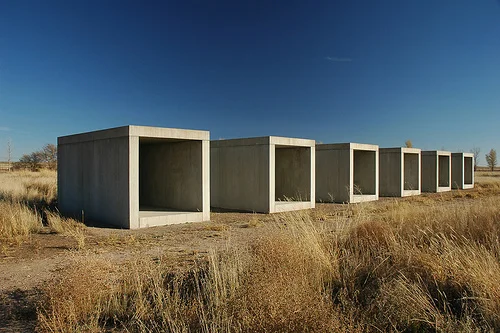
It all worked out. I stayed in shitholes ("the Bleek 'n Reek) in Beaver Lick, Kentucky, not far from Big Bone Lick. I discovered great barbecue on all three trips, when we had zero barbecue in Toronto. I especially loved the gigantic Moonlite Barbecue in Owensboro KY, where I first had burgoo, and Ollie's BBQ (and bibles) in Birmingham. I had my life changed in Marfa where we saw Donald Judd's Chinati Foundation; and I miss the brand of energy I had when Shellie and I made the trek to see Marc Savoy at his accordion factory in the heart of Louisiana (see various Les Blank films for reference).
I have been emotionally, intellectually and creatively moulded by these trips, not to mention driving to and from Boulder to shoot my film on Brakhage; a childhood trip through the US to Florida, camping the whole way with my parents and sisters (I was 5); many drives to Montreal, Quebec City, Ottawa, and Halifax; a trip up to Marathon in 1998 to visit Bonnie, Mario, and their kids; a wonderful road trip with Meredith and Shellie in 2009 through New York State and Massachusetts (many highlights). Oh, and then there was Calgary to Nelson and back (with many stops) (1998).
My friendships with Kelly, John, Ella, and Will have been deepened on many road trips, short and long. South from SF to LA one trip, Monterey on another and north to Portland were as much fun as anything.
Each trip, like those on the West Coast is a revelation of natural or human-designed beauty that has been entirely unexpected. That was true on a dozen trips with both families to Pittsburgh to visit our friend Jessica, that city's topographical and architectural beauty always coming as a shock.
I've never done a road trip in Europe. Train and bus trips through England/Wales/Scotland, and trains around Switzerland, The Netherlands, Belgium, and Germany. That is a whole other thing that I romance, and maybe a car trip around Europe would be similar to one in the US: I think the relentless mikes and miles of forest and desert would be missing, as would the pockets of banality that punctuate the experience. Still, if you want to take me on such a trip, I'm in.
I'm grateful that Shellie likes to break up trips as much as possible. Neither of us have that "making time" compulsion. For me, that need to stretch out the trip had been made more acute by a couple of physical and cognitive conditions that make long trips almost impossible. The worse of these is restless legs syndrome (which should be called restless body syndrome), which I won't get into right now, but it makes this whole thing rather difficult.
Speaking of personal challenges, one of my favourite things to do when I'm on the road is to go to local AA meetings. It's always super grounding and humbling. So, that's a reminder to self.

"Our battered suitcases were piled on the sidewalk again; we had longer ways to go. But no matter, the road is life."Jack Kerouac


IMG_1508.JPG
IMG_1507.JPG
banner.png
image-000291-1372089534.jpg
2147_62243007151_8111_n.jpg
1091012_10151816818132152_1611665008_o.jpg
1078936_10151816815772152_298952567_o.jpg

#16: CFNY-FM (1978-1982)

Back in 2014, in response to a comment that Rick Campbell made about CFNY-FM, I wrote a a manic appreciation of the station, at least the "wonder years" as far as I'm concerned (1978 to 1982). I posted this as a Facebook Note. Since those Notes are all but inaccessible, and since that format is practically obsolete on Facebook, I thought I would repurpose it. It's almost word-for-word what I wrote in 2014, which makes sense since I still feel pretty much the same about CFNY-FM and its importance to my life (it is definitely one of the 500 things that define Jim Shedden). Here goes (thanks Rick, and thanks David M, Brad M, Tim K, Ivar H, Bookie, et al):

You’ve given me reason to think about ow important CFNY was to me back in my high school days. Specifically , 1978 to early 1982 were dominated by listening to CFNY and identifying with that station, their playlists, their DJs, and their overall ethos. Sounds pretty similar to what you were experiencing. 

What amazes me, however, is how every individual who was tethered to that station back then has a slightly different memory of what they were playing. You remember songs that I’m not sure I heard till now. Adam Sobolak remembers others. 

Obviously so much credit for what happened goes to Dave Marsden, so I’m tagging him here - maybe he can clear up some of my murky memories of how things unfolded back then. 

I’m pretty sure my sister Lisa told me about CFNY. Or Lisa Godfrey, who went on to become a radio producer as it turns out (now at CBC’s Q) was also into it. Probably it was both. I remember being somewhat loyal to CHUM-FM, but already divided between it and the brand new Q-107 so I could barely get another radio station into my consciousness. Radio may have been in the hands of such a lot of fools, trying to anesthetize the way that you feel, but I first heard that song on CHUM-FM, and they were the station that promoted and aired Elvis Costello’s legendary first show at the El Mocambo. I also heard a live broadcast of a  Diodes show on CHUM-FM in 1978, so I was pretty happy with what was going on there, and I certainly remembered occasionally spending time listening to it in pre-punk days, when it was very freeform  and very hippy. Sometimes they’d be playing classical music; other times the Beatles; and other times prog rock. 

(Q-107, similarly, is where I first heard stuff like Jim Carroll’s “People Who Died’. Program director Bob Mackowycz had a pretty open approach too. By 82 all three of the rock stations would find their formula.) 

I didn’t really have any reason to jump ship to ‘NY, or so I thought. 

I soon discovered two reasons. I’m not proud of this, but as long as CFNY was marginal, I was in. I was so uncomfortable with myself at that time that I wanted desperately to both fit in and, since that was never going to happen, be different, radical, ahead of the curve, “unique”. For the first few of the Marsden years, CFNY was the soundtrack of suburban youth uniqueness in the late 1970s. 

The second reason is that I was so excited about what seemed like a new moment in music, my generation’s “1960s”. I’m not sure if that was true or not, but something was happening, even if we didn’t quite know what it was. CFNY was the place we could go to to hear it emerge. 

In my school of 2000 kids, I suspect the like-minded souls equalled around 1% of the school! or 20 of us. That included my sister Lisa, my friend Dave, and then Lisa, sara, Kim, Wendi, Bib, Grant, Philip, and a handful of others. But how would I know?

We never fully expected to deliver everything. We knew we had to go to hip record stores, exchange mixed tapes, read rock mags and fanzines, and just take in whatever news we could about the emerging music. But in CFNY we could hear it all happen live, and coming form what seemed like voices of authority: Mardsen himself, but also Brad MacNally; Tim Keele, who graciously hosted a benefit for my fanzine, The Hanged Men Dance; Ivar Hamilton, a serious music lover who I’m sure is still pulling the strings somewhere in the music industry; Daddy Cool, just to remind us that ‘NY was also playing blues, r&b and classic rock ’n roll (I had Daddy Cool DJ an AGO event back in the 90s, the night we had Kim Campbell do The Twist with Ron Mann); Ted Woloshyn (before he went to Q-107 as the morning man, and before he was replaced by “Pete and Geets”, formerly of CHUM-FM - that was the nature of the scene then); Live Earl Jive, who I associate with the post-eclectic CFNY (not because of him, just that he started sometime in 1981); Hedley Jones; Liz Janik…

]I gave up on all radio but the college variety (mostly CKLN and CIUT) and CBC from 1983 until about 2000 when streaming radio changed everything, and allowed me to access creative radio formats worldwide. 

Ultimately, what interested me most was the eclectic conceit of CFNY, the idea that I might hear anyone and anything on the station, at least from 1978 to 1981. There might be a particular sensibility at play, and a commitment to playing the new music that was emerging, but that could potentially include anyone, and it would be presented in a context that might occasionally be historical. 

My favorite show was Brad McNally’s The Eclectic Spirit, a free form, hour long, poetic radio documentary organized around themes. One such theme, Heroin, I had suggested to McNally, but I’ll never know if it was just a coincidence that he actually did one, since he never responded to my typewritten proposal. The show did include Patti Smith’s “Land” and America’s “Horse with no Name”, Eno-produced ambient music, and the more obvious “Heroin” by the Velvet Underground, so I am more and more convinced my enthusiastic letter was at least a catalyst. 

McNally also wrote “Working on the Radio,” by the 102.1 Band, which was hilarious and a tiny bit offensive. I talk about it here, as well as my whole history with radio: <a>https://www.facebook.com/notes/1000-songs/song-303-working-on-the-radio/10150216031086451</a>. 

You might also hear a monologue by Marsden, like this strange, manic, political, paranoid, and brilliant rant that follows Long John Baldry’s “A Thrill’s a Thrill”: <a>https://www.youtube.com/watch?v=tQiFI0pYz4k</a>

I was hungry for any creative use of radio, and by 1982 was moving on to CBC, where interesting things would show up on their Ideas program, and where I discovered the brilliant work they had done with Glenn Gould over the years. Further, I discovered a great show called Neon Nights that came out of Vancouver. Sometimes we’d listen live on Saturday nights, and sometimes my girlfriend Wendi used to record them and play them later, finding that DJ JB Shayne was playing more of the music that we were reading about in fanzines and in British music mags, and in the bins of stores like Records on Wheels and the Record Peddler, than CFNY was. 

It was on Neon Nights that I first heard Laurie Anderson’s “O Superman”, and I still feel like I remember every single second of that life-changing night: <a>https://www.facebook.com/notes/1000-songs/song-3-o-superman-for-massenet/10150193683596451</a>. 

By 1982, CFNY had found its niche, which was no longer about anything goes eclecticism. They were plugged into a genre that was went by various names over the years, starting with new wave, after that came to mean a particular electropop kind of thing, alternative, etc. From that moment till today, the station would oscillate between a danceable kind of pop to guitar bands and back. 

It was almost always dominated by white bands after that, which I don’t say critically necessary, but the r&b/soul/funk/hiphop line was generally absent from their story, which ended up limiting them. I didn’t really think about that then, but when I look back on their playlists, I don’t ever remember hearing Chic or Parliament-Funkadelic or anything like that, and it’s not as though anyone else was playing it on the radio in Toronto in those days. 

I do remember a few categories of music though: 

“Vintage Alternative” (my term): the prehistory of punk and new wave that influenced everything that was being played from 1978-1982, especially Roxy Music, Brian Eno, David Bowie, Iggy Pop, Genesis, King Crimson, Van Der Graaf Generator, Kraftwerk, The Soft Boys, etc. 

Goofy novelty songs: some don’t seem so much like novelty songs now, but they were played with great frequency, and you would never hear them anywhere else. “Think Pink,” by the Fabulous Poodles. “Cool for Cats,” by Squeeze. “Warm Leatherette,” by The Normal (<a>https://www.facebook.com/notes/1000-songs/song-816-warm-leatherette/10151489363416451</a>). “Is That All there Is?” by Cristina. “Toast,” (<a>https://www.youtube.com/watch?v=0UZlCRpCXys</a>). And “Working on the Radio” itself. Maybe “Turning Japanese” and “Kitchen at Parties.” “It’s My Party” by Barbara Gaskin and Dave Stewart. 

The songs everyone else was playing. I’m glad CFNY didn’t ignore, and even championed, some mainstream monsters like Pink Floyd’s The Wall; Neil Young’s Rust Never Sleeps; and The Rolling Stones’ Some Girls. The last two are among my favourite albums of all time. They also played Darkness on the Edge of Town regularly. I know that CHUM-FM and Q-107 played those first three albums. Did they play Darkness on the Edge of Town? I really don’t remember. These are the songs that I no longer associate with CFNY, even though perhaps I should. And then there are guys like George Thorogood. I only remember him on CFNY, even though by 1982 they wouldn’t play music like that. Oh, there was also Who Are You? Big on CFNY, but also on the other two FM stations. 

The songs that I completely associate with CFNY, songs that excite me when I hear today, and that always bring back a bit of a memory of that station when I hear them, even if I didn’t hear them there first. 

“Making Plans for Nigel” represents, perhaps, the best of ‘NY for me. 

“Life During Wartime.” This is almost in order now. 

Almost anything from the first three Elvis Costello’s first three albums. 

The first two Joe Jackson albums. 

The first Cars album.

Nick Lowe. 

Robert Palmer’s “Bad Case of Loving You” and “Can We Still be Friends” (even though these may have been more of a CHUM-FM thing). 

Gary Numan. 

Kraftwerk: oldies and “The Model”. 

The first three Peter Gabriel albums. 

The first two by Kate Bush. 

The Diodes. 

Teenage Head. 

Nash the Slash: “Dead Man’s Curve.” 

FM: “Phasers on Stun.”

Gabriel-era Genesis. 

In the Court of the Crimson King. 

“New York City,” by the Demics

Rough Trade. 

Martha and the Muffins. 

The first three Siouxsie albums. 

London Calling. Sandinista. The first two albums, I guess, but I don’t remember hearing them on the radio. 

Goddo. 

The Jam: “This is the Modern World.” “That’s Entertainment.” 

New Order, but not Joy Division. 

OMD. 

Echo and the Bunnymen. Not Teardrop Explodes

The first two Psychedelic Furs albums. 

Madness, Specials, Beat

Devo

The first two Police albums. 

“Radio Silence,” by Blue Peter. 

Blondie. Lots of Blondie. 

“Imperial Zeppelin,” by Pete Hammill. Or maybe I just owned it.

Bauhaus 

Dave Edmunds

Bram Tchaikovsky 

Squeeze 

Ian Dury

801

Max Webster

The Kinks’ Misfits

Van Morrison’s Wavelength

Joan Armatrading 

ELO - Out of the Blue 

Aja 

The Last Waltz (yep, they played it - you see my point? By 82 they wouldn’t and it would “belong” to Q-107 only) 

Bryan Ferry - The Bride Stripped Bare 

The B-52s (of course) 

Boomtown Rats - Fine Art of Surfacing (“I Don’t Like Mondays” eventually got played everywhere, but not the superb “Rat Trap”)’

Lene Lovich 

Ian Hunter

B.B. Gabor

Magazine 

Ultravox 

Patti Smith’s Wave (no one else played any Patti except for “Because the Night”) 

Bowie - Lodger, and then Scary Monsters and Super Creeps (everyone played the big hit from that, but no one played Lodger except for ‘NY). 

Fripp’s Exposure 

Flash and the Pan

Steve Forbert 

Japan 

The Only Ones 

Bop Till You Drop - Ry Cooder 

Dire Straits (that was a very “new” sound to me, and I originally associated it with ‘NY, until it became ubiquitous) 

Phil Manzanera

Tony Banks

The Buzzcocks

Chris Spedding 

Tom Verlaine

Dexys Midnight Runners

There’s a crisp, upbeat, pop beauty that runs through all of those albums and singles that turns my crank today like almost nothing else. I’m playing “Life During Wartime” right now and it just gets better: the more I’ve heard it, the more I got to understand the Talking Heads’ inspiration, the more I’ve loved this song. 

Within reason. I’m 50 and was 15 when I first heard it. Something was active in ears, heart and brain then that’s different today.

At the end of 1979, CFNY included a “worst 10 albums of 1979” in their annual roundup. This was perhaps the beginning of the end: the demise of eclecticism. Some of their choices (listener choices?): Get the Knack, even though songs like “Good Girls Don’t” fit the ‘NY sound just perfectly at the time; Breakfast in America by Supertramp, Dream Police by Cheap Trick, The Long Run by the Eagles, and Head Games by Foreigner (OK, they suck, but that’s not the point); Slow Train Coming (generally considered a great album these days, but I remember the need to vilify it too); etc. OK, they also included Blondes Have More Fun, which was more than terrible.

On their Worst of 1983 list they included Thriller.

Their most interesting list was the “Best 102 Songs of all time” that they compiled in 1982, based on listener responses. It feels like the last moment of eclecticism, a list that could only belong to CFNY at precisely that moment in time. It includes music I may not have heard on that station, but I could have sometime in those first four years. 

Yes, Rick, “Suppers’ Ready” topping the list is very curious indeed. I do remember hearing it and other Gabriel-era Genesis on ‘NY a lot, but only up to 82 and then never again. If Marsden stuffed the ballot box (which I’m sure he didn’t), what do I care? I quite love a Genesis song could top the all time greatest list from a station better known for playing Depeche Mode and The Human League at that time. 

“Satisfaction” was #2. I could never have predicted this and I remember being surprised even then, especially because it’s followed by “Don’t You Want Me” by the Human League! This is is fantastic craziness! 

It’s followed by “Money.” Pink Floyd is one of Mardsen’s favorite bands. A mix of predictable for any list - Beatles and The Doors - mixed in with Tubular Bells (also standard ‘NY fare), Trio (JESUS!), Traffic, Pigbag… You know what? It’s a great list. 

"Greatest Music of All Time" from 1982

Genesis - Supper's Ready

Rolling Stones - Satisfaction

Human League - Don't You Want Me

Pink Floyd - Money

John Lennon - Imagine

The Clash - London Calling

The Clash - Pressure Drop

Duran Duran - Planet Earth

David Bowie - Heroes

Beatles - Hey Jude

Earl jive - Tudor the Dog

Mike Oldfield - Tubular Bells

The Specials - Ghost Town

Sex Pistols - Friggin' in the Riggin & My Way

Trio - Da Da Da

Japan - Television

Clash - Rock the Casbah

Beatles - Twist and Shout

Duran Duran - Girls on Film

Beatles - Let it Be

Billy Idol - White Wedding

King Crimson - Fracture

Led Zeppelin - Stairway to Heaven

OMD - Joan of Arc

Pigbag - Papa's Got a Brand New Pigbag

Rough Trade - High School Confidential

Bruce Springsteen - Born to Run

Traffic - Low Spark of High Heeled Boys

The Who - Won't Get Fooled Again

Kate Bush - Wuthering Heights

The Beat - Save it for Later

The Doors - The End

David Bowie - Young American

Echo & The Bunnymen - Rescue

Peter Gabriel - Solsbury Hill

Generation X - Dancing with Myself

King Crimson - In the Court of the Crimson King

Nobby Klegg - My Old Man

Madness - Madness

Led Zeppelin - Kasmir

Elvis Presley - Don't Be Cruel

Romeo Void - Never Say Never

New Order - Temptation

Iggy Pop - Lust for Life

Rolling Stones - Sympathy for the Devil

Supertramp - Fools Overture

Sex Pistols - God Save the Queen

Animals - House of the Rising Sun

The Beatles - While My Guitar Gently Weeps

David Bowie - Sorrow

The Beat - Stand Down Margaret

David Bowie - Cat People (Putting Out Fire)

Depeche Mode - See You

Queen - Bohemian Rhapsody

Elvis Costello - Alison

Duran Duran - Hungry Like The Wolf

Roxy Music - Jealous Guy

Generation X - Kiss Me Deadly

Japan - Ghosts

Cockney Rebel - Mirror Freak

Joy Division - Love Will Tear Us Apart

Lynyrd Skynyrd - Freebird

Van Morrison - Moondance

Don McLean - American Pie

OMD - She's Leaving

102.1 Band - Working on the Radio

Pink Floyd - Us and Them

Rolling Stones - Start Me Up

Payolas - Eyes of a Stranger

Roxy Music - Both Ends Burning

Peter Sarstedt - Where Do You Go to My Lovely

Angelic Upstarts - I'm An Upstart

Stranglers - Get a Grip on Yourself

Frank Sinatra - New York, New York

Genesis - Lamb Lies Down on Broadway

Dexy's Midnight Runners - Come on Eileen

Spoons - Nova Heart

Elvis Costello - Pump It Up

The Beat - Mirror in the Bathroom

Lou Reed - Take a Walk on the Wild Side

Bow Wow Wow - I Want Candy

Tom Tom Club - Genius of Love

ABC - Look of Love

UB40 - One in Ten

Soul Sonic Force - Planet Rock

Asia - Heat of the Moment

Urban Verbs - Only One of You

Troggs - Wild Thing

Leisure Process - Love Cascade

Clash - Clampdown

Laurie Anderson - Oh Superman

Yes - Close to the Edge

Beatles - Help

Moody Blues - Nights in White Satin

Rita Marley - One Draw

Yazoo - Situation

David Bowie - Changes

Yazoo - Only You

Kate Bush

Crosby, Stills & Nash - Teach Your Children

Beatles - She Loves You

Bob Dylan - Like a Rolling Stone

The regular year-end list for 1982 demonstrates that they were no longer eclectic. There are a lot of great songs on the list, but it feels more like a CFNY genre of niche than anything quite so kookoo as the top 102 songs of all time. For example: 

Simple Minds - New Gold Dream (81-82-83-84)

Duran Duran - Rio

Roxy Music - Avalon

The Spoons - Arias And Symphonies

ABC - Lexicon Of Love

Joe Jackson - Night And Day

Peter Gabriel - Security

Kate Bush - The Dreaming

Flock Of Seagulls - Flock Of Seagulls

Culture Club - Kissing To Be Clever

Clash - Combat Rock

The Beat - Special Beat Service

Men At Work - Business As Usual

Psychedelic Furs - Forever Now

Yazoo - Upstairs At Eric's

UB40 - UB44

Haircut 100 - Pelican West

China Crisis - Difficult Shapes & Passive Rhythms

Once they were no longer eclectic, I moved on. Not only was I finding what I needed on Neon Nights, by more aggressive record buying and mixed tape making, and by more attendance at live shows, CBC’s Brave New Waves also came into our lives in 1984. I wasn’t listening to CFNY much at all by then, but this new show featuring producer/announcer Augusta LaPaix would have closed the deal for sure, with its programming mix that ranged from the Rheostatics to Philip Glass (eg, a complete broadcast of Glass’s Einstein on the Beach, to Glenn Branca, conceptual poets, Montreal bands I’d never heard of, etc. This, plus other CBC moments, plus college radio meant that CFNY, for me would forever be a 1978-1982 phenomenon. 

But that’s OK. That was the period of my life when music mattered more than anything. Music determined who my friends were what authors I’d read, what films and plays I’d go so, how I’d dress, what my politics were, who I’d fall in love in with, and what I’d do with every spare moment. 

I feel like I was lucky to have 102.1 as my default location on the dial during those important years. I think I may have even known that at the time. I certainly knew that radio was exciting, and that I looked forward to putting it on whenever I could for a fix. 

Thanks, Rick, for stirring this up. And thanks Marsden & Co., for sharing your crazy enthusiasm for music when I needed it most. 

502494361-612x612.jpg
the-1021-band-working-on-the-radio-ready.jpg
CHUMFM-1973-Sepia.jpg

#15: Paul Sharits

"I´d like to give up imitation and Illusion and I'd like to enter the higher drama of Celluloid, 2 dimensional film stripes, individual images, nature of perforation and emulsion, projector operations ... Light as energy creates its own objects, shadows and textures. If you take the facts of the retina, the flicker mechanism of film projection than you can make films without logic of language."

— Paul Sharits

I count Sharits among my 10 favourite filmmakers, and he’s one of 3 or 4 filmmakers who reminds me, every time I’m sitting in a theatre or a gallery looking at his work, that this isn’t marginal for me, this isn’t counter-cinema: as with Michael Snow and Stan Brakhage, Sharits found a cinematic language that doesn’t depend on its dialogue with the dominant Hollywood narrative. Instead, in each case these filmmakers put forward, in their works and in their writing, what film does best. In other words, when I’m watching Epileptic Seizure Comparison (Sharits), Rameau’s Nephew by Diderot (thanx to Dennis Young) by Wilma Schoen (Michael Snow), or Dog Star Man: Prelude, I am completely convinced that this is “normal”, that this is why the gods gave us cinema. Because even the most radical documentary, like Emile de Antonio’s Year of the Pig, ultimately uses the representational and storytelling conventions of mainstream filmmaking, I don’t feel the same way about it. I love it, but in a way it’s just another movie. I’ll go out on a limb and say the same about Bresson’s Mouchette: it’s brilliant, and it definitely puts a few stakes in the ground as far as film form goes, but it’s still kind of like Hollywood at the end of the day. 
To be clear, none of this matters if my experience of watching Sharits's films (every single one that I’ve seen) didn’t have something I have to call a spiritual effect on me, one achieved at the level of the retina and the ear, and involving or invoking: intense cutting (in more than one sense), repetition, trance states, synesthesia, hallucination, nausea, paranoia, mania, psychic breakthroughs, relief. And each time I watch even one film by Sharits, it’s a clear reminder to me that this is what I want. I’ll take everything else too, but this is what normal looks like. 

You can find a few of Sharits’s films online (on ubu.com and elsewhere), and if you’re lucky you will see them at a rare avant-garde screening in cities like Toronto, New York, Boston, San Francisco, Denver, or Buffalo (Sharits’s hometown for many years). See this work on 16mm, or as installation work, if you possibly can. 

I am attaching a great interview with Sharits by Gerald O’Grady. Gerald is a special person and I think I should save my discussion of him for another X/500 instalment. http://www.ubu.com/film/sharits_interview.html. I am also embedding the final movement of T,O,U,C,H,I,N,G, a film that was a regular with the Inns Film Society, one that we included in our 25th anniversary reunion screening, where it continued to alienate and freak out even some of our core members. 

#14: Sam the Record Man

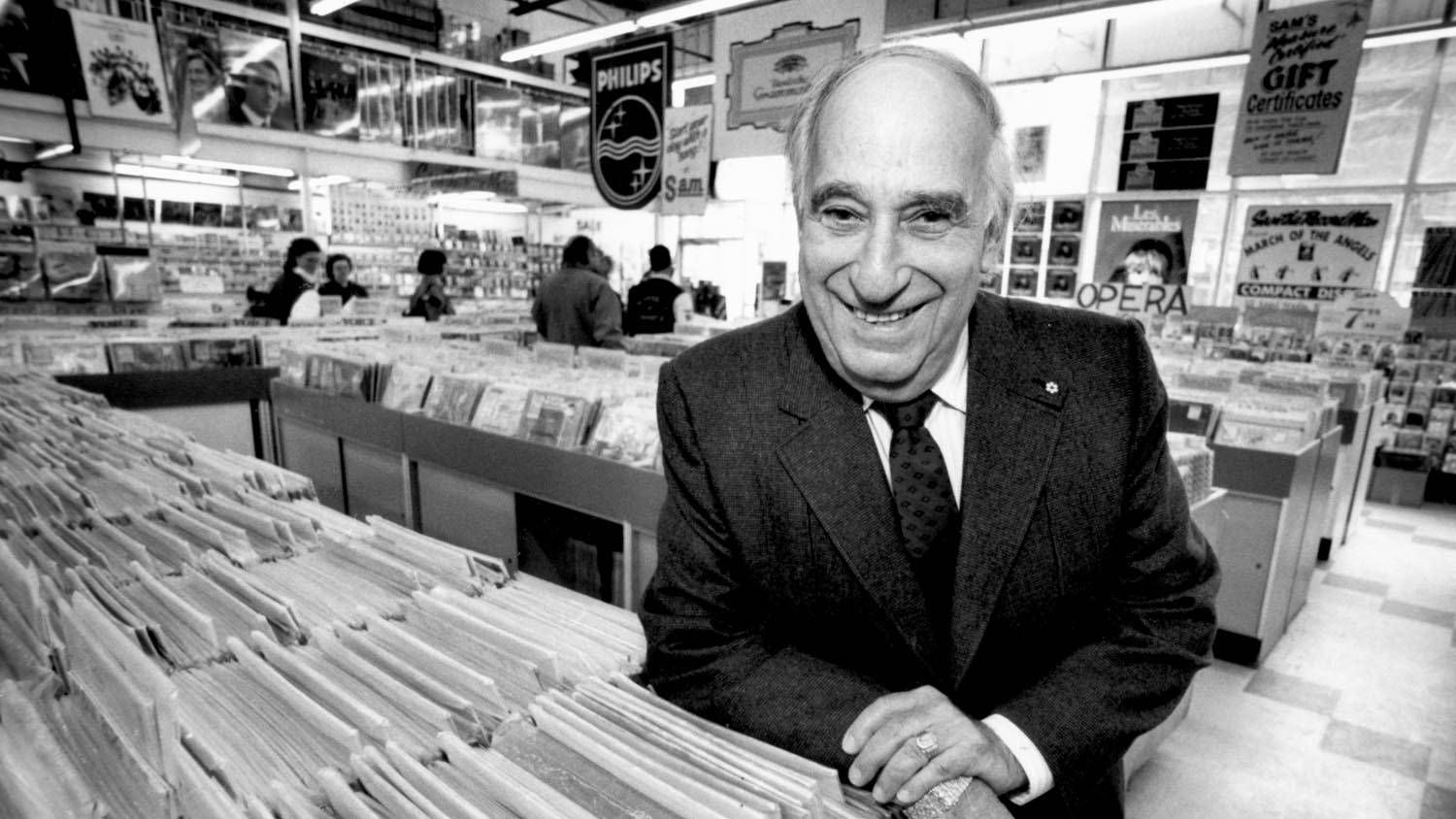
Adapted from a piece I wrote when Sam Sniderman died in 2012. Where do I even begin? My earliest memories of coming downtown with my family always involved Sam the Record Man. That store in the late 60s, through the 70s and even into the early 90s was mecca to me. I made a vow when I was quite young that when I grew up I would move downtown, walking distance of the the flagship Sam's. I said it; I did it. While I waited, with only a couple of visits a year, I would head to Sam's meagre store at Cedar Heights Plaza in Scarborough every Friday to pick up the latest 1050 CHUM Chart. I'd then find out what the Saturday morning special ($1.99 or $2.99) was going to be and then return the next day to grab it. Once I was 14 and heading downtown regularly, I would spend hours, sometimes the bulk of  the day, at Sam's getting a music education, not so much by listening but by looking at sleeves and reading liner notes. That's what we did before Wikipedia and YouTube and all that kids. I hung out on the bargain floor, perhaps the most musically rewarding part of the Yonge St. mecca, but learned much of what I know about classical music, 20th century new mu (minimalism, etc.), r&b/soul, hip hop, cajun, bluegrass, easy listening, blues, jazz, and rock and roll there. 

IMG_1301.JPG

#13: The Bloor Cinema

Before I really discovered the not-for-profit screening venues, and before VHS began to change  things, for better or for worse, my intense film education happened at the Bloor Cinema, today called the Ted Rogers Hot Docs Cinema. 

It was the Madison when it opened in 1913. It became the Midtown in 1941, and somewhere along the lines it became the Eden. In 1979 it was renamed the Bloor and the the theatre, run by Famous Players at the time, shifted briefly from the mix of horror and soft-core porn that defined it for several years, with first fun films. By 1980 or maybe it was late 1979, Carm Bordonaro took over and began the formula of film classics, genre films and cult films: $1.99 admission or 99 cents with a membership. If I remember correctly, memberships were $5. At some point Carm left but returned in 1999. Prior to that, the Bloor became part of the Festival chain (was it a real chain? Or an alliance?) that included other theatres that played a big role in shaping my consciousness: the Fox, the Brighton, the Revue, The Kingway/Nostalgic, the Paradise, and the Royal. Discussions about films after at By the Way/Lick’n Chicken, Combo’s, Sneaky Day’s (on Bloor originally!), The Mug (and then J.J. Mugg’s), Greg’s, the schnitzel strip, Foodworks, Blueberry Bill, the GOOF and Griffith’s (after the Fox screenings), and so on. 

Though I frequently went to the Bloor alone, Bloor-mates over the years, included Lisa (Shedden and Godfrey), Kim Dawson, Wendi Brklacich, Lori Brklacich, Sara Heinonen, Dave Keyes, Barry King, Craig Burgess, Stuart Ross, Lillian Necakov, Paul Della Penna, Mike Zryd, Kate MacKay, Robin Gibson… and I’m sure I’m forgetting a few. 

Those were glorious years for me, and for many others of course. As I said, there were probably five solid years, from 1980 to 1985, where I practically lived at the Bloor. By the late 1980s, however the rise of VHS (and then all the technologies that followed) made going to the movies a less efficient way to consume vintage film fare. For myself, I eventually discovered the AGO, Harbourfront Centre, the Rivoli, the Funnel, the ROM, the Science Centre, the Euclid (briefly), the GAP/CineCycle, and of course, Innis Town Hall. By the time the Bloor’s significane had faded for me, I was programming the Innis Film Society, and eventually the Art Gallery of Ontario.

I saw films by these filmmakers at the Bloor. In most cases it was where I saw my first film by the director in question: Alfred Hitchcock, John Ford, Howard Hawks, Gene Kelly/Stanley Donen, Federico Fellini, Werner Herzog, Rainer Werner Fassbinder, Wim Wenders, Francois Truffaut, Jean-Luc Godard, Alain Resnais, Stan Brakhage (yes!), Kenneth Anger (yes!), Alan Pakula, David Cronenberg, Lindsay Anderson, Peter Greenaway, Stanley Kubrick, Roberto Rossellini, Luchino Visconti, Charlie Chaplin, Buster Keaton, Godfrey Reggio, John Huston, Milos Forman, Francis Ford Coppola, Martin Scorsese, Tarkovsky, Bernardo Bertolucci, Ingmar Bergman, Loader/Rafferty/Rafferty, Ken Loach, Hal Ashby, George Roy Hill, Michael Cimino, Bob Fosse, Terry Jones, Norman Jewison, Woody Allen, Sydney Pollack, Sidney Lumet, Luis Bunuel, Peter Bogdanovich, Jim McBride, Mike Nichols, Gillian Anderson, Paul Cox, Alex Cox

My own film, Brakhage showed at the Bloor in 1999, around the time Carm came to run it.

Screen Shot 2018-07-11 at 3.24.03 PM.png
americaine.jpg
Fellini8.jpg
maxresdefault.jpg
1113503_landscape.jpg
20100111mug.jpg

#12: Killbear Provincial Park

I camped a lot as a kid with my family and with Boy Scouts. I pretty much tired of the whole thing by the time I was 17 or so, preferring to do my exploring and life experiencing in my city and cities around the world. I went camping (to Killbear Provincial Parik) exactly once in my 20s, and never again, though staying at anyone's cottage always feels a bit like camping. 

And, yet, though it's not something I do today, some of my happiest memories of childhood were camping. Killbear Provincial Park tops the list for me, with its stunning views over the lake, clean warm sandy beaches, granite rock everywhere, random pine trees growing out of the granite, the smell of conifers everywhere (their needles creating a consistent bed across the park), rattle snakes, bears, chipmunks, deer, the marina, toasting marshmallows, reading Marvel comics, playing board games while it rained for three weeks solid (we would occasionally camp that long), catching my first fish on Grundy Lake (another Provincial Park nearby). 

I have a small desire to get back to Georgian Bay and am thinking of taking a bus up to Killarney (where I've never been) to stay in Killarney Lodge one of these days. 

I also had great times camping at Arrowhead with my friend Barry; camping at Presqu'ille (with my family and Barry), Serpent's Mound, Bon Echo, Balsam Lake, The Massassauga (with friends in high school), The Pinery, and throughout New York, Ohio, Kentucky, Tennessee, Georgia, and Florida. 

1931191_46382567151_1412_n.jpg
Screen Shot 2018-07-08 at 11.04.50 PM.png
Screen Shot 2018-07-08 at 11.05.36 PM.png
Screen Shot 2018-07-08 at 11.15.33 PM.png
Screen Shot 2018-07-08 at 11.17.55 PM.png
Screen Shot 2018-07-08 at 11.15.17 PM.png
Screen Shot 2018-07-08 at 11.18.50 PM.png
Screen Shot 2018-07-08 at 11.14.18 PM.png
Screen Shot 2018-07-08 at 11.07.35 PM.png

#11: Glenn Branca's Symphony No. 6

R.I.P. Glenn Branca. Branca passed away from throat cancer on May 13 this year. He was 69 years old. 

When I was in high school I first heard about Glenn Branca. He was one of those figures that I knew about, but didn’t hear for several years later. Maybe I first read about him in a Hide fanzine interview. I’m not sure. I know the Garys brought him town and I kept missing him, but everything I read suggested he was going to be a key figure in my musical imagination. 

I really don’t know what made me eventually buy this particular record, the first Branca recording I bought, but it was everything I needed and wanted at that moment, some time in the late 1980s (1988 when it came out perhaps?) I think. I was sort of into hardcore at the time, but kept wanting it to be more adventurous musically, which is counterintuitive I guess, but someone had to be curious about what happens when you, a self-taught composer like Branca, take a typical rock band bass/drums/combo, and then add a choir of ten electric guitars. In Branca’s case, the guitars were used to produce notes that were outside of the typical Western system of tuning. We would call the effect a drone today. Back then it just cleared the slate for me: it gave me great hope for the possibility of artists producing new things, new sounds, new ideas.

Discovering Branca was like discovering Michael Snow, Peter Greenaway, Philip Glass, Steve Reich, Jackson Pollock, Kathy Acker, Patti Smith, Meredith Monk. I'm grateful that I somehow ended up becoming a fan. 

It’s difficult to find the piece on YouTube or Vimeo, but here’s a link to it on Spotify (https://open.spotify.com/album/09ipfPocCDSAhmLp5pBV7K?si=FHF9uvyKS4GSf1daL8ZzOA). I suspect you can find it on Apple Music as well. 

11f502a0b50878542d851a5959cd6790.jpg
R-1094590-1285511787.jpeg.jpg

#10: World Leaders: A Festival of Creative Genius

Shortly after I started working at Bruce Mau Design, I had the privilege of working on the Harbourfront Centre "account" (we didn't really use that word, but I guess that's what it was). I was really excited because Harbourfront Centre was on my list of places that I wanted to work. I was, and still am, a fan of what they are able to pull off down there, from avant-garde music, dance and theatre, to more community-oriented world music, dance and food festivals, the Power Plant of course, recreational activities, and much more. 

We had the task of figuring out how to celebrate their 25th anniversary without doing the usual things. This was typical Bill Boyle (their long-time CEO and artistic director): X but not X. I quite enjoyed challenges like that, and knew where Boyle was coming from, so we had a pretty good time, despite the usual frustrations along the way. 

After developing a communication campaign in the first year (2000) along the lines of "25 Years of Brouhaha and Hullabaloo," the next year we were able to do something that didn't just say "we're 25" but modelled the best Harbourfront Centre behaviour. We proposed a campaign based on innovation and world leadership. Bill hated the words, rightfully objecting that they had become cliche, but we argued that they had to own them in a different way, that Harbourfront Centre could stake a claim to 25 years of consistent artistic leadership (and "world" had all kinds of layered connotations that were right for them). Why not a festival of genius. No more festivals! said Bill. We understood where he was coming from, but when our mock creative was tested with audiences, all they wanted to talk about was the festival of creative genius. So we ended up doing it. 

It took a year to organize 14 gala events, each revolving around one of our invited creative geniuses? Who were they? We decided they had to be people who, through their work, changed their field forever so that, even if you didn't like what they did, you had to confront it in your own work. Miles Davis was my example. If he was alive, we would invite him. Many revere him, and many dismiss his work, or large swaths of it, but there's no getting around him if you play jazz. We had a committee that chose the artists. I can't remember everyone on the Harbourfront Centre side, but it included Bill (the final arbiter), Tina Rasmussen, Marc Mayer (I think), and a few others; plus Bruce and me. The final list: 

Frank Gehry 

Philippe Starck 

Issey Miyake 

Robert Rauschenberg 

Harold Pinter 

Stephen Sondheim 

Quincy Jones

Peter Gabriel 

Joni Mitchell 

Guy Laliberte 

Robert Lepage 

Pina Bausch 

Lily Tomlin 

Bernardo Bertolucci 

OK, they're not all the Miles Davis's of their field (or fields) but Pina Bausch, Harold Pinter, Stephen Sondheim, Quincy Jones, and Frank Gehry are for sure. Gabriel for sure if you consider the career from Genesis to WOMAD. Guy Laliberte in his own way. The case can be made for Lepage (very strongly by some people), and Miyake. Not so sure about Starck anymore, or Bertolucci would not have been my first choice but we knew someone like Brakhage wouldn't have attracted the 1000 people we needed to make it work, and we didn't want to pursue Godard. Altman was busy. I couldn't convince people to consider Greenaway. Can't remember who else was on the list, but many were recently departed. 

We ended up doing the events at the Liberty Grand, a bummer that we couldn't do them on site at Harbourfront Centre but the spaces were just too small. We had to have dinner for 500, and then the events, which were sometimes like a roast and sometimes a simple, poignant performance (eg, Pinter reading from a new play), had to accommodate 1000. Liberty Grand worked pretty well. Feeling bad about this situation, as well as the whole elite nature of these expensive tickets for "world leaders" Bill had his staff organize another 100 events that focussed on Toronto creative talent that fall. Very Harbourfront Centre. 

Each participant was given the "Harbourfront Centre Prize", which was a sizeable sum of money that some of them donated back. They also got an actual prize that was designed by Toronto artist Micah Lexier (one of my favourite creative people for sure). 

Lily Tomlin cancelled because her performance was on September 12 (or 13?), and she was freaked out about 9/11. She later felt she over-reacted and donated a chunk of her revenue from a Massey Hall performance to Harbourfront Centre. 

Helping shape this event with Harbourfront Centre and my colleagues at Bruce Mau Design was a major highlight of my life. Some of the actual events are still resonating with me, especially Sondheim, Gabriel and Pina Bausch. 

Three of the people we presented died shortly after, and I appreciate how fortunate I was to see them at the time: Harold Pinter, Robert Rauschenberg, and Pina Bausch.

Though we had a robust website designed by Michael Barker, worldleadersfestival.com, Harbourfront Centre took it down, and there are very few images, videos, or even articles online. This all happened in that moment just prior to our culture's fuller embrace of the web, not to mention ubiquitous smartphone photography/videography. That may be for the best, but I'd sure like to see some of that Sondheim evening again!  

(I'm leaving an image from the website that I reconstructed from the Wayback Machine.) 

Screen Shot 2018-05-23 at 9.21.52 PM.png
1758_user3006_091115-144124.jpg
1758_user3006_091115-144340.jpg
1758_user3006_091115-144226.jpg

#9: Apocalypse Now

A version of this post was previously published in Facebook Notes in 2014 (https://www.facebook.com/notes/10152731573444079/). 

I'm fond of identifying huge moments in my reading, listening and watching life, pronouncing them as absolutely critical. Sometimes it has more to do with finally recognizing that something has had a huge effect on me. And sometimes, it's just true.

Apocalypse Now was a line in the sand. It's the first film that I saw, loved, still love today, and remember it as it really seems to be. What I mean to say is that we went to the drive-in when I was 10 and saw Chinatown. I loved it then and I still quite like it, but when I look at it now I barely remember a single shot or other element of the film that I saw when I was 10.

When I was 13 I saw Star Wars, also at a drive-in. It was such a special moment, coinciding with the second period of my life that I loved comics. I hadn't seen anything like it - who had? - and for the first time everI was conscious of what cinema could be, what it could do for me. I felt like maybe this would define my life.

I started seeking out classic science fiction films  on TV, reading science fiction and fantasy, making SF and comics zines, and checking out every new film in the SF and fantasy genres.

Though fetters of interest remained for a few years, Apocalypse Now blew the whole Star Wars thing away. My father and I saw it at the University Theatre in 70mm. I think it's safe to say from the opening montage (helicopter/crazy Sheen/The End, "Saigon. Shit.”) on, my life changed. Film mattered like nothing else, except maybe rock and roll (and this was a very rock and roll film). THIS is what I wanted films to look like, sound like, and feel like.

Not that I wanted every film to be Apocalypse Now or directed by Coppola, but I wanted films to be the product of personal visions, rendered obsessively, and adding something of value to the world. Films that weren't formulaic, especially when the formula was always to involve what Stan Brakhage used to call a "brain drunk."

From that moment on, I couldn't stand "escapism" in movies or literature: I guess I fulfilled that need with booze and drugs. I had no use for "light", for feel good, for nostalgia, for tuning out.

Admittedly, the powerful experience I had with Apocalypse Now had to do with me being a tabula rasa. When it came out I had seen no more than a couple of dozen films, certainly no more than that at the movie theatre. Maybe if I count all of the Don Knotts-type Sunday afternoon movies it's more, but the list of real movies prior to Apocalypse Now included:

Burnt Offerings

Logan's Run

Rollercoaster

Earthquake

Towering Inferno

Norman, Is that You?

Jesus Christ Superstar

Butch Cassidy and the Sundance Kid

(Part of) Alice Doesn't Live Here Anymore

The Aristocats

A Three Musketeers movie

The Birds

Wizard of Oz

Jungle Book

Divorce American Style

Oliver!

Star Wars

The Long Trailer

A Carry On movie

Blazing Saddles

Chinatown (a strange story that we may return to)

Here Come the Nelsons

I'm missing a few, but that's where I was at when I was 15watching Apocalypse Now. I saw some other great films prior to it - especiallyThe Birds and Chinatown - but they felt distant and mysterious: after Apocalypse Now provided the benchmark, I had a sense of what I needed from film.

The funny thing is, today I'm not sure that I can watch anotherVietnam film, nor anything that is so obviously spectacular. I'm not qualified to compare the treatment of war in today's cinema, nor the use of surroundsound, visual effects (which had a different meaning in the 1970s anyhow), etc.I got turned off as other cinematic possibilities opened up for me - classicHollywood, avant-garde, verité, postwar French, German and Italian film, etc.Still, what I have to say about the modern trend in spectacular filmmaking fromLucas to Cameron to Jackson can best be described as "contempt prior to investigation," a special form of ignorance that seems to plague me.

No matter how much Apocalypse Now's appeal is at the intersection of the spectacle of cinema and the spectacle of war, that wouldn't have been enough to turn me on and hold me all these years. It was so powerful that it became a kind of ground zero for me:

Ground zero for commercial American filmmaking: like, I know movies can be this good, so what's your excuse?

Ground zero for Coppola's career: the height of a creative career that was preceded by the two Godfathers, which are as good but I didn't see them till later, and that mini-masterpiece, The Conversation. As much as I love many of the films that follow, including the "catastrophe" One from the Heart, which I live, we never get the thrill of Apocalypse Now again. I'm not complaining.

Ground zero for any film about Vietnam. I always have to compare, even and especially the other great Vietnam films from that period, The Deer Hunter and Coming Home.

Ground zero for anytime I hear someone argue that films are never better than the literature they adapt. I'm not saying Coppola's better thanConrad and Eliot, but in this film he's as good.

Ground zero for any film that attempts to weave rock and roll into it so seamlessly. It's not my favourite in that regard, but it set a new standard, almost surpassing American Graffiti and Mean Streets (but not Scorpio Rising).

Ground zero for any discussion of film sound.

Ground zero for understanding Brando's career. This is the End, and what an end. He appears to have gone as loopy as Kurtz himself. Whenever I watch him in A Streetcar Named Desire or The Godfather, On the Waterfront, Guys and Dolls or anything else really, I am aware that he is Kurtz. I hear Stanley Kowalski, 1st Lt. Fletcher Christian and Don Vito Corleone all mutter, "the horror, the horror."

Ground zero for Martin Sheen too. Mention The Exorcist and my mind goes to Linda Blair, then Sweet Hostage, Martin Sheen, and then"Saigon. Shit."

Ground zero for Duvall. I don't care if you say Tender Mercies, my brain conjures up:

"You smell that? Do you smell that? Napalm, son. Nothing else in the world smells like that. I love the smell of napalm in the morning. You know, one time we had a hill bombed, for twelve hours. When it was all over I walked up. We didn't find one of 'em, not one stinkin' dink body. But the smell! You know - that gasoline smell... the whole hill! Smelled like... victory. (Pause) Some day this war is going to end..."

Ground zero for intelligent filmmaking.

an2.jpg
an4.jpg
an1.jpeg

#8: The Four Horsemen

Back in grade 11, our Canadian Literature class was bussed to a conference at a community college. This was either in 1979 or 1980. I don’t remember the overall theme, but a performance by The Four Horseman was my first introduction to sound poetry. 

As much as I enjoyed the performance, I didn’t realize that it would be the moment that I was able to fall in love with poetry. The avant-garde craziness of this quartet, both as a group and in their other pursuits, allowed me to get past all the emotional and intellectual roadblocks that I had experienced trying to “understand” poetry prior to that fateful performance. Suddenly I was able to understand that poetry could be an act of performance, and that the sounds, timing, the montage of voices, the improvisational gumbo, and the enigmatic tension between erudition and dada nonsense could all be called upon to create a vital form of poetry. Well, whose life wouldn’t be changed by all this? 

After that performance, I went to more Horseman performances, saw all of the readings that eventually comprised Ron Mann’s Poetry in Motion - a who’s who of performance poetry, from bill bissett to John Giorno, and Anne Waldman, discovered small press poetry, attempted to write my own small press poetry and start my own imprints, and learn about concrete poetry. I met and befriended individuals who were writing, reading/performing, publishing, and otherwise making independent poetry happen in Toronto, people that I now consider legends, like Stuart Ross, Lillian Necakov, Mark Laba, john curry, Paul Dutton (he of the Four Horseman), the late bpnichol (the greatest genius of the sound poetry and concrete poetry in Canada?), Nicky Drumbolis, Paul Venright, Charlie Huisken and Dan Bazuin of This Ain’t the Rosedale Library, poetry organizer Elliott Lefko (who would hire me to help out), Crad Kilodney (not a poet, but a key figure on the scene and in my life back then), Kevin Connolly, Lynn Crosbie, and countless others. 

There’s a great little pocket book collection of the Horsemen’s poetry, Horse d’oeuvres (http://www.doullbooks.com/?page=shop/flypage&product_id=106172). 

And here’s an excerpt from Ron Mann’s Poetry in Motion, a very fine performance by the group. You will either hate it or love it. https://www.youtube.com/watch?v=843O0bTVKHQ

four horsemen.png
Source: http://www.doullbooks.com/?page=shop/flypa...

#7: Donald Judd's Chinati Foundation

“It takes a great deal of time and thought to install work carefully. This should not always be thrown away. Most art is fragile and some should be placed and never moved again. Somewhere a portion of contemporary art has to exist as an example of w…

“It takes a great deal of time and thought to install work carefully. This should not always be thrown away. Most art is fragile and some should be placed and never moved again. Somewhere a portion of contemporary art has to exist as an example of what the art and its context were meant to be. Somewhere, just as the platinum iridium meter guarantees the tape measure, a strict measure must exist for the art of this time and place.” (Donald Judd, 1987) 

In 1992, while driving across Texas with my friend Wilma Sanson, we made the very long and, to us, very scary trip from San Antonio to Marfa. I knew that Marfa was the town where Giant was shot and, subsequently, Come Back the Five and Dime, Jimmy Dean. Marfa had the famous “Marfa lights”, which I didn’t really see, but we were there to see Donald Judd’s famed Chinati Foundation, “a contemporary art museum based upon the ideas of its founder, Donald Judd. The specific intention of Chinati is to preserve and present to the public permanent large-scale installations by a limited number of artists. The emphasis is on works in which art and the surrounding landscape are inextricably linked.”

Chinati is a going concern, a pilgrimage destination that everyone interested in contemporary art should consider taking. When we went it was barely open. We lucked out in that Judd’s nephew was around to open up the gates and show us the various barracks and fields filled with stunningly installed works by Judd, Dan Flavin, David Rabinowitch, Claes Oldenburg, Carl Andre, John Chamberlain. I might be misremembering the Oldenburg and Andre works - they may not have been there yet - but I was definitely impressed that a formidable Canadian sculptuor, Rabinowitch, was included. 

Chinati was possibly the single most important in my art education. There are a few other contenders, but that trip was clarified so much for me, so much so that sometimes when I see single works by Judd or Chamberlain in a museum, they feel a bit sad to me, like monkeys in those old fashioned zoos. I’m being a bit childish, but really just honouring that moment when, all of a sudden, I had a strong intuitive experience with work that had hitherto only been known to me academically, work I wanted to like but was never as powerful for me as its counterparts in minimalist music or structural film.

9330ChinatiIN0851.jpg