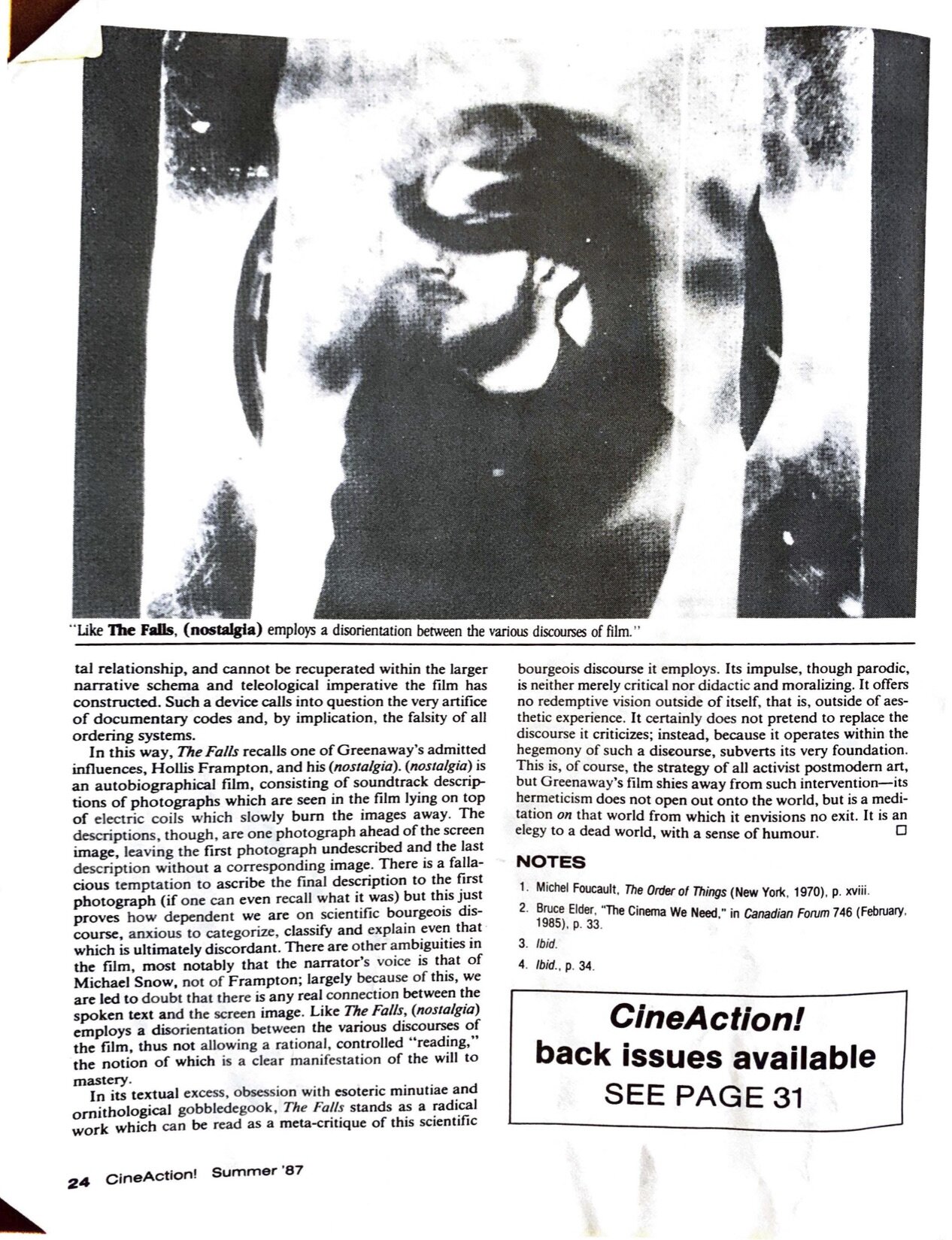
Written by Paul Della Penna and I back in our undergraduate days. I was a huge fan of Greenaway, especially The Falls.


#45: The Art of Song
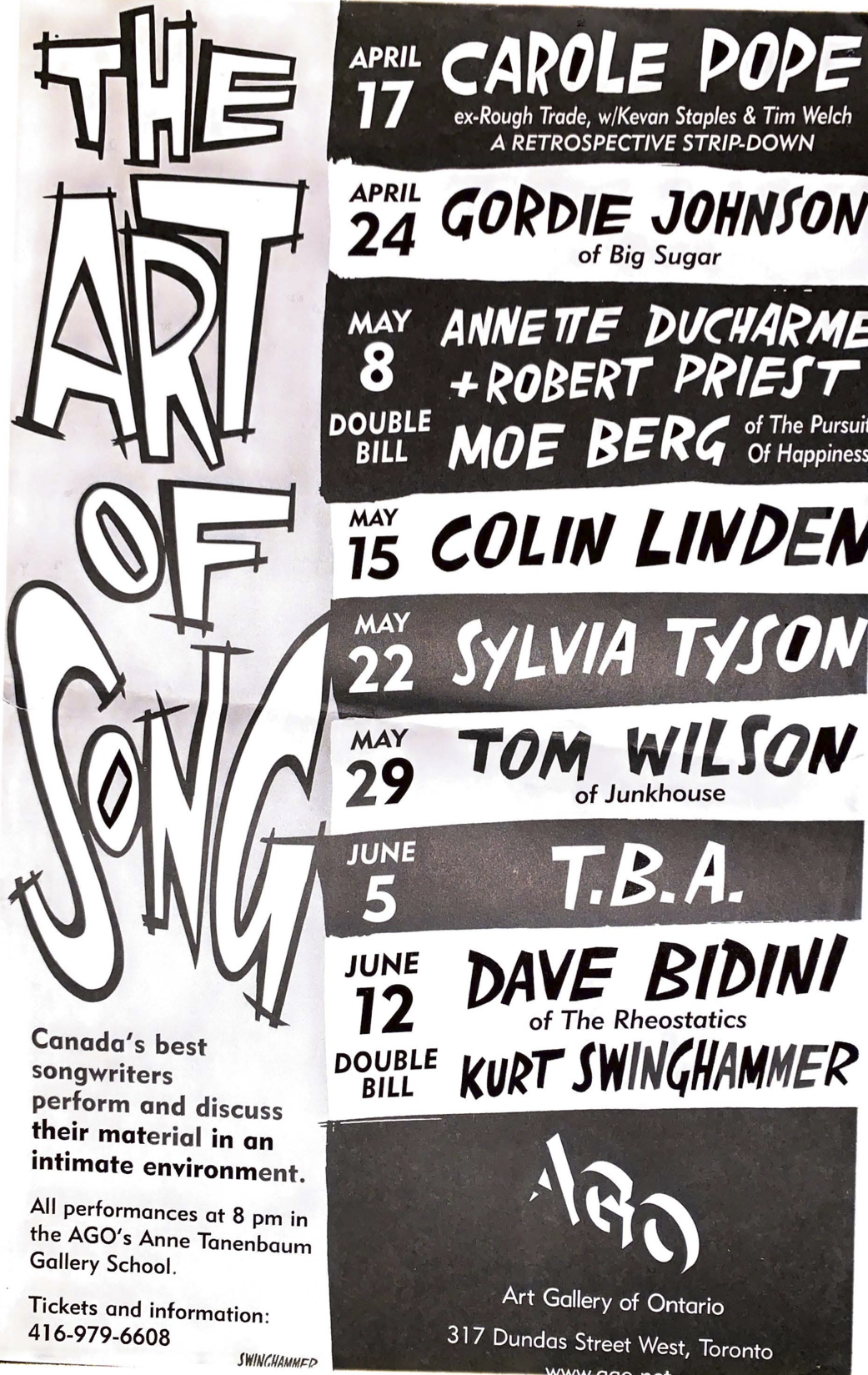
My last window as a music programmer during my first time around at the AGO (1989-1998). After many hundreds of jazz, classical, world, childrens, avant-garde, and hip hop shows, I went out with this series dedicated to some of the heroes of the Toronto songwriting scene. Co-programmed with Molly Johnson, from whom I learned a lot, and with graphics by Kurt Swinghammer, himself part of the Toronto visual and music culture, the series could have been great. But it wasn’t. It was too expensive in a city of too much competition. We were in my favourite space for such things (the Gallery School) but it was lonely and cavernous. Still, the performances were actually all memorable: Carole Pope with Kevan Staples; Sylvia Tyson (with Clay Tyson); Colin Linden; Gordie Johsnon; and Tom Wilson. Sadly, the Dave Bidini and Kurt Swinghammer show was cancelled and, though I was a bit sheepish when I informed the artists, it was the right thing to do. “You gotta know when to hold ‘em, know when to fold ‘em.”
#44: Bruce Mau Design
26 Things I Remember Fondly About Working at Bruce Mau Design
Jim Shedden
July 22, 2011
From 1998 until 2010 I worked at Bruce Mau Design, which proved to be an extraordinary time of growth for me, both personal and creative. It’s now been 18 months since I last worked there, so I thought I’d put a few thoughts down on my time there for posterity and, I hope, commentary by others who worked there over the years. I’m not sure how much sense it will make to people who haven’t had an association with BMD, but I’m throwing it out there anyhow.
It's all a bit random, so don't feel neglected if I've failed to mention you in any significant way. I limited myself to the 26 letters of the alphabet to give this note some structure, and myself some closure. Also if I didn't tag you, please don't take offense: I think there's a limit on the number of people who can be tagged.
“Amanda”: three wonderful people, all called Amanda: first Sebris, then Ramos and then Happé. It’s helpful for me to remember that, aside from Bruce’s leadership, the simple but lovable physical design of the studio, and our impossible-to-top roster of clients, the support of my colleagues over 11 1/2 years made my experience there great. With each Amanda I learned some crucial life lessons. Sebris and I learned how to manage someone as complex as Bruce (can’t say we ever figured it out), the ups and downs of the New York art, design and culinary worlds, and the art of making exquisite books as we argued about whether it was the end of print. With Ramos, I learned how to remain ruthlessly and tirelessly creative, even when it seemed as though we were never going to get it right, and to have fun traveling, whether we were in Copenhagen, or Holland, Michigan. And with Happé, the one Amanda who remains at the studio, I was reminded how important it was to always remain optimistic, curious, open-minded, and, something we often forget, friendly.
Bruce: Brilliant. Infuriating. Introverted. Extroverted. Gregarious. Shy. Generous. Self-absorbed. Perfectionist. Laid back. Serious. Constantly joking. Obsessive. Open-minded. Straightforward. Complicated. Ambitious. Easygoing. I learned a lot from Bruce: lots of predictable stuff about typography, design, books, architecture, and art, but more importantly many things about managing clients, staff and business, especially when we were failing at those things. For many of the years I was there, Bruce seemed like my best friend, but we reminded each other that we weren’t. He could fire me, and I could quit, and the extremes implied in those plausible actions suggested all the other possibilities that ultimately make it difficult, if not impossible, to be friends in that context. So, while I often saw Bruce 7 days a week, all day and into the night, here in Toronto and around the world, I’ve barely spoken to him over the last couple of years. Around the time I left the studio, Bruce’s own relationship to it changed radically, allowing him to invent some new directions, and the studio to reinvent itself as well.
Change, as in Massive Change. Our biggest project, with so many branches it’s staggering looking back on it. The most fun I ever had at BMD, the most exciting it ever got. This isn’t the place to detail what that project was about, but you can get a good glimpse at the http://www.massivechange.com blog, sadly out-of-date, so it feels like a ghost town, but dig a little and the project is all there: the ideas, the research, the people, the project elements, and so forth. There were some major residual effects of the project. First, the Institute without Boundaries (http://www.institutewithoutboundaries.com/), which we founded in tandem with Massive Change, as a “machine” for producing the projects. It continues to thrive at George Brown College, and the work they produce has a Massive Change flavor. Second, inspired by the vitality and forward-thinking we found in Chicago, the final location of the Massive Change exhibition at the Museum of Contemporary Art, Bruce moved there. For a while we had a studio there, which is another story altogether, but the upshot of the move is that Bruce is in Chicago, and Bruce Mau Design is in Toronto, and they are pretty much autonomous. From 2002 until 2004, when the project opened we produced: a manifesto and gobs of research; a best-selling book for Phaidon (still in print - it’s really good too: http://www.phaidon.ca/store/general-non-fiction/massive-change-9780714844015/); a fantastic exhibition for the Vancouver Art Gallery that travelled to the Art Gallery of Ontario and the Museum of Contemporary Art, Chicago; a marketing and communications campaign; public programs; products; a website, which morphed into the blog I referenced above by the time we opened in Chicago, an educational website for the Virtual Museum Canada project (http://www.massivechangeinaction.virtualmuseum.ca/), and many other vehicles. Jennifer Leonard, one of the students in the first year of the Institute without Boundaries, started an amazing radio program that you can still access (http://www.massivechange.com/mcradio), and from which much of the content for the book was derived. Once the project opened in Vancouver, it seemed as though everything else we were doing was either a spin-off or continuation of Massive Change, or an opportunity to approach more traditional design work using the Massive Change lens. I can’t say for certain, but it seems to be that the spirit of what we started back in the summer of 2002 still informs the studio’s approach. It definitely informs Bruce’s, as he has started a new entity, along with his wife Bisi, called the Massive Change Network (http://mcnonline.massivechangenetwork.com/). I’m not entirely clear on what that is, but the spirit of it is clear. My experience of Massive Change was the highlight of my time at BMD intellectually and creatively.
Downsview Park: In the year 2000, our team, which included Rem Koolhaas and OMA, Petra Blaise and Inisde Out, and David Oleson, won the competition to convert 150 acres of the Downsview military grounds into a public park, with our proposal “Tree City.” It was a major international competition so it was huge pleasure to win. At the same time, we had our reservations about entering the competition in the first place. It proved to be the beginning of the end of the studio’s relationship with Rem and OMA. That was fine: all things must pass. Besides, the proposal was really driven by BMD, and we led the project for the next six years after the competition. Bruce and our team, led by Anita Matusevics and Jason Halter, developed a fantastic concept, where poetry meets pragmatism, and the rural, urban and suburban dance together. Later, the team would evolve. I can’t remember all the individuals involved, but Cathy Jonasson and Henry Cheung led it through to the final design documents, but dozens of others came in and out of the project over the years. Though I had very little to do with this particular project directly, I have a huge passion for urban parks, and I was really inspired by the philosophy and the design that we developed for Downsview. It was a long process (11 years so far), but it looks like they’re finally building a version of the park, more-or-less according to BMD’s final Design Development specifications. Here’s the original concept: http://www.downsviewpark.ca/eng/park_design_concept.shtml. Here’s an update on the construction: http://www.downsviewpark.ca/media/constructionmap_may2011.pdf, although this suggests that it’s significantly more banal than we envisioned: http://www.downsviewpark.ca/eng/illustrations.shtml.
Eating: There’s no way around it, my time in the studio involved a lot of great eating. My first official day at the studio I went to New York with the rest of the studio to celebrate Bruce winning the Chrysler Award. Bruce spent the prize money bringing us down, and feting us at a number of great restaurants. It was a great introduction to what was to follow. Shortly after returning the trip, I remember going to a Scaramouche (for my first time ever) for a last minute meeting with Bruce, André Lepecki, and Bill Boyle (Harbourfront Centre), where the idea for our video installation STRESS was launched. Our trip to VIenna to meet with the curator and the director of the MAK involved, of course, seriously great meals. And on it went. Some of my favorite or most memorable meals? Every meal we had in Lisbon, whether haute or peasant, back in September, 2001, a very strange but fantastic time. All my meals with Shaw Contract (carpet), whether they were in Atlanta, the outskirts, Chicago, or Toronto: they were all such fun dinner dates, and brought a gregarious and open-minded spirit to the table. Cheesecake Factory (don’t laugh) with Sara Weinstein Kohn in Marina del Rey (LA). Christmas parties at Bruce and Bisi’s house, and then a few in the studio (see Xmas below). Eating cake tops from Dufflet, when our studio was above her Dovercourt factory, when I was still a client (Dufflet was connected to the studio from the beginning in various delicious ways. All birthdays and other festive occasions were celebrated with a variety of her cakes, Bruce lived above her store for many years, and that apartment became an extenions of the studio when Bruce bought a house. Eventually we even redid her identity, taking the spiral design that Lisa Naftolin developed in the 80s, and making a system that was chocolatey, delicious, classic French and American fun. It was one of those projects that many of us worked on, but Helen Sanematsu eventually cracked and perfected. As light as the whole thing seemed, I frequently showed prospective clients the Dufflet standards manual because it was so clear and tasty.). Long days that would often start at lunch and go till closing time at the Queen St. W. location of Le Select, at a table I called “the office”, the only one without the dangly bread basket. The only restaurant where we had a corporate account, though we should have had one at Bar Italia in the late 90s and Terroni throughout the last decade, and probably Mildred Pierce in the mid-90s, again when I was a client, but often found myself discussing everything that mattered with Bruce and company over a great meal. A few great meals at Susur Lee’s various establishments, most impressive with out-of-town clients, but also of interest when we were working on a cookbook with him (we left the project, but our stamp seems to be on the finished product in any case). Great meals were also had with clients at Canoe, still one of the great Toronto experiences. Elaborate, impeccable Italian meals at the home of Rolf Fehlbaum, then CEO of Vitra, and his wife, the curator and architecture scholar Frederica Zanco. Over the top, old school steak dinners in Chicago, one at Smith & Wollensky’s with Bruce, Bisi, Joanne, and Kris Manos (Herman Miller), the night that Massive Change opened at the MCA; and several at a place whose name I always forget, but it seems like it’s right out of the height of gangland culture, Chicago in the 1930s (when I find the name, I’ll revise this). Breakast with Joanne often, in various cities, but my favorite being Lou Mitchell’s in Chicago (http://www.loumitchellsrestaurant.com/). Everything I ever ate in Denmark, a country where everything is perfect including the food. And the best for last: ice cream cones and sundaes with Kris Manos, Bruce, Amanda Ramos, and Judith in Holland, Michigan.
Frank Gehry and his studio gave us the best opportunities imaginable, and not just the opportunity to work with the world’s most important living architect. Frank invited us into an astonishing group of projects, always demanding that we play the role of the cultural research team, and inventors of innovative approaches to user experiences, whether we were developing graphics and wayfinding systems, as in the case of the Walt Disney Concert Hall or the M.I.T. Stata Centre or whether we were conceiving an entire museum from the ground up, as was the case of the Panama Museum of Biodiversity. What Frank never did was engage us in pointless, meandering research or strategy exercises. There was always a real world design deliverable. Some of those projects came to pass in very big ways: Walt Disney Concert Hall, M.I.T. Stata Center, the Art Gallery of Ontario, the IAC headquarters, the Gehry exhibition at the Gugggenheim, and various books along the way.The Panama Musuem of Biodiversity, one of the studio’s most ambitious projects is under construction. A number of projects never ultimately came to pass, at least not for BMD, like the Schmidt Museum of Coca-Cola Memorabilia, Saks Fifth Avenue, and many others. Almost as important are the projects that came into the world through Gehry but became programmatic challenges for BMD even after the Gehry studio left them: Riversphere in New Orleans is the most significant of these (http://riversphere.tulane.edu/), but so, too, were the Connecticut Historical Society; the Bathurst Jewish Culture Centre; and the World Youth Centre (Toronto Olympic Bid 2008). When we were hanging around the Gehry studio in Playa Vista (L.A.), we were usually aware that we were in the middle of something special, even if our colleagues there, Frank included (usually), were just down-to-earth, experiencing the same daily struggles as the rest of us. I learned a lot from Jim Glymph, George Metzger, Craig Webb, Marc Salette, Keith Mendenhall, and many others, sometimes just by standing around, drinking coffee and waiting for Barry Diller to show up at the studio in order to dismiss our collective efforts one more time. Even then, I like how L.A. days were usually far less stressful than NY days, for the simple reason that it’s impossible to go from meeting to meeting to meeting. Our days would wind down by 4 or 5pm and then evenings might be spent eating Mexican food (or Cheesecake Factory!) back in Marina del Rey, or wandering around Santa Monica, the easiest part of L.A. for a Torontonian to love (and I do love it).
Gagosian: So many books, exhibitions, special projects, invitations, advertisements, crazy meetings, dinners, nightclubs, angry phone calls, happy phone calls. At the end of the day, however, we got to work on these projects, often with these artists (the ones who aren’t dead): Rauschenberg, Lichtenstein, Rosenquist, Warhol, Douglas Gordon, Richard Prince, Richard Serra, Cy Twombly, Baselitz, Cecily Brown, Beuys, Ellen Gallagher, Picasso, Cindy Sherman, Franz West, Schnabel, Glenn Brown, Artschwager, Bacon, Basquiat, Boetti, Calder, Michael Craig-Martin, John Currin, Dexter Dalwood, de Kooning, Gorky, Gursky, Richard Hamilton, Neil Jenney, Jasper Johns, Mike Kelley, Kiefer, Martin Kippenberg, Koons, Vera Lutter, Tim Noble & Sue Webster, Ruscha, Jenny Saville, Elisa Sighicelli, Taryn Simon, David Smith, Phillip Taaffe, Al Taylor, Robert Therrien, Richard Wright. Holy crap! That was an incredible time and I’m reminded that I left the AGO back in 1998, because I thought I would have a better chance of engaging with the living culture at BMD. I was absolutely right on at the time, and now things have come full circle, because the AGO seems like the right place to be. Regardless, that’s a staggering list.
Hospitals, like the Massachusetts General Hospital, elements of which were designed by our client nbbj, the “largest architectural firm you’ve never heard of”. They asked us to produce a monograph because they liked something we had done for Pelli Clarke & Associates. With Bruce’s encouragement, I somehow convinced them to let us take on a much more ambitious scope. Without going into all that, I’ll just say that this seemingly unsexy megafirm changed my ideas about what constitutes good architecture. The journey we went on with them over the next couple of years was an education on dozens of levels. Because they were all great people - smart, generous and social - it was also a great time. Yes, great meals were part of the equation: in Seattle, Columbus and New York. We didn’t produce as much as we wanted to, but the main book for the firm, Change Design, has some great ideas in it, backed by compelling stories that demonstrate a very different role architects can play in designing change.
Identity: Identity was at the core of everything we did, and still is for BMD as far as I can see. That started, it turns out, with Zone Books and certainly carried to Massive Change. For every client, and for every self-generated endeavour, our work always involved crafting a client’s story, “by any means necessary”: a visual identity; a story or approach to language; actions, events, environments, etc. So Tree City, STRESS, Too Perfect, the Panama Museum of Biodiversity, and Massive Change were no less identity projects than the more conventional visual branding systems we developed for Indigo, Roots, the AGO, Harbourfront Centre, or the Gagosian Gallery. This notion was very attractive to me, and I try to bring it to bear on my work whenever it makes sense.
Jonasson, Cathy: When I was 21, I started colaborating with Cathy Jonasson. She was the film curator at the AGO and I was a university student with ambitions to make the Innis Film Society a force within the tiny, insular world of avant-garde film. Colaborating with the AGO on the premiere of Bruce Elder’s 8 hour Lamentations (his best film, in my opinion) was an important stepping stone. Then, in 1988 Cathy and I collaborated on a series and catalogue for the AGO called Recent Work from the Canadian Avant-Garde. Then Cathy was on the Board of Directors that hired me to coordinate the International Experimental Film Congress in 1989, an event that changed my creative and professional life like almost no other. When the Congress was over, Cathy hired me to stay on at the AGO to clean up a few things administratively, but then asked me to manage the Peter Greenaway series that Bart Testa was programming, The Body in Film series that Bruce Elder curated, an Ulrike Ottinger series, and so forth. I never left until 1998 when I came to BMD. Cathy left the AGO in 1996 to go to BMD and, with Bruce, hired me to manage a project, Mutations, that never happened, at least not for BMD. See a pattern? I don’t know why I was so blessed with someone who made such leaps of faith, but there you have it. Thanks Cathy!
Kevin Sugden: Kevin is one of the reasons I wanted to join the BMD studio. I first worked with him on the Michael Snow Project film catalog. For that book, we had an insanely small budget, and I was really impressed with how Kevin and Bruce were invent creative ways of making it work. I look at it today and it doesn’t feel compromised at all, and I doubt that more cash would have made it a significantly better book. Good design and good art requires open-ended entrepreneurship. And that’s what Kevin is at the end of the day: an entrepreneur, always cooking up ideas, and not daunted when any one of them - or dozens of them in a row - were rejected by the client, by Bruce or by his colleagues. At the studio Kevin was a master on both our identity projects and what we called “programming” projects, but I guess they could be called cultural invention or something along those lines. Riversphere in New Orleans, the Panama Museum of Biodiversity, the Schmidt Museum of Coca-Cola Memorabilia, the “Culture of Work,” and even the initial concept for the Institute without Boundaries were all led by Kevin, or had his stamp on them. And I should never forget that his role on S,M,L,XL went from design assistant to design manager by the end of the project, his brutal aesthetic an integral characteristic of the book. And as far as the identity projects go, Kevin’s graphic design approach wasn’t always immediately attractive - in fact, it was often clunky and unappealing - but he proved that a smart and rigorous process would lead to the best, most intelligent solutions and they would invariably be beautiful. Hence, the identity for the UCLA Hammer Museum, which Kevin developed, has proved to be one of the most effective, and attractive, visual identity systems in the studio’s history. Similarly, Kevin was able to help the studio develop and articulate their most ambitious identity projects at the time: Indigo, the Rotman business school, and Access Storage Solutions. Finally, I admired and emulated Kevin’s openness to the world. As the studio has matured over the years, it became mandatory that everyone have an openness to the world, to all the crazy possibilities that might present themselves. But in my early days there, I remember certain prospects emerging, like the Taco Bell account with a San Francisco advertising agency, and there was general disdain, of the “I’ll quit before I work on that” variety. But Kevin was open to it, as he always was, and that inspired me on the best of days.
Life Style: It’s too big, so like S,M,L,XL it doesn’t get read. Those who do read it seem to only come upon the Incomplete Manifesto. At the time, the book was a fantastically crazy essay on where the image economy was going, but it went there so fast that the book looked quaint and naive only a few years later. Research for the book was not primarily accomplished online: that really only happened at the end of the image research. Only three years later, the entire Massive Change project was researched and developed almost exclusively online, which sort of proves what Life Style was all about. Most people, even those who work in the studio, never caught on to the Life Style thing and just write it out as Lifestyle. We developed it at the same time that we developed STRESS. Kyo, the book’s main editor and champion, became my best friend in the studio for a while. We were the the leads on both the Life Style and STRESS teams, she being Bruce’s right hand person creatively, and with me as producer on both. We kind of were the whole Life Style team, but then added Bart Testa to help push the editorial work uphill, and then we were joined by an evolving team of designers, eventually led by Chris Rowat, with Reto Geiser, Michael Barker, Dave Wilkinson, Nancy Nowacek, and others. It was so difficult to get from 90% to the 100% that Phaidon needed or the 110% that Bruce wanted, that Phaidon sent the editor, Megan McFarland, up to Toronto to park herself in the studio to get the job done. It got done, we took everyone to New York to launch it and it was a great success. I joined Bruce on the road for some of the launch tour and, while the book is a wonderfully succinct articulation of Bruce’s approach to typography and identity, to which I still refer people, the less baked discussions of the image economy, optimism, collaboration, and the future would end up determining the shape of the studio’s work for the next decade. Definitely one of my favorite moments in the studio.
Marigold Lodge: Herman Miller was one of my 3 or 4 favorite clients and, no, we didn’t sit around talking about Charles and Ray Eames and George Nelson. Our time with them was not about chairs, as much as we were all fans (like, I wish I had an Aeron in my office at the AGO - I get by with some Staples reject, but I’m not actually complaining). Instead, this was an opportunity to finally explore the Culture of Work and, as it turns out, the inherent values driving a company like Herman Miller. Something I learned doing this project is that I don’t know always know what I want. I would always default, if given the choice, to clients in New York, San Francisco or similar centres. For Herman Miller we had to fly to Detroit or Cleveland, then fly to Grand Rapids, where a car would take us to Holland, Michigan, about an hour away. What I found out the first time I was there was that that meant going to the Marigold Lodge on Lake Macatawa, a stunning group of buildings designed by its owner Egbert Gold, all set within a horticultural utopia. There, to put it simply, we were taken care of. It worked, The early core team on the project - Bruce, Amanda Ramos, Judith and myself - were completely eager and engaged. Whether we were at Herman Miller’s main campus in Zeeland, Michigan, or at Marigold Lodge, where we often worked, ate and slept, they were special times, creative in ways that 45 minute meetings in New York never made possible. In the context of the rest of our work, it was such a pleasure to slow down, be civilized, enjoy the lake, the flowers (especially the tulips - it’s Holland after all), and our colleagues at Herman Miller. In the end, as far as I know, nothing concrete came of our work with Herman Miller. This was distressing at the time, but I really learned a lot from it. When we started the work, we were careful to describe, in painstaking detail, exactly how we would realize the various projects and initiatives we were proposing. By the end of the project, we were producing Power Point presentations about brand hierarchy and strategy. Deadly. Necessary, I guess, but there are hundreds of agencies that are good at that song and dance. Ultimately I feel that Bruce Mau Design was about cultural insight and creative execution. A simple image explains it all: when we started the project, we wowed the Herman Miller folks, in their pristine offices, with our crazy foamcore boards that didn’t quite fit, but allowed us to look at fields of information and ideas, and work together, moving them around and revising them, and creating something out of the noise; by the time we finished the project, we were creating single channel Power Point presentations. So the frustrating inertia that developed helped me understand what mattered to me (culture, creativity), and what didn’t (hideous “marcomm” consultantspeak).
New York: My favorite place on earth, aside from wherever I’m currently living with my family (so far always Toronto). I spent so much time there over the years that it eventually made sense for me to get an apartment in Brooklyn, which was both a magical time, and the worst time of my life. Not New York’s fault: it just coincided with some mental and emotional difficulties that came to a head during that time. But my first day on the job was spent in New York, and as many as 100 other trips followed. I’m so lucky to have had that experience, learning in ways not otherwise possible, and meeting an insanely talented, eccentric and just plain interesting cast of characters. I’m not sure if it’s true now, but for many years at least half the studio’s revenue was generated out of New York. During my time there we were able to work with: MTV, the New York Jets, the New York Giants, MoMA, the Guggenheim, the Gagosian Gallery, Saks Fifth Avenue, Terry Winters, IAC, Phaidon, the Cooper-Hewitt, OMA-NY, Ian Schrager, Rockwell Group, and dozens of other artists, galleries, museums, and businesses. And, while my heart is in New York, over the years I also enjoyed my less passionate flings with Chicago, Boston, Los Angeles, San Francisco, Atlanta, Denver, Holland (MI), Seattle, Vancouver, Copenhagen, Vienna, Rotterdam, Ghent, Essen, Basel/Weil am Rhein...
Open: The weirdest project ever. A trip to a Renaissance castle in Lisbon, where Bruce, Hamilton Fish (who runs The Nation Institute), a photo editor, and a client who we just discovered was recently released from prison for fraud. If we hadn’t discovered it, she was going to tell us one night over drinks to shock us. Anyhow, this strange meeting, in this stunning but bizarre setting where we also had a staff at our beck and call (and a tour guide and bus driver), all managed to happen during 9/11. So the magazine we were to develop, OPEN, about the new, open world we saw, was threatening to become CLOSED. I can’t quite put into words who weird this whole experience was, but I have to say I remember it fondly. We were incredibly productive, if argumentative, ate exceedingly well, and probably had a good distance from which to watch the insanity unfolding in the U.S. and Canada. For Hamilton it was especially difficult, however, because he lives in TriBeCa and his wife and young daughters experienced the horror that morning, so his trip was mainly taken up by figuring out how to get back. Weirdest moment: when the client and I took the bus one afternoon to check out Fatima, truly one of the most bizarre experiences I’ve ever had. After promising to bring all of our families to a lovely setting in the south of France at Christmas, the client stopped paying our bills, and stopped answering our calls. Petra Chevrier, Bryan Gee and Helen Sanematsu continued to develop fantastic prototypes in our studio, and we didn't want to stop even when it was obvious it wasn't meant to be. The best ideas from Open ended up in Massive Change so it’s just as well. Developing a new magazine proved to be one of the stupidest things one could do in the 21st century.
People. I’m going to screw this up, so I’ll keep revising it as new memories surface. Names will be misspelt here and there. Some of these people remain good friends of mine. Some were not friends. But I fondly remember each. It’s not meant to be a complete list of people with whom I worked. A small number are deliberately missing, either because I didn’t get to know them very well, or where the word “fond” would be nothing but a lie. In no particular order: Joanne Balles Crosbie. Kyo Maclear. Anita Matusevics. Jason Halter. Mary Moegenburg. Amanda Sebris. Amanda Ramos. Amanda Happé. Ruth Silver. Quinn Shepherd. Cynthia Budgell. Eha Hess. Henry Cheung. Andrew Clark, Paul Kawai, Rafael Santos, Harry Choi. Rob Sawden. Kevin Sugden. Chris Rowat. Chris Pommer. Louis-Charles Lasnier. Cathy Jonasson. Aaron Currie. Kelly McKinley. Michael Waldin, Julie Ezergailis. Koto Sato. Judith McKay. Breanne Woods. Natalie Black. Beth Mally. Chris Bahry. Barr Gilmore. Danella Hocevar. Julie Netley. Peter Blythe. Heather Thelwell. Mark Cohon. Jackie Rothstein. Alan Belcher. Lisa Molnar. Catherine Rix. Kristina Ljubanovic. Jyhling Lee. Christina Bagativicius. Laura Stein. Carolina Soderholm. Dane Solomon. Elva Rubio. Monica Bueno. Seth Goldenberg. Simon Chan. Reto Geiser. Sara Weinstein-Kohn. Sarah Newkirk. Eric Leyland. Robert Labossiere. Petra Chevrier. Bryan Gee. Julie Fry. Pauline Landriault. Alex Quinto. Alex Seth. Tyler Millard. Alexis Victor. Alita Gonzalez-Vucina. Ayla Newhouse. Britt Welter-Nolan. Chris Braden. Clementina Koppmann. David D’Andrea. Dan McGrath. Dave Gillespie. Jonathan Seet. Maris Mezulis. David Shantz. Dieter Janssen. Donald Mak. Doug Chapman. Jill Murray. Jennifer Leonard. Ilene Solomon. Eha Hess. Duncan Bates. Enoch Chan. Emily Waugh. Rochelle Strauss. Evelyn Wang. Gisele Gass. Glenna Wiley. Gina Doctor. Grant Cleland. Gary Westwood. Greg Van Alstyne. Helen Papagiannis. Ian Rapsey. Jayne Brown. Greg Judelman. Jack Fisher. Jason Severs. Jeremy Stewart. Jill Holmberg. Joanne Freedman. Kelsey Blackwell. Kar Yan Cheung. Jonathan Seet. Jonas Skafte. Leilah Ambrose. Leslie Alpert. Lisa Mamers. Marc Lauriault. Mark Beever. Lorraine Gauthier. Nancy Nowacek. Michael Dudek. Doug Chapman. Mike Bartosik. Milena Vujanovic. Anthony Murray. Neeraj Bhatia. Paddy Harrington. Diane Mahoney. Philip Wharton. Sarah Dorkenwald. Whitney Geller. Tanya Keigan. Tobias Lau. Keely Colcleugh. Tania Boterman. Kate MacKay. David Shantz. Robert Kennedy. Blair Johnsrude. Vannesa Ahuacztin. Vanessa Ward. Randi Fiat. Norah Farrell. Judith Hoogenboom. Sonny Obispo. Lisa Santonato. Lena Senstad. Nina Ladocha. Angelica Fox. Laurel MacMillan. Gina Doctor. Randi Fiat. Jeremy Stewart. Helen Sanematsu.
Quiz: Two advertisements we placed in Now, the first one full-page and the second one two full pages, took the form of elaborate cultural quizzes one had to answer and then submit to us, along with other crucial pieces of evidence. These were audacious, perhaps a bit arrogant, and tons of fun. The first quiz, which has a history to it before we placed it in Now, is reproduced in the book Life Style. About a hundred people took the trouble to reply to quiz #1, and a couple of hundred to the quiz #2. Almost everyone we hired out of the process proved to be major contributors to the studio creatively. The names I remember include Michael Barker, Maris Mezulis, Alan Belcher, Amanda Ramos, Bryan Gee, Robert Labossiere, Kelsey Blackwell, Julie Fry, but I know there were a few others.
Rem Koolhaas: “Fondly remember” “Rem Koolhaas”? Well, yes, I do in a qualified way. I remember this fondly: I was in New York with Bruce doing the rounds. One night we were to meet Rem Koolhaas at Da Silvano to discuss Mutations, and probably a handful of other projects. I was new. I was green. I was in awe. I was nervous. Rem arrives. Bruce excuses himself because he’s suddenly violently ill. So I’m left with Rem, and I’m freaked out. He alternated between questions about the project, to pointed questions about my qualifications for Bruce’s studio. At one point he told me that he wasn’t afraid to go bankrupt, that he’d done so several times, but that Bruce was terrified of it so I must promise to do whatever I could to make sure it didn’t happen. After two full meals and a dessert, which Rem shared with me, he took off, I picked up the bill, and then our relationship proceeded to get much weirder over the next three years. Still, I remember it fondly.
STRESS: An eight-screen video installation (+ objects in some variations), this was one of my favorite projects, not because of the content, which I no longer love, but because I love to work in situations where, regardless of all the obstacles, hardships and whatnot that one experiences, the final product is never in question. From the time we started STRESS to the time we finished, DVD technology was introduced, the G4 was launched, Final Cut Pro was launched. That all sounds primitive now, but it allowed us to actually do the project completely in our studio and, since we only finished it 11 years ago, it’s a reminder that one should never get too comfortable with hardware, software, or standards. More importantly, it was a great experience because we discovered that we could produce work as a team, taking Bruce’s direction when he was available and ready, but taking the bull by the horns when he wasn’t. We produced a couple of iterations of this installation. The internal team - mainly Bruce, Kyo, Robert Kennedy, Maris Mezulis and myself - were joined by André Lepecki, a dramaturg who helped shape the piece, and John Oswald and Phil Strong on sound. In a new version we created for an exhibition at the Power Plant in Toronto, we redid the sound with Kyo and Dave Wall.
Too Perfect: The idea behind this project was pretty promising: a kind of “applied Massive Change”, working with Danish architects and designers. In a letter describing the project we said: “Dear Denmark, Remember the late 1940s? That was when a group of young Danish architects anddesigners decided to throw off the shackles of tradition-bound design. They formed a distinctly Danish movement, inspired by natural materials, organic forms, handcrafting, and Danish humanism. Worldwide, Danish Modern became a sign of being innovative and experimental. Today it means nothing – an invisible image. Fifty-odd years later, Danish Modern is so pervasive in Denmark that it's become a stylistic canopy blocking the light necessary for new developments to flourish, a formal straitjacket that's "too perfect." Isn't it time for a new generation to break free? The Danish Architecture Centre (DAC) had a hunch that in order to cut a clearing in the forest for reinvention and to return Danish design to a leading position on
the international scene, it was necessary to look at Danish culture and tradition with
new eyes. DAC called in our Canadian design studio, Bruce Mau Design, to work with
a team of Danish architects.” The execution: simultaneous exhibitions of seven propositional projects by Danish architects and designers as well as BMD itself, presented in Toronto, as part of the Superdanish festival at Harbourfront Centre, the original comissioner; in the Danish pavilion at Venice Biennial of Architecture; and at the Danish Architecture Centre. A funky looking catalog. A website of sorts. The funny thing is, because this opened at the same time as Massive Change, it was strangely underwhelming. Also, Massive Change had the distinct advantage of being a documentary project, whereas these propositional exercises were less compelling. Once again, however, what I remember more is the experience: in this case, of being immersed in Copenhagen as we (usually Bruce, Amanda Ramos, Angelica Fox and me) planned this project with Kent Martinussen, director of the DAC, as well as PLOT, a young architecture firm led by Bjarke Ingels, who is now a superstar, and Julien de Smedt, and a brilliant young guy called Rasmus Bech Hansen from the firm Kontrapunkt. Yes, we liked to make fun of his “Beck Hansen” name. I could go on and on, but I’ll just say this. Denmark may be “too perfect” but it is perfect. Everything about it: buildings, infrastructure, parks, transportation, public bicycles, maintenance, theatres, museums, and, of course, food. I just love it there.
(The New) Urban (Deal): A major project in Tokyo, our first big thing after Life Style and STRESS, sharpened our thinking about cities, globalization, and design. For the Mori Building Company and their monumental Roppongi Hills development (http://en.wikipedia.org/wiki/Roppongi_Hills) we produced a book on the future of Tokyo; a video installation on the same theme, Tokyo Countdown; a mile-long collage on the construction hoarding; an identity; product; and a public programming concept for the information centre. It was a huge learning experience for everyone involved (Bruce, Amanda Sebris, Donald Mak, Maris, Jason, Bruce, Julia, Michael, and myself - though I’m probably forgetting someone), one that I was certainly grateful for. Aside from the all the funny things one learns about dealing with another culture, what I took away from it was that (almost) everything is design; that this fact is a reason for great optimism; that all my assumptions about cities might be wrong, and I should open my mind if I really want to learn anything, and effect positive change. By the way, “The New Urban Deal” was an essay by Mr. Mori that directed his thinking about the development.
Vitra: The great designer and cultural force Tibor Kalman had just died and Rolf Fehlbaum, the CEO of Vitra, was looking for a new designer to help steer he creative communications direction for his company, the manufacturer of great designer furniture (http://www.vitra.com/). We were going to have a blast. An initial meeting suggested that Rolf was open to our “Culture of Work” concept, a project Bruce had cooked up a number of years earlier as a way of engaging with one of his obsessions: the cultural significance of the changing world of work. Could we use Vitra as an incubator, a think tank for generating research and ideas around this topic, in a manner so robust that they would “own” this territory and that the value of the intelligence created by the Culture of Work project would transfer itself to the Vitra brand. Many trips to Germany and Switzerland (Vitra’s operations were split between the twin cities of Basel and Weil am Rhein), side trips to New York, visionary work, not-so-visionary work, an ambitious and complicated exhibition on Barragan at the Vitra Design Museum, lovely meals at the Kunsthalle in Basel, and many nights (completely sleepless) in the strange, lovely but ultimately alienating (for me) Teufelhof Hotel (http://www.teufelhof.com/de/teufelhof.html): all this didn’t add up to much. I can’t remember why. It would be easy to say it’s because Rolf was ultimately more interested in “design” in the fussy, precious sense; and we weren’t quite ready to put a stake in the ground about our different perspective on design, the way that Massive Change allowed us to five years later. Even so, it struck me that Bruce, Kevin and I, the usual suspects on the Vitra junkets (along with Anita, who led the Barragan project, and took over the overall Vitra relationship later on), were more interested in culture, and less in the world of celebrity design. So what though? Ten years later, I realize that our inability to realize the “Culture of Work” ambitions, except in a kind of watered-down form in a few publications, isn’t that important. It may have been a bit of a bummer at the time, but the experience, like all experiences, allowed the studio to move forward, learn a lot about itself (as I did about myself personally), refine the ideas and approach, and realize the ambitions in a more profound way later on. The chase is better than the catch, to quote Motorhead. I assume that Rolf and Vitra learned a lot about themselves, too, and I was impressed to see how they continued to engage communication designers after our stint with them in ways that were probably more in sync with their needs.
World Leaders: A high moment for me at BMD, a project that was rooted in doing Harbourfront Centre’s visual identity, grew to helping them with their communications approach in general, and then inventing, with Bill Boyle and his staff at Harbourfront Centre, World Leaders: A Festival of Creative Genius. Secretly, I always wanted to work at Harbourfront Centre because I love the who they are and what they do, but this was better, because I got to be the consultant and, therefore, naively recommend something so ambitious, risky and audacious, that I’m sure it wouldn’t have happened had I been a staff member there. In other words, Bruce and I were unencumbered by reality. Not everyone’s going to want to hear this, but that’s often we did our best work at BMD. The upshot of this project: 14 gala evenings celebrating 14 creative geniuses who each changed their fields forever, such that no artist coming after them could do their work without taking into account the contribution of the genius in question. Lily Tomlin dropped out owing to 9/11 fears, but later made it up to Harbourfront Centre. The other 13 were Frank Gehry, Philippe Starck, Issey Miyake, Robert Lepage, Guy Laliberte, Joni Mitchell, Stephen Sondheim, Quincy Jones, Harold Pinter, Robert Rauschenberg, Peter Gabriel, Pina Bausch, and Bernardo Bertolucci. On top of the gala evenings, Harbourfront Centre organized another 100 supporting events that were free to the public and focusing on local talent. An amazing organization.
Xmas: We loved Christmas at BMD. Dinners at Bruce and Bisi’s were incredible, and sometimes featured guests, like Jamie Kennedy cooking for us one year, including a special meal for the kids who played in the basement, and a portable fryer for his frites, the best in town. In those years we were still very much about books, so everyone in the studio would get a special book not produced by BMD, chosen by Bruce (later by me and Bruce’s assistants), and spouses and partners would get one of the studio’s books. We grew out of the house, so tried various restaurants around town, and a few years where the party moved into the studio, a lovely idea with mixed results, owing to obsessive working happening in tandem with dinner. We also had a few years where we invited Bootysmacker to play for us, first at their default venue, the Winchester on Parliament St., so we were able to invite clients, suppliers and friends to join our Christmas festivities, and later the Drake, probably the most successful of our hipster venue parties (more so than the Spoke Club and other places). The whole tradition continued to evolve and, while I don’t want to sentimentalize, there was a certain energy to the whole thing that seemed impossible to continue capture no matter what we did after 2002.
YYZ: I spent huge amounts of time in airports while at BMD, but nothing close to Bruce, and probably a few other people. I’m sure I was at Pearson departures 200 times during my time there (so 400 visits in total) and got quite used to getting my shoes shined there, eating lots of marble cheese, buying every magazine and newspaper that might possibly be of interest, dealing with delays, the institutional food, and occasionally drinking too much (happily, not in the last few years there). So that must have meant 100 or so trips to New York, 20 to Chicago, 10 to Atlanta, 10 to Los Angeles, 10 to Grand Rapids, 25 to various places in Europe, 5 to Vancouver, and another 20 misc. trips. While I don’t miss all that travel, I’m so grateful that I had that opportunity. There’s no better and faster way to learn about the world than to travel.
Zone: In 1985 I bought a copy of Zone 1|2 at Pages Bookstore. I was craving interdisciplinarity, so was seduced by the collision of architecture, design, literature, philosophy, urbanism, and film. Since that time, interdisciplinary publications have exploded (in fact, I’m on the advisory board of a very good one, Alphabet City), but it was somewhat rare in 1985. I was also seduced by the graphic design itself, which I later found out was meant to model the City, the theme of the first issue, rather than illustrate it. And it kind of does that. All I knew then was that I loved he book I was holding, that it was a new thing, and that maybe the 80s weren’t going to be entirely terrible. Shortly after that, I met Bruce Mau at the public launch of Zone Books, an event that took place at the Rivoli which I attended because Michael Snow was a guest and would be “playing” The Last L.P. That’s literally what he did: he put it on a turntable and walked away (and even then, I found out that what was actually playing was a cassette tape of the LP). Anyhow, I was totally intrigued by Zone, Mau, the books they were putting out (these were the days when I got pretty jazzed by Foucault, Deleuze, Bataille, et al), and the whole promise of the enterprise. Looking back, buying that copy of Zone 1|2 was the moment I became interested in architecture, design, and urbanism, and none of that has waned since. It was also the moment I knew I needed to work with Bruce Mau, and so was jealous when my friend Greg Van Alstyne became the first person that Bruce ever hired. By the early 1990s, however, I was working with BMD on the Michael Snow Project, then The OH!CANADA Project and, then, in 1998, in the studio. By then Zone’s place in the studio was less central and it seemed to me that the ambitions of the early Zone project got taken up by BMD, while Zone settled down into a perfectly fine, but no longer ground-breaking, academic publishing outfit. I still get excited when I see a new book, reliving what I felt in the 1980s, but I rarely go so far as buying the books. I’m grateful that Zone gave birth to BMD, however, and that BMD, in turn, afforded me the opportunity to take an extraordinary creative journey.
#43: The Ramones
The Ramones mattered the most.
I’m talking about bands I heard in high school during the punk/postpunk/new wave eras, 1977-1982.
It’s hard to write that. What about Patti Smith? OK, maybe it’s a tie. But it’s just that when I first heard “Blitzkrieg Bop,” “Beat on the Brat,” and “Now I Wanna Sniff Some Glue,” I knew I had what I needed. I knew that this was the real thing, this was going to get me through day, and maybe even high school.
I bought all their albums. I loved them all. I made lame excuses to myself for End of the Century but, in fact, I still kind of like it.
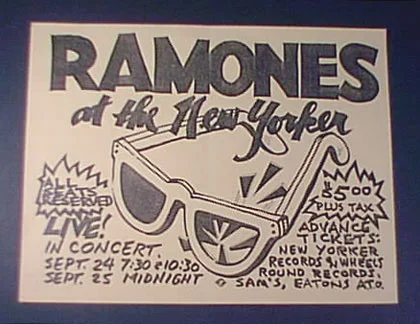
Thanks to the Garys, who booked the Ramones more than any other promoters did (so we had more shows in Toronto than any other city did), I saw a pile of gigs. I’m showing a bunch of ticket stubs, though I was at only one (the Music Hall) of these particular gigs. There were three gigs at the Concert Hall, one at the Kingsway (I think the same place that became the Kingsway film theatre?), and one or two others I might be forgetting.
In 2010, in my Facebook blog/group, I wrote the following about “Beat on the Brat” (orginal is here https://www.facebook.com/notes/1000-songs/song-417-beat-on-the-brat/10150209795826451/):
Few days have been as exciting as the first time I heard “Beat on the Brat,” by the Ramones. It was 1978 and probably around the time I first heard the late (last night) Captain Beefheart, who has nothing in common with the Ramones on the surface, but for me, growing up in Scarborough, they both meant being alive, creative and social possibility, and differentiation. A lot of that was naive, adolescent stuff, and certainly many other artists represented those things for me back then, but most of them don’t matter so much to me today. And, while I don’t listen to The Ramones or Captain Beefheart much these days, when I do I am definitely brought back to the moment when I fell in love with them musically, and I’m reminded of all the positive energy that they gave me, even while it was all caught up, at the time, in equally strong, or more powerful, negative forces: fear, loathing, isolation, self-destruction.
I guess I’ll never know for sure what music was really most dominant in my life back in those days. I misremember things, so I often tell people it was Elvis Costello, or Elvis and Dylan. It was probably more accurate to say a mix of The Doors, Patti Smith, Dylan, the Velvet Underground, Elvis. I think from 1978 to 1980 it was probably The Ramones, on the one hand, and Bruce Springsteen on the other. In every case it was single songs, not necessarily their best nor even my favorites today, that sealed the deal. “Born to Run.” “Because the Night.” “Riders on the Storm.” “I Want You.” “Radio, Radio.” “I’m Waiting for the Man.”
And, for the Ramones, it was definitely “Beat on the Brat,” the first song I ever heard by them, followed immediately by “Blitzkrieg Bop,” “Now I Wanna Sniff Some Glue,” and “Chainsaw”, “53rd and 3rd.” These songs, and that entire 1976 Ramones debut album epitomize punk for me. I judged all other punk according to it. There were punk albums prior to it, but they definitely feel “proto-punk”, like “Punk B.B.B.” (Punk Before Blitzkrieg Bop), and everything that follows, including every other Ramones album might be interesting, but it was never quite purely punk the way these songs are.
This isn’t actually a critical observation, by the way, just an account of how I perceived things.
Punk was: loud, fast, sloppy, bass-guitar-drums only, built on two chords, simply produced with no overdubs, funny, witty, pissed-off, Levis, sneakers, leather jackets, sunglasses, New York. Strangely, it was artful and pop. I liked a lot of UK bands, of course, but my heart was in New York, my image of this scene having been painted by Lisa Robinson, Lester Bangs and others in the pages of Hit Parader, Creem and Circus.
At first I thought that punk was all about reviving some rock and roll spirit of the 50s that had been lost, and that’s certainly how everyone was talking back then. It quickly became clear, though, that punks like the Ramones derived more of their energy from the 1960s. Earlier I wrote on a few of their covers, “Needles and Pins” and “Surfin’ Bird,” and it’s these songs - along with other definitive covers of theirs like and “California Sun” and “Do You Wanna Dance” - that demonstrate their deep love of girl groups, surf, garage, psych, Spector, The Beatles, and bubblegum.
It’s been said, maybe by me here one day, that the Ramones are somewhat of a bubblegum band. I won’t be so perverse as to argue that “Beat on the Brat” is a bubblegum song but...
I didn’t care about that then. I just loved them. I saw every show they did in Toronto from 1978-1981 (1982?), had all their albums, t-shirts, buttons, etc. I played this song and a this album in the mornings to get going, to wake up and get an aggressive attitude on, sort or a cross between happy and angry, which is what I hear in their songs.
The album was produced for $6400 in four days, during the days when people were taking years and hundreds of thousands of dollars to make records. We could hear it and that intelligence wore off on us. It was the beginning of D.I.Y., something many of us took up and which, I have to say, still keeps me going today.
In the Nicholas Rombes 33 1/3 book on this album, he argues that though the album sounds like "the ultimate do-it-yourself, amateur, reckless ethic that is associated with punk," but that the band approached the whole process with a "high degree of preparedness and professionalism.” It’s punk, but it’s thoughtfully executed and, oddly, precise.
Rombes quotes Joey Ramone on the origins of the song: “When I lived in Birchwood Towers in Forest Hills with my mom and brother. It was a middle-class neighborhood, with a lot of rich, snotty women who had horrible spoiled brat kids. There was a playground with women sitting around and a kid screaming, a spoiled, horrible kid just running around rampant with no discipline whatsoever. The kind of kid you just want to kill. You know, 'beat on the brat with a baseball bat' just came out. I just wanted to kill him.”
Not nice, but let’s face it, we’ve all felt it. I could relate, in a way that I couldn’t to “London’s Burning” and “White Riot.”
The bottom line: I’m blown away that this song and album still sound so bloody great.
PS: When I was in New York recently I swung by 53rd and 3rd, as I’ve done a number of times since my first trip there in the mid-1980s. I just can’t imagine anyone trying to turn tricks on the corner. I always stop when I’m there, though, to see if I can’t see what the Ramones did back in the mid-1970s.



#42: Wizard of Oz
80 years ago (on August 15, 1939), the Wizard of Oz had its debut at Grauman's Chinese Theater in Los Angeles. Today it remains one of the greatest films. Weird, clunky, and creepy, for sure, but it is great in part because of its weirdness, clunkiness and creepiness, as well as its timeless characters, miraculous transition from b&w to colour, the revelation that the Wizard is a bit of a charlatan, and "Somewhere over the Rainbow," one of the greatest vocal moments in the history of cinema (it just doesn't become cliché, no matter what).
#41: Alain Resnais's Muriel
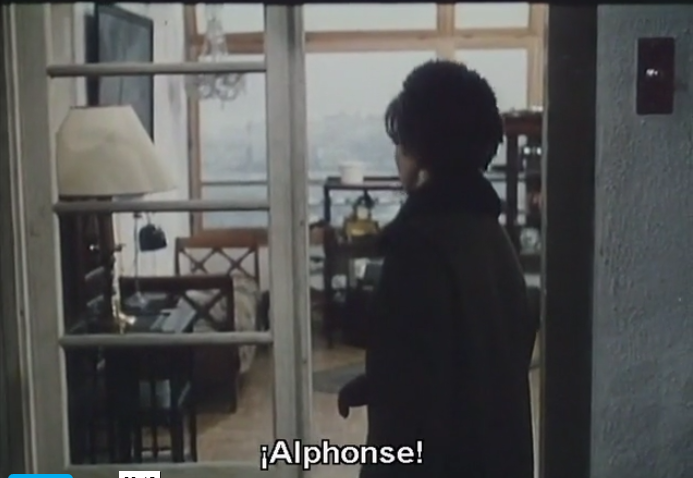
I know I saw Alain Resnais’s Muriel before this afternoon’s revelatory screening at the TIFF Lightbox. But that would have been around 1984 - yes, 35 years ago - in Bart Testa’s auterist Personal Visions film course at U of T, which I was auditing, having already taken it a year before with someone else. I remember almost nothing from it, and I certainly don’t remember liking it. I was probably too fixated on Marienbad, Hiroshima and Night and Fog to actually get that this was possibly his best film. I certainly didn’t think of it as was one of the best films I had ever seen, but I felt that very strongly today.
The TIFF Cinematheque programmer, James Quandt, agrees. “The purest expression of Resnais' central theme — how the present is the prisoner of the past, can never elude its snares — Muriel is singled out by many critics (correctly!) as the director's masterpiece: Jean-Louis Comolli called it "Resnais' most beautiful film," and Godard loved it so much he featured its poster on a wall in Two or Three Things I Know About Her. A middle-aged widow (Delphine Seyrig) living in an antique-stuffed apartment in Boulogne summons her ex-lover (Jean-Pierre Kérien) from Paris. As she attempts to recapture the (illusory) happiness of their past, her stepson (Jean-Baptiste Thierrée) is driven to violence in a futile attempt to extinguish the memory of his actions as a soldier in the Algerian War. Filmed with what has been called "hallucinatory realism," scored with unnerving songs by German composer Hans Werner Henze, and acted with stylized intensity by Seyrig, Muriel" surpasses [the] better-known Last Year at Marienbad and Hiroshima mon amour … a subtle, precise, and wrenching film" (Dave Kehr, Chicago Reader).”
This is a beautiful film to watch The shooting is impeccable, and the cutting makes the best use of jump cuts I may have ever seen. The streets, architecture, sets, props, and costumes are precisely deployed. And yet, the film is borders on impossible to watch, given the relentless alienation of the characters. Everyone seems to be in denial, dishonest and manipulative. Everyone seems unlikable to me, although it’s hard for anyone played by Delphine Seyrig (Hélène) to be entirely unlikable.
Bernard, Hélène’s stepson, is creepy, possessed by his memories of “Muriel” (I’ll leave it at that), but the big surprise for me today is that he makes home movies throughout the film: home movies of the war, home movies of the present violence, etc. I don’t remember this at all, and it is a very useful feature for me given a big project I’m working on.
That’s not the only reason I loved this film, but it’s definitely one of them.


#40: Bill Shedden on his 84th birthday
75 random memories of great times with my dad.
June 17, 2012; revised May 5, 2019
I first posted this on Father’s Day, 2012. That’s almost 7 years ago, so I decided to revise it a bit and make it 84 random memories, on the occasion of my father’s 84th birthday.
1. Going to Expo 67. Riding a ferris wheel with my dad, or maybe checking out some multi-channel film installations. My first memory in life, I think.
2. Driving around downtown taking a look at my father's old neighbourhoods - Palmerston, Fallis and Landsdowne - and developing a fantasy about living in neighbourhoods like that (which I ended up doing for the past 35 years).
3. Climbing granite rocks in Killbear Park.
4. Going to the dump in Killbear Park.
5. Washing ourselves with mud in Killbear Park.
6. Getting fake tattoos with magic markers in Killbear Park, modelled on my father's own that he acquired in his navy years in the 1950s.
7. Fishing in Grundy.
8. Pinery.
9. Serpent's Mound.
10. A road trip to Florida in 1968, involving camping in Kentucky, Tennessee, Georgia and Florida, many welcome rest stops (complimentary OJ in Florida, but Coca-Cola in Georgia of course).
11. Riding shotgun in the various parades in his Model A Ford pick-up.
12. Going downtown to the University Theatre to watch Apocalypse Now when it came out.
13. Playing a trivia game in our little white (rental) cottage in Eastham, Cape Cod.
14. Arriving in hippy dippy, and very gay, Provincetown for our first time in the early 70s.
15. Going to the army/navy surplus store in Provincetown. Having my dad explain what all the stuff was.
16. Various decks, tool sheds, saunas, swimming pools, walkways, gardens, fireplaces, shelving units, and other household features that would seem to just show up.
17. An odd assortment of part-time jobs and businesses that, though different from anything I would ever do, helped ensure I had a driven work ethic, and an entrepreneurial sensibility.
18. Climbing the waterfalls in Ocho Rios.
19. Eating crepes in Yorkville, when it was still just barely a counter-culture destination.
20. Going to Sam's and A&A's on Yonge St., approximately annually. Buying a serious stack of 45s there once to populate our new jukebox, a big old, German beast of a machine.
21. Converting said jukebox from one designed for 78s to one that would play 45s. Imperfect but charming results.
22. Minis, MGAs, MGBs, BSAs.
23. A Falcon, replaced by a big black Chevy (a retired OPP car), and then our first ever new car, a Datsun (before it became the generic, anemic "Nissan") station wagon, considered a compact car at the time. Replacing that with a gigantic Plymouth Satellite Sebring, our first new car ever, and then replacing that with a Dodge Omni, my parents' worst car ever.
24. Driving to Halifax in that Datsun when my mother's aunt (her primary caregiver) died. An earlier family trip to Halifax on the train occurred earlier but I don't remember it.
25. Staying home with my dad while my mother and sisters went off to church and Catechism (sadly, the party was over for me when I turned six, when I too had to be saved).
26. Watching Red Skelton.
27. Watching Ed Sullivan.
28. Watching The Birds.
29. Going to Evita. Not my favourite musical by a long shot, but it was still a fun experience.
30. Seeing Sinatra at the CNE. It was a wretched evening, and I think my dad hated it, but still...
31. Open face, broiled Kraft slices on Wonder bread.
32. Tobogganing.
33. Arriving home one day to one of those newfangled "coloured TV" sets, complete with UHF, so that we could watch all those reruns on channel 29, of mostly black-and-white 50s shows).
34. Coming home one day to a fabulous, vintage jukebox (Tommy-style), thus making it impossible for me to like anything even vaguely electronic or digital in the games realm.
35. Picking up the Christmas trees (once we stopped using the artificial one).
36. Feeding massive amounts of catnip to our cat Walter, as well as our neighbor's, Tiger.
37. Going downtown to check out this insanely-OCD model railroad (HO) installation, and not being entirely bummed that we weren't going to turn our basement into such a thing.
38. Getting my first gun, one my dad crafted out of a spare piece of plywood and a broom handle. Just because I loved this gun, and the cowboy revolvers that I got a year or two later, doesn't mean I would ever give a kid a gun though.
39. His raccoon coat.
40. Taking the family to Earthquake (in Sensurround!) at the Fairlawn theatre the first New Year's of his sobriety. Great night. Terrible film.
41. Taking us to see Chinatown at a drive-in in Welfleet, Cape Cod, when I was 10 or 11. This masterpiece was preceded by The Big Bus, perhaps inspiring me to become a film programmer so that no one would ever have to suffer such insanity. My first ever drive-in and a life-changer it was.
42. Same drive-in two or three years later to see Star Wars, another life-changing moment, the only difference being that Chinatown still has huge power over me. I assume dad didn't know how important those trips to the drive-in would be though. (PS: the second film on the Star Wars bill was Carry On, On the Bus or something like that - bizarre.)
43. Fudganas and Banana Supremes at HoJos, especially the night where we just ended up in Niagara Falls, on a whim, for said treats.
44. Hanging out on Roy Brown's boat.
45. Chilling in Bill Furness's "bunker", hearing his authentic, WW II banter, and checking out the fascinating, spooky paraphernalia.
46. Model A picnics.
47. Learning how to use the Gestetner 26 and 66 printers in our basement, so that I could produce fanzines and help my dad with the Model A newsletter.
48. The Model A expedition to Dearborn (50 years of the Model A), Ford's headquarters, and then to Arlington, Virginia and Washington, D.C. A tough trip in a 1928 sedan at times, but a great experience.
49. Popcorn.
50. Making our own peppermint taffy.
51. Playboy playmate centrefolds, and stacks of Playboys that I honestly did enjoy for the interviews and other articles. Which doesn't mean I didn't like the airbrushed breasts.
52. The antique phones.
52. The light fixtures made from Lily cups.
53. A love of cats, shared with the rest of the family, sometimes to the point of insanity.
54. The back-to-school, George Brown College days.
55. Paint by numbers.
56. Making tables out of industrial wire spools, featuring varnished, vintage ads.
57. Vintage signage and other hardware.
58. Solar heating experiments and composting decades before anyone else seemed to care (and he's not a hippy).
59. St. Marie-among-the-Hurons.
60. Waffles at the old Eaton's Annex.
61. Converting our 1960s German stereo console into components that I could use instead, integrating my fabulous Fisher double cassette deck into the mix.
62. Making stilts.
63. Making clackers.
64. Sam, our dog (ever so briefly).
65. Making 8mm films, and borrowing a projector from the public library so we could occasionally watch them (they jumped, as the film sat precariously in the gate, but that was part of the charm).
66. Having the cleanest swimming pool in Scarborough, I think.
67. A day trip to Cambridge during our last trip together to Cape Cod, in order to indulge me at the height of my bookwormish days (1988?).
68. Fish and chips.
69. Flying kites on the beach in Cape Cod.
70. Making kites.
71. Short wave radios.
72. Mary Hartman, Mary Hartman.
73. Black licorice.
74. La-Z-Boy chairs.
75. The Whizzer
76. Refridgerated Solarcaine
77. Stacking firewood
78. Tobogganing at behind Ceaderbrea
79. Christmas Shopping at Scarborough Town Centre on December 24th
80. The biggest bon fires in the provincial park
81. Singing Weavers songs on long car trips
82. Ernie, the cat, R.I.P.
83. Doodle Art, particularly “Progress” and “Jungle.”
84. Spending time with, quite regularly, with Bill and friends of that other Bill.
#39: Record Store Day (30 Great Record Stores)
I haven’t really participated in recent years, but I still have a deep fondness for record stores. I remembered 30 of them fondly back in 2014.
30 Record Stores for Record Store Day (Facebook, April 19, 2014)
From 1969, or thereabouts, until 2005, or thereabouts, I spent as much time as I could in record stores. They were the most sacred places in the world, the places where I learned everything about music, made purchases that changed my life more times than any other action, and sometimes even made friends.
These are the ones that changed me the most, kind of in order. Some of them were obviously fantastic, while others were comparatively lame, but sometimes the latter served as my emotional lifeline anyway.
From 1969, or thereabouts, until 2005, or thereabouts, I spent as much time as I could in record stores. They were the most sacred places in the world, the places where I learned everything about music, made purchases that changed my life more times than any other action, and sometimes even made friends.
These are the ones that changed me the most, kind of in order. Some of them were obviously fantastic, while others were comparatively lame, but sometimes the latter served as my emotional lifeline anyway.
1. Sam's Yonge St. HQ - The first record store I ever went to. We’d go as a family maybe once a year, buying mostly 45s. My favourite place in the whole world for a few decades.
2. Sam's Cedar Heights Plaza in Scarborough - Saturday mornings I’d ride my bike from my house on Ivy Green down this street that we still have to name every time we’re there - “Hiscock” - to go to Sam’s for their 9am, $1.99 special.
3. Vortex, Dundas & Church (original location AFTER the Augusta St. location in Kensington that I think I missed). Bert Myers sold our fanzines, This Tiny Donkey Looks Rather Lost and The Hanged Men Dance, in this tiny store where I traded in a hundred records or so, and bought closer to a thousand. I also bought cassette bootlegs of live shows here, including three very memorable ones: Patti Smith, Richard Hell and John Cale. One of the guys who worked there did this as a sideline and Bert let him keep all the money to help out his situation.
4. Kop's (when it was mostly 45s and in its location much farther west on Queen St.)
5. A&A's Yonge St. HQ. Lisa and Kim worked there. The 45s selection was pretty decent, and they had a “BASS”, so we were always there getting concert tickets.
6. Records on Wheels Yonge St. - Rob Bowman. Steve Kane. Carla MacDonald. Debra Lary. Tickets - lots of tickets. The best place to get tickets. Bootlegs. Picture sleeve 45s - lots. Zines.
7. Record Peddler - Ben Hoffman, and his long hair. Punk Brian (Youth Youth Youth). Some shitty intimidating times, but eventually it became a bit of a comfort zone. Buttons! Lots of buttons. Tickets. Zines. Melody Maker. NME. New York Rocker. Probably the best punk and new wave and marginal music selection ever (?) in Toronto. A regular hangout for me and various friends, especially Sara, Grant, Dave Keyes.
8. Star Records (also Eglinton Ave. E. in Scarborough) - Star Records, the same chain as the famed store from Oshawa, was a one of the few places you could buy bootlegs in Toronto. There, RoW on Yonge and the Record Peddler. Managed by my friend Dave Curtis for many years.
9. Vortex - Queen St. W. & Portland upstairs. I think they merged with Kop’s by then, or something like that? I know I continued my buying and selling here well into my grad school days.
10. Peter Dunn’s Vinyl Museum - bought many of my Scott Walker, Walker Brothers and Love records at the Yonge St. location.
11. The Disc Shoppe (or Discus?) - Super crappy record store in Cedarbrae Mall in Scarborough. Still, it was one of the two places I’d go to pick up my weekly CHUM Chart, and I frequently bought singles and K-Tel albums there while my mother was off at Woolworth or Zellers. Right across from “Signor Marco Pizza”, where I first enjoyed pizza (as bad a pizzeria as this was a record store, but culture happens where it happens).
12. Rotate This - saw bands like Sloan (I think?) play there, or maybe I’m misremembering. Glad it emerged, even as I was starting to buy fewer records.
13. Zounds (Eglinton Ave. E. in Scarborough) - speaking of Lisa Godfrey and speaking of BASS (see A&A's above), this OK record store often found me lining up to get concert tickets, though sometimes Lisa helped me avoid that chore.
14. Sonic Boom - I go in to buy 33 1/3 books, t-shirts and just to look around. I’m not a record or CD buyer anymore, but I’m glad there is still sacred ground for those who are. I generally go to the big one on Bathurst, but happy to swing by the Kensington location from time to time.
15. She Said Boom - I tend to buy books there occasionally, not CDs or LPs, but feel warm and cozy knowing that great used record stores still exist. More of a College St. thing for me, but I like the Roncy store too.
16. Driftwood - Queen St. W. Kind of nondescript. Still managed to buy a hundred or so great records there over the years, usually while doing the rounds of other record stores and bookstores. Grew out of Round Records at Bloor & Bay (where Holt Renfrew is), but I may have missed that entirely.
17. Ernest Tubb’s Record Shop - Nashville. Was tempted to buy many 8-Track recordings, still in their plastic, as well as Johnny Cash reading the New Testament.
18. HMV Yonge St. - For a few brief years in the early 90s they had great selection, great prices (all those $3.33 specials), and it was bright and fun. I would go from loving it to hating it. Sam’s still generally had a better selection, so I’d usually end up going to both.
19. An incredible used record store in Ann Arbor where I bought a shitload of blues, jazz, “serious rock” and other fine matter in 1989.
20. Lunch for Your Ears - New York City, late 1980s, purchased some Minimalist and guitar noise recordings. Tiny but great place.
21. Tower Records HQ in NYC in their heyday.
22. The Jazz and Blues Record Store or whatever it’s called in Chicago, before it got forlorn and depressing.
23. A&A’s, Scarborough Town Centre - met Gord Cumming there. My sister’s friend Rosemary worked there (I think that was her name). She dated Ivar Hamilton from CFNY, I think.
24. Soundscapes - I am one of those people who would be happy to own everything that Soundscapes sells.
25. Vortex - Yonge & Eglinton. Still there, right?
26. Around Again - on Baldwin. There forever. I bought and sold my copy of LaMonte Young’s record there. Sold the best stuff I had before moving, and just generally found it a mellow, peaceful place to sit with music for an hour or two on weekends.
27. Cheap Thrills on Yonge St. - the first used record store I ever went to maybe?
28. Pandemonium
29. Paradise Bound
30. Don's Discs (Queen & Landsdowne - can't remember when it closed)
#38: This Tiny Donkey Looks Rather Lost + The Hanged Men Dance
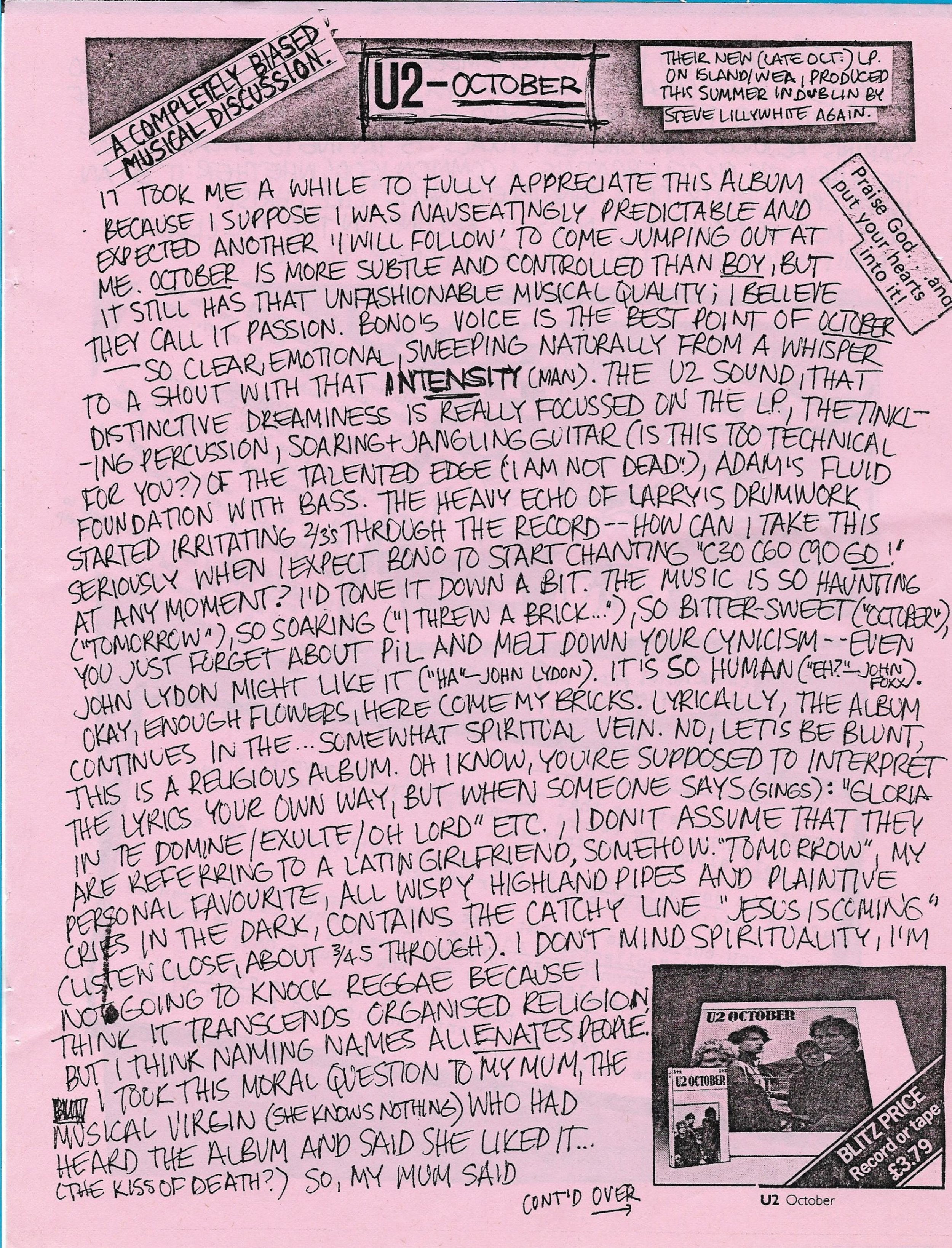
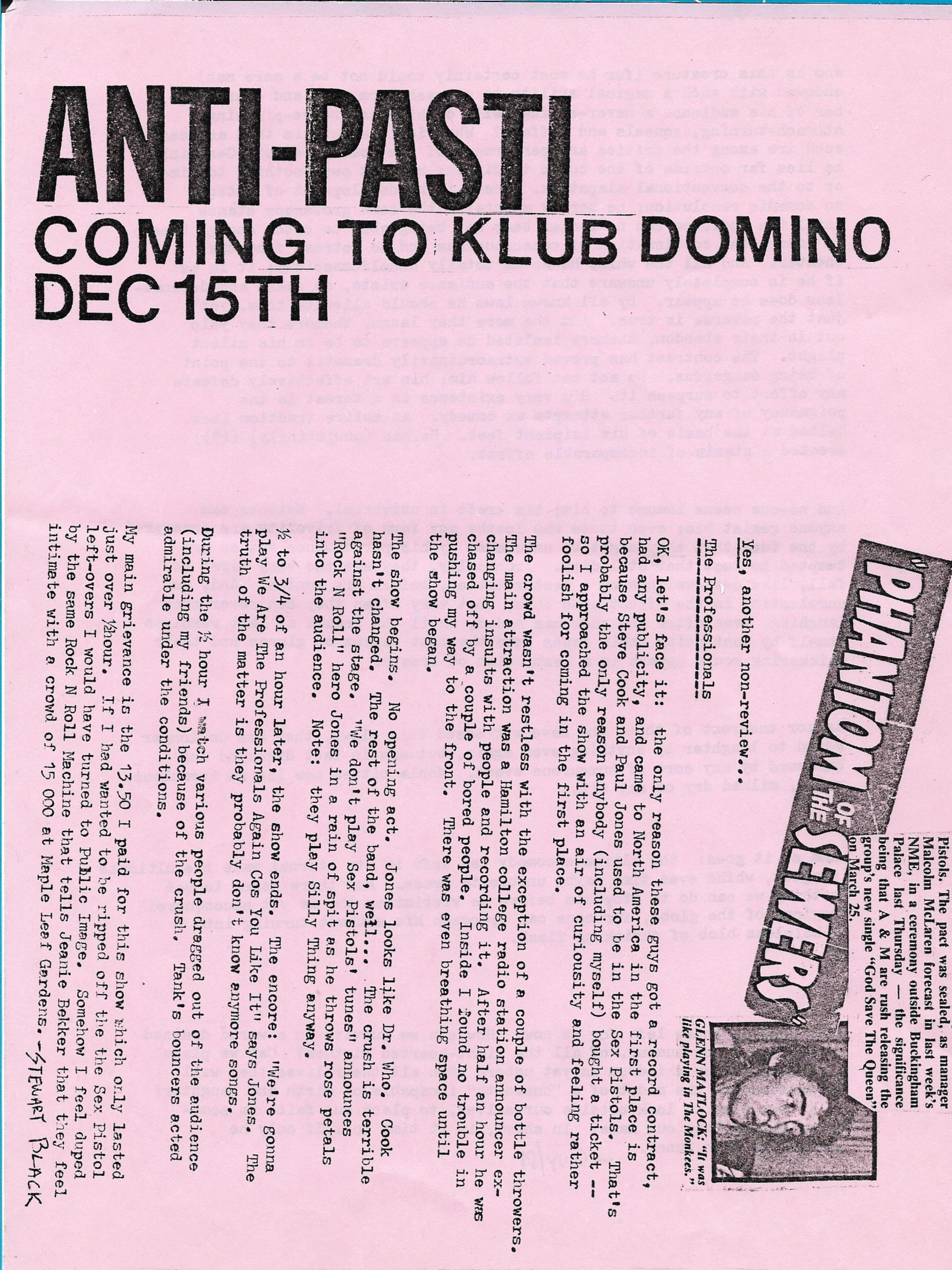
This Tiny Donkey Looks Rather Lost, “Fetus Issue,” December, 1981 (I think). Edited by Lisa Godfrey with Jim Shedden. This link will give you the whole PDF to the first issue of this zine. I took over after the first issue, to be joined by Sara Heinonen (“Sara Bellum”) for a while, and often aided by Dave Keyes.
The zine became The Hanged Men Dance, and then bounced back to This Tiny Donkey, etc. etc.






#37: Nirvana
Kurt Cobain left us on April 5, 1994. I remembered where I was (sort of): sitting at the bar of either John's Italian Cafe or Cafe le Gaffe on Baldwin St.
A number of years later, "Smells Like Teen Spirit" would become one of my 1000 Songs entries, and a very thoughtful discussion followed, which would be continued sporadically in the months and years to come.
You can still find it in the FB Group, but the entire text follows as well: https://www.facebook.com/notes/1000-songs/song-192-smells-like-teen-spirit/10150228405286451/
Song #192: Smells Like Teen Spirit
By Jim Shedden on Monday, July 4, 2011 at 10:58 PM
Jim Shedden
1000 Songs in 1000 Days
September 2, 2008
Song #192: “Smells Like Teen Spirit.” Nirvana, Nevermind, 1991.
Sometimes I feel so hopelessly unoriginal.
You know my story. Big pop and rock music fan from an early age, up until the early 1980s when, with few exceptions, I just shut off, owing to my perception that music had gone completely to hell. For me, 1984 was Depeche Mode, Frankie Goes to Hollywood, Duran Duran, Wham!, The Bangles, a Meat Loaf comeback, Skinny Puppy, Banarama, Gary Numan, Spandau Ballet, Simple Minds, Hall & Oates (not the good stuff), Dead Can Dance, Talk Talk, The Thompson Twins, Alphaville, and on it goes. Tired releases by Foreigner, Styx, Don Henley, Nazareth, Toto, Donna Summer, Chicago (17). I ignored the fact that REM, Husker Du, the Meat Puppets, Stevie Ray Vaughan, Kevin Ayers, the Minutemen, Nick Cave and the Bad Seeds, Flipper, The Smiths, Los Lobos, Robyn Hitchcock, The Gun Club, The Replacements, Robert Earl Keen, The Waterboys, Cyndi Lauper (yes, I like her), The The (yes, I like them), Roger Waters (mixed feelings), Prince (Purple Rain), Tina Turner (mixed feelings), Sonic Youth, Big Country, Talking Heads, The Fall. So it really wasn’t that bad, but that wasn’t my perception.
At the same time, it wasn’t 1979, or 1969, or 1959. I was convinced that it was over for me and I listened to anything but the new pop and rock for almost a decade. I got into jazz. I got into 20th century new music. I listened to Bach and Mozart. I got into Zappa. I got into world music.
As I thawed out in the early 1990s, I started hearing about “grunge”. Since the people I knew who were into this music also tended to be in punk – ie, especially the L.A. and D.C. scenes, and bands like Black Flag, Minor Threat, and the Dead Kennedys – I expected to hear that in the music. And it’s there, to a degree. But I immediately made the connections to Neil Young and Crazy Horse, 1970s “hard rock”, Led Zeppelin, and then The Dream Syndicate and the Gun Club, especially The Dream Syndicate, whose Days of Wine and Roses strikes me as the first “grunge” album.
But here’s where I’m 100% unoriginal. “Smells Like Teen Spirit” stopped me in my tracks. Got me back right back into rock music again. Gave me enormous hope that something brilliant was happening.
The funny thing is, album for album, 1984 might have been a far better year for music, but I’m actually fairly ignorant about most of the releases of 91. The tired releases by Queen, Sting, David Lee Roth, Rod Stewart, Gary Numan, Michael Bolton, The Rolling Stones, Pat Benatar, Siouxsie and the Banshees, Cher, Joe Walsh, Simple Minds, etc. continued. And there was a lot of hip hop, which I’ll get back to: 1991 was a high point in hip hop history. There was good stuff like Fugazi, Dinosaur Jr., REM, Elvis Costello, Green Day, Tom Petty (his first “solo” album), Sarah McLachlan, Soundgarden, but all in all it seems like it was a pretty meager year.
So Nevermind really, really sticks out.
It’s not the beginning of grunge, but the end of grunge. It’s the album where Nirvana moved away from Sub Pop and the self-marginalizing Seattle scene, a scene that really defined itself in 1986 but had its heyday, as an alternative scene 1989-1991.
Nevermind, and especially the hit “Smells Like Teen Spirit”, weren’t “alternative” because it had too much appeal, it struck a chord with the mainstream. “Teen Spirit” was the song of the summer of 1992.
The song was written by Cobain and Dave Grohl (and also credited to Krist Novoselic, after his significant contributions to the rhythmic counterpoint of the song) and produced by Butch Vig. Cobain had admired his work for Killdozer and wanted to sound as heavy as them, and they pulled it off. Cobain has also credited the Pixies as an influence on this song: “We used their sense of dynamics, being soft and quiet and then loud and hard.” I’ll have to return to the Pixies, a band I missed the first time around because of my closed mind in the 1980s.
The song basically consists of four power chords – F5, Bflat5, Aflat5, Dflat5 – played by Cobain in a syncopated sixteenth note strum. That’s my mind of song. Add to that that the chords were “double-tracked”. I can’t describe what happens technically any more than that. I will say that there’s an incredible drama created by the unpredictable presence and absence of the chords, the occasional suspension of the trajectory of the song, the alteration between quiet verses with lyrical guitar and Big Ass Guitar Chords. It all ends in Cobain’s strained voice singing “a denial” over and over again, finally closing with guitar feedback.
I was into Nirvana from that moment in for almost a decade. I like almost all their other songs, admittedly the better known cuts like “Rape Me” and “Heart-Shaped Box” the most. I also really like MTV Unplugged in New York, especially their covers of two favorite songs of mine, “The Man Who Sold the World” and “Where Did You Sleep Last Night?”.
Mostly I’m grateful to Nirvana, though, for being a catalyst in me opening my mind and my ears again back in 1991.over a year ago · Delete Pos
Alan Zweig
It was a great song. I'm glad you didn't include the lyrics because I never had a clue what the song was about and I still don't. I saw some "behind the music" type doc recently where they explained the origins of the song but I quickly forgot it.
And it's time you stop beating yourself up about missing this or that period of rock music. That totally makes sense. To be honest, I think what makes less sense on some level, is that you ever came back.
On some level, you're not supposed to. You're supposed to grow up, right?
So if your story were, you grew up, you moved on, and then you heard this amazing song and it drew you back and once you were back, you could never totally get away again, that would be a lovely story.
As I write this, I'm going through a whole bunch of recently acquired "alternative rock/indie etc" stuff and maybe it's the road pavers outside my door driving me nuts but none of it is working for me today and I'm wondering whether this might finally be the end for me.
Dramatic maybe. Or maybe not. Sometimes I do think that you can get to the point where you've heard too much or seen too much and you have to distract yourself in new ways.
Or just stop completely paying attention.
Then again, somebody plays you something as great as this song and you'll probably be back.
I'm making a circular argument, aren't I?
Well then all I'm going to say is that it's interesting for me to see you trying to explain the song structure here.
As an aside, do you know that when they make a trough in your street, they don't just pave over the trough. First they completely remove the rest of the street's surface and then they repave the whole thing.
On the day they remove the street's surface, you should be somewhere else.
But I digress.
The thrilling thing about this song is what you're calling those "big ass guitar chords".
I like his voice too. And I think Cobain was a great songwriter. Maybe Grohl too. And the thing, I think, that distinguished Nirvana songs from other grunge songs, was that Nirvana was, I guess, poppier.
Other grunge - I'm thinking of Soundgarden, certainly Alice in Chains - came from more of a heavy metal/blues rock place. Nirvana on the other hand, reminded me more of a new wave band.
Pop music with heavy guitar.
I think you could dispute that. Cobain said he liked Killdozer. Fine I'd say. But you AREN'T Killdozer (who for me, existed for one reason and one reason only, namely their brilliant cover of "I am I said".)
Writing about some of your songs here, I've come to realize that I have a pretty consistent - if somewhat indefensible - theory of pop music running in the back of my head.
There's folk music, there's pop music and then there's this other thing I don't know what to call because blues doesn't say it. Let's call it "heavy" music.
And all so-called rock music breaks down into folk music with loud guitars, pop music with loud guitars and then this third less melodic, less poppy thing with loud guitars.
I think I'm just typing to get the sound of roadbreakers out of my head. So I'd better go.
But yeah, the big ass guitar chords in that song were big ass enough to restore your faith in electric guitar. And if that's what they did, that only makes sense.over a year ago · · Report · Delete Post
Dan Bazuin
It's hard to imagine the impact of this song with out mentioning the video. It's one of a hand full of videos that made pop culture turn a corner. You get an almost perfect song, you got a vision of what life would be like in Grunge high school -sexy, smokey and loud ... it even gave you a picture of the school uniforms.
And over night the gods of flannel smiled down upon us and made Ben Hoffman look hip.over a year ago · · Report · Delete Post
Rick Campbell
First of all, what the hell is wrong with Dead Can Dance? I've got two beers in me and am feeling feisty!
Secondly, "....this might be the end for me." Alan Zweig Sept. 3, 2008.
But not until you tell me what you think of Fleet Foxes, the album, and also their Sun Giant EP. Then you can piss off if you want to. But I will hunt you down like a dog and play great music for you until you come back.
Blitz AKA Michael Kaler introduced me to Nirvana. I always thought it was before I moved to Vancouver, but he must have played Nevermind in Innis Pub on one of my visits back. Although, I distinctly remember him going to a club at Ossington and College to hear Nirvana, Soundgarden and Alice in Chains. I saw the band All (a terrific offshoot of Descendants) with him there. I can't remember the name of the venue. Maybe that was before Nevermind came out.
How strange to have my memory so wrong!
Anyway, I moved to the Pacific Northwest just as grunge became the big movement it did---Sept. 1990. And let me tell you, it is the closest I'll ever get to feeling like being in Swinging London. Only with the flannel instead of the paisley Edwardian thing. But that was great too. The thing was that all my clothes that I've pretty much worn (my style I should say) since around 1975----excluding when I want to make an impression in show business, which is what it's all about isn't it?----STUPENDOUSLY came back into fashion.
In short it was okay to dress like Neil Young. In fact, a lot of people were dressing like Neil Young again. This was very exciting for about four people. But I was one of those four people! It also proved my theory about musical trends. Could a Sex Pistols reunion tour "sell out" be far behind? NO! Beautiful. Check and mate.
But beyond all that crap was how much I loved the music of that scene. I loved Nirvana (who always sounded like The Beatles to me), I liked the Zeppelin/Sabbath/Crazy Horse panache of Pearl Jam, and the metalish tinge of Soundgarden. I liked the misanthropy of Mudhoney and the Doorsy dour of Screaming Trees. I thought "Rooster" by Alice in Chains was just what I needed the first time I heard it. And I still hear grunge in Queens of the Stone Age (and their affiliates) and many other bands today. Even Seattle's Fleet Foxes, who have about as much to do with grunge music as the poor, lovely Seattle pop band of the grunge period, The Posies did), remind me of what is at the heart of the Pacific Northwest scene cannot be replicated elsewhere. That DIY spirit. That sound of rainy winters and too much rain that I hear in all their music. I saw virtually everybody while I was there EXCEPT Nirvana.
I was also lucky enough to see The Pixies during this period. They opened for U2, when their Achtung Baby tour came to town the first time, the hockey arena tour, before the stadium Zooropa thing and the irony got to be too much. What a fantastic set The Pixies played. A nice healthy set too. Respect to U2 for that. I saw Kim Deal in Vancouver a couple of years later with The Breeders. "Cool As Kim Deal" is one of my favorite pop songs.
I was one of those who was genuinely upset and bereft when Cobain killed himself. I thought that In Utero was a masterpiece. I loved its uncompromising quality. As much as Butch Vig's production on Nevermind is stunning, I loved that Cobain stuck to his guns (sorry) and made that record. It was brave. And if you listen closely to "Serve the Servants", you can hear how much he was influenced by The Beatles. Just speed that song up a bit, add some polish, and it wouldn't be out of place on the Beatlemania album.
I remember the video for....oh god I can't remember the name of it, and I won't wikipedia now...the video where they're playing on an ersatz Ed Sullivan-type show better than "Teen Spirit". A wonderful song too. I remember Crazy Al Yankovic's superb parody of the "Teen Spirit" video better. That was the high water point of video. I doubt that Sarah MacLaughlan and many others would have had the careers they had without video. Now it's all so trivial and dull. I find it astonishing that much of the new music I still love I heard/saw for the first time on MuchMusic. Remember the death metal videos they'd show? IN THE AFTERNOON??
Nirvana were a superb trio. Great attitude. Great players. I truly regret not seeing them in 1993 at the PNE. Or earlier. I had a few chances. I was so happy that people were playing rock music again, or that , beyond hardcore, and straight edge, which I liked (thank you Blitz) there was something that spoke to me, back in the mainstream. Something less ideological. More universal.
The song itself remains awesome. Tori Amos' version is superb too, and strips the song bare of it's Pixie-construction to reveal a stunning piece of pop. I love her for recording it that way so we could see where Cobain is coming from. Cobain himself was a musicologist of the first order. Too bad we lost him, but I hear his spirit in the voices of some of the people who write for MOJO and on this site.
Pop and rock is better off for having had Nirvana. And that's all I can say without getting maudlin. Or maybe I did already. I'm going back to Fleet Foxes.
Rick Campbell
It occurred to me that perhaps my little note to Alan at the beginning there might be misconstrued. That it might not be seen as being written with warmth and yes, a little affection.
It was.
Alan Zweig
I meant finished in terms of keeping up with indie rock. I'm not quite finished keeping up with you and your joyous rants.over a year ago · · Report · Delete Post
Dan Bazuin
*Ben Hoffman is the legendary flannel clad gnome and owner of the Record Peddler, the first(?) punk new wave record store in T.O. I could never determine Ben's actual tastes, but he seemed to love Lemmy and co. I didn't make the connection at the time but Neil Young may have been his sartorial guru.over a year
Alan Zweig
Oh, you mentioned the Record Peddler. Hated that place.
HATED.
I can laugh about it now.over a year ago · · Report · Delete Post
Rick Campbell
I was not a fan of that place either. I really wanted to like it but never bought a single thing in there. Too cool for school.
And Alan, I know what you meant, which was why I mentioned Fleet Foxes which, if you haven't yet heard them, may get you back on the road. But you must do it old school. You must play their Sun Ginat EP in its entirety. You must play the eponymous album in its entirety. No sampling. No jumping away after the first minute and a half of a song.
Yeah, I can hear you now. "Don't lay your Establishment trip on me, old man."
I'm guessing but, happy thing day that we must ignore.over a year ago · · Report · Delete Post
Rick Campbell
Okay, the Ep is called Sun Giant, not Sun Gnat.
Sun Gnat. Good name for a band.over a year ago · · Report · Delete Post
Dan Bazuin
I'm curious, was that the queen street store, or college street store? I think I remember our first conversations were at the Queen street store. When Charlie started the bookstore, he shared a door with the Record Peddler and Ben Hoffman, one of the owners, was always good to us. He helped us import a book from Britain that paid the rent for 2 months. The store moved across the street and I joined up a year later as something of a casualty of the counter-culture and the counter-counter-culture(punk?) We were neighbors of the record peddler and did some import and bootleg business with them, but now, looking I back I realize that most of the staff were a pain in the ass. We also did business with Steve at Records on Wheels on Yonge Street. More fun.
I have the same knee jerk reaction when someone mentions the Funnel.
Rick McGinnis
The Peddler. The Funnel. Impulse magazine. The staff at the Rivoli. Toronto was such a friendly place, so full of welcoming people who needed to share.
It was all very intimidating for a naive working class kid from Mt. Dennis who'd barely seen a half dozen subtitled films in his life at that point. I'd never been to a store where people seemed to find my money distasteful before, or who handled their own stock as it passed over the counter like it was smeared with mucus.
I bought quite a few things from the Peddler, even briefly dated a girl who worked there, but I always felt depressed whenever I left the place. I hate to say it but I was actually kind of happy when it closed - one more miserable relic of a time when even the supposed outsiders let me feel like an outsider.
And yeah, I really liked the Nirvana record, too.over a year ago · · Report · Delete Post
Rick Campbell
Anyway...to rip off TS Eliot, this song proves that one can totally "get" the meaning of a great song without understanding the lyrics.
The other video I mentioned which, as it turns out, looks to be a parody of American Bandstand, is for the song "In Bloom".
I told MY favorite "Steve at Records on Wheels story" somewhere else on this site. That was a great era. I remember when that store first opened. It was if a prayer had been answered. When I go into She Said...Boom I'm reminded of those days.over a year ago · · Report · Delete Post
Steve Campbell
At the time that grunge was ruling the world, which effectively came from this record, I was turning it off in my brain. Naturally, I hadn't really "listened" to any of it. There were a couple of excellent bands in the UK, Blur and The Auteurs who had written coded two finger salutes to grunge mainly because they were pissed off that no-one was listening to bands in the Uk anymore. On top of that quite a few UK bands were trying to be either Nirvana or Pearl Jam or the Pixies and it was just PISSING US OFF!
This is an attitude that is easy to take the piss out of for lots of reasons all based on what happened next. What happened later was that Blur's best selling song was effectively a grunge song right down to the quiet loud structure. It was especially big in the US. I wonder if the band found that ironic. I know it only lasted one album (and really only existed in that one song). More importantly what happened next was Brit-pop and all its excesses creating some of the best but also some of the most execrable english pop music of the 90's.
But the reality was that in 1991, Britpop was just a twinkle in Noel Gallagher's eye as he roadied gear around for The Inspiral Carpets and danced to the fag end of the Stone Roses and The Happy Mondays down the Hacienda. Gallagher sick to death of American music permeating the English conciousness, quit his job, grabbed his brother and formed a british pop band; the only decent music around being made by a bunch of Creation bands (My Bloody Valentine, Primal Scream and Teenage Fanclub) that's where he ended up.
So yeah, without listening, I bought into the two fingers and avoided grunge for another year or so. Funnily enough it was not Nirvana that got me listening to America again but The Throwing Muses. They'd been around for years but I'd never really heard them before they appeared on my telly with some video off the Real Ramona (a great record). I was taken by misses Hersh and Donnelly and promptly went out and bought it. When I heard that Donnelly had left for some other band called The Breeders, I thought I'd better have a listen to them as well and Hey presto, this US rock scene sounds pretty good to me!
Obviously, exposure to Deal led me to The Pixies and then finally after reading something about Nirvana having ripped off the Pixies quiet loud schtick, I listened to Nevermind, probably a tape from my brother. During 1991 and 1992, I remember arguing with Rick about how grunge was too big RAWK sounding, how it had no nuance. By 1993, I was listening to Pearl Jam, The Smashing Pumpkins, the Screaming Trees and even giving the odd UK version of the music a chance (Bivouac).
Retrospectively, my shutting out this stuff for the best part of a year or more seems ridiculous to me, especially considering that I was not of an age where I would have expected to have such a closed mind to music (this wasn't 1979, it was fuckin 1992!) but anyway, pretty soon it was all over. By the time I was getting into it, grunge was going commercial and sounding less punk. Nevermind was the deathknell and Cobain knew it.
However, his ultimate reaction was as ludicrous as any other rock and roll suicide (although who knows what really was going on). The best reaction was In Utero and there was no reason why he couldn't have just carried on ignoring the business and playing what he wanted. But what do I know, fame is a bugger.
Finally, I just have to say that I couldn't agree more to the Beatle comparison. Back a long time ago I did a compilation tape where I placed About a Girl next to I'll Be Back. It seems pretty obvious to me. Nirvana were a pop/punk band. I don't know if Cobain had a problem with that (see In Bloom) but he did have a penchant for writing wonderful melodies.over a year ago · · Report · Delete Post
Mark Brownell
Round Records on Bloor was my favourite place.over a year ago · · Report · Delete Post
Rick Campbell
I still think it's funny that Blur's "grunge song" gets played at North American sporting events. I remember being at a hockey game and hearing it just when had come out and thinking Blur just beat Oasis. But I was wrong. America still couldn't care less about either one of them----well...maybe Oasis in some major centres.
But I think Blur's 13 album was more influenced by the then American Indie scene----bands like Pavement and Sebadoh. Wasn't it?over a year ago · · Report · Delete Post
Steve Campbell
Absolutely, that's why I say that their grunge moment only existed in that one song. I have to say that for me, Blur will always be a far more interesting band than Oasis. They constantly changed and demonstated a restlessness that was quite unique in the music scene in Britain at that time. Damon is quite the clever fellow (if still up his own ass so much that it must hurt) and still putting out interesting music.over a year ago
Sara Lewis
I'll preface my mumblings by stating outright that a) I'm wearing a Nirvana Bleach t-shirt and b) writing this in my dining room, directly beside the wall with two framed sepias of Kurt holding an infant Frances Bean.
I don't just love the 'DC, y'know. :)
Having said that, the last time I listened to Nevermind was...was....was...I can't remember. It's my least favourite Nirvana record, by far.
Bleach was released in 1989 and that's when I saw the band play at the Danforth Music Hall. They were a notoriously spotty live act, but that night, they were incredible. Kurt pretty much embodied every guy I ever liked in high school, and that attraction coupled with the fact that Bleach is an enormously hooky record cemented my forever-love for Nirvana.
Nirvana's a band that for me is all about the sum of its parts - unlike, KISS, say, which is all about Ace. Individually, they're decent musicians, and Dave's certainly gone to do some listenable (yet hardly groundbreaking) stuff with Foo Fighters. RS ranked Kurt in their Top 100 Guitarists of all time, and as much as I love Nirvana, I felt that was stretching it, to put it mildly.
When Teen Spirit came out, I felt a wave of disenchantment. To my ears, it sounded like the Bon Jovi of grunge. Slick, overproduced, and made for the masses. Even the band hated playing it.
I get why people like the song, and there are some decent tunes on Nevermind (I like Lithium the best, if only for the lyrics and the best loud-quiet-loud this side of The Pixies) but after the shadowy-grey raw shine of Bleach, Teen Spirit was a letdown for this fan.
Sara Lewis
One more thing:
The Peddler. The Funnel. Impulse magazine. The staff at the Rivoli. Toronto was such a friendly place, so full of welcoming people who needed to share.
It was all very intimidating for a naive working class kid from Mt. Dennis who'd barely seen a half dozen subtitled films in his life at that point. I'd never been to a store where people seemed to find my money distasteful before, or who handled their own stock as it passed over the counter like it was smeared with mucus.
I bought quite a few things from the Peddler, even briefly dated a girl who worked there, but I always felt depressed whenever I left the place. I hate to say it but I was actually kind of happy when it closed - one more miserable relic of a time when even the supposed outsiders let me feel like an outsider.
WORD!!!!!!
:)over a year ago · · Report · Delete Post
Sara Lewis
I lied.
One more thing:
I guess another reason why I dislike Teen Spirit so much is because of its utter cynicism. Kurt became a whining misanthrope, and it really bugged. The whole "I hate being a rock star" ethos rubs me the wrong way. Quit the band; go live in a cave. Pull a Syd Barrett. Who cares.
When a band does a complete 360 - from Bleach to Nevermind, goes with Butch Vig as a producer, and makes a radio friendly unit shifter (later the name of a track on In Utero - cynicism, thy name is Kurt Cobain) like Teen Spirit, it becomes difficult to take the self-involved "I never wanted this" angst all that seriously.
Can you tell that this record really pissed me off?
:)
over a year ago · · Report · Delete Post
Lorna Bell
I never liked this song, because I didn't understand what the lyrics were, something about a potato, and don't be stupid.
I thought it was cool when Paul Anka did a remake....then I could understand the lyrics, and I like his musical arrangement of the song....'runs and hides'.over a year ago · · Report · Delete Post
Jim Shedden
You know what I like about all of this? First, that people seem to be comfortable going back in the 1000 Songs time machine and putting some more meat on the bones. Makes me feel less anxious about posting the next one, though I will get to that tomorrow I promise.
More importantly: it seems clear to me now that, when it comes to pop music, we can completely agree on facts, and even on interpretation, but ultimately part ways where judgment is concerned. Reading your take on this song and this album, I have to agree with your observations. But I love the song and I love the album, but my situation was different and I have completely different associations I guess.
That's what I love about pop music.over a year ago · Delete Post
Rick Campbell
Maybe it's because I'm a fogey but I don't condemn people for their contradictions or else I'd have tossed out all my John Lennon albums years ago. I do, and this is probably wrong of me---life is too short--- condemn people like John Lydon who, (apparently) like to put on an act at other's expense, but I'm even getting over that now.
Nirvana gave me much pleasure. And I just heard Teen Spirit again and remembered everything I like about it and that record. And it was a getway song for a generation and that made me very happy (see above). And without it there would have never been an In Utero which is a magnificent record. Let's face it, whatever shit he was complaining about (and I don't think TS is about how hard it is to be a rock star AT ALL), he was troubled, made decisons on the fly like we all do and later regretted them, as we all do. He could have chosen his friends (and wife) more carefully.
Also, if someone comes out condeming the ethos of hair band culture or whatever and gets famous doing it then I have no problem with that either. Again I direct you to the man who died twenty-eight years ago today. One of the great hypocrite rock stars of all time.
But I wish he and Kurt were still here making their thrilling music.over a year ago
Sara Lewis
Having had to work with John Lydon on more than one occasion, I can assure you, it's no act.
TS isn't about how hard it is to be a rock star; the whining about hating rock stardom commenced after TS became a huge smash. I think it's hypocritical to make a shiny near-pop record like Nevermind, release it to the masses, and then whine about how you hate fame.
And Courtney's a decent songwriter, Rick. A lousy guitar player (they cut her sound more than once up at Molson Park it was so terrible) but a decent songwriter who inspired a lot of young women just like I once was to pick up a guitar and write a tune. I don't blame her for Kurt's unhappiness; I blame Kurt for sticking a needle in his arm the first, second, third, fourth time.
One thing we agree on here - In Utero's a magnificent record. Filled with self-loathing, and a difficult listen, but a magnificent record. But not nearly as great as Bleach
Don Busbridge
Dan TheMan
Dan TheMan Listened to it a zillion times. I was 18 in 1990. First time I heard it was Leaside High School upstairs boys bathrooms. Great song.
Alice Lenore Sellwood
Alice Lenore Sellwood I made the horrible mistake of using the term "world music" in a review I wrote last year. I got quite the unforgettable lecture from my Professor regarding its generalization. I guess it is a little vague. What "world music" were you listening to in those days?
Delete or hide this
LikeShow more reactions
· Reply · 7y
Rick Campbell
Rick Campbell World beat was the monicker when I worked at Sam's in the mid-90's.
Jim Shedden
Jim Shedden We knew world music and world beat were "problems" back in the day (hey, I even worked on the last WOMAD in a minor way) but it worked. Language is funny that way. If I said "world music" in the early 90s it could certainly mean any of African, Latin American, Indian, Caribbean, American regional (Tejano, Cajun, Bluegrass, etc.), Celtic... It was clear that it wasn't classical/renaissance/baroque, jazz (unless...), rock (unless...), pop (unless...). I don't use either term today, because everything is so much more available, so much less "exotic", and so much more integrated. This is all good.
#36: Jonas Mekas
Originally posted on Facebook on Jan 23, 2019, 6:03 PM.
Where would I be without Jonas Mekas? Jonas, who passed away today at age 96.
I first heard about him in Andy Warhol’s Popism: The Warhol 60s, which I read when I was 17. I read it because I loved the Velvet Underground, but took away from it this guy Mekas, who ran the Film-Makers’ Cinematheque in New York in the 1960s and showed Andy Warhol films. He was such “an academic” as Warhol said, that he even showed films by Stan Brakhage. So thanks for the leads, Andy, even if you were unappreciative of Stan.
I knew reading those passages about the underground film scene that it was my scene, and that Jonas was at the centre of it. This was all without seeing his films. I wouldn’t, in fact, see any Mekas till I was in the CFMDC preview booth on Portland and Kate and I watched Report From Millbrook, Hare Krishna and The Brig. I understood the context for Millbrook (Timothy Leary freaking that town out), but not yet The Brig (The Living Theatre, avant-garde performance that overlapped with Mekas and the underground film world).
I made a pilgrimage to New York in the late 80s and finally met Mekas. I spent a day at Anthology Film Archives, one of the more venerable and influential avant-garde film institutions that Jonas founded. My friend Mike Zryd was working and researching there, and I became a regular whenever I was in town. I also met Robert Haller helped make it all possible (strange but true). I bought every issue of Film Culture magazine, Jonas’s journal - no film periodical ever mattered as much to me. Brakhage’s Metaphors on Vision was a special issue, as was a great issue on Expanded Cinema designed by George Maciunas (that I show EVERYONE who comes to my office, because I still love it so much), and a Maciunas-designed Warhol issue.The Paul Sharits issue still confuses and excites me.
I also bought as many other books and periodicals as I could stuff in my luggage.
About six years after that I brought Jonas to Toronto for screenings organized by Innis (but at the AGO?), and to talk about Snow during the Michael Snow Project (and be interviewed for my Snow doc.). By then, as much as the Film-Makers’ Coop, Cinematheque, Anthology, Film Culture, Essential Cinema, etc. mattered and still matter deeply to me, Jonas’s films entered my psyche for good. There’s almost nothing that I like more than first-person, low-budget, poetic, diaristic, autobiographical films: Mekas is the ultimate. My favorites:
• Award Presentation to Andy Warhol (1964) • Walden (Diaries, Notes, and Sketches) (1969) - 3 hours
• Reminiscences of a Journey to Lithuania (1971–72)
• Lost, Lost, Lost (1976)
• He Stands in a Desert Counting the Seconds of His Life (1969/1985)
• Scenes from the Life of Andy Warhol (1990)
But, there are dozens of others that I’d be happy to see right this second.
#35: Cancer
Listen to your doctor.
Originally posted on Facebook on May 16, 211, 12;05AM
Listen to your doctor.
A few months ago I went to my doctor for a routine check-in. I take lithium and other bipolar meds that require my blood to be checked regularly. On the last go round, my lithium was low for some unexplained reason, but my doctor also noticed that my hemoglobin counts were low. A follow up blood test showed no change, and confirmed that my ferritin (iron) count was low.
I’ve been feeling progressively lousier for the last several months, and perhaps longer. Sleepy, foggy and unbalanced. It turns out I was anemic and, because I was am neither a vegetarian nor a woman, my doctor thought I should have a colonoscopy and a esophagogastroduodenoscopy (EGD) to see if anything was amiss internally: colitis, ulcers, etc.
I wasn’t showing any of the other external signs of any of these afflictions (losing blood for example), I was skeptical. The pharmacist that dispensed the ferrous gluconate to me suggested that maybe I was just having a hard time absorbing iron. I wanted to believe him but I’ve learned to discount my fear-voice, so I found an ounce of courage and made an appointment for the double scope procedure.
I was a little spacey from the Demerol - usually administered to anyone getting both procedures simultaneously - but I could hear that the doctor performing the colonoscopy found and removed a polyp, probably benign, but also found a very large, “messy” tumor: colorectal cancer.
A CT scan verified that the cancer had not spread. My surgeon advised me that with cancer good news is the absence of bad news. In other words, there’s always a small chance - very small - that the CT scan simply failed to detect some microscopic but deadly cancer cells.
On Tuesday I go into Mount Sinai to have the cancer removed. Tomorrow (Monday) will be spent fasting and purging, and then I have to be at the hospital on Tuesday morning at 6. I will then be anesthetized and operated on at 8am. If all goes well, I will be cancer free later that morning. A 7-10 day stay in the hospital will be followed by 6-12 weeks of convalescing at home. Sometime in July I hope to be back at work, and fully engaged in my usual activities.
While I’m in Mount Sinai, I’m able to have visitors (2 at a time) between 2pm and 8pm. Presumably by Thursday I should be ready. Then I’m happy to have visitors at home if I know in advance.
If things go less well, I may have to do chemotherapy for a well to eliminate residual cancer cells. There is that tiny chance that the cancer is worse than it seems, or that something will go wrong in surgery. But I am 100% optimistic that it’s going to turn out well. I’m not exactly looking forward to it, but I am looking forward to feeling better.
Because I listened to my doctor, I probably avoided a much worse and possibly fatal scenario. I’m grateful to our medical system, especially my doctor and the fantastic people at the Rudd Clinic, Princess Margaret and Mount Sinai, for their diagnoses, attention and sensitivity. I’m also grateful that I was somehow able to summon the guts to follow through on the scoping, that I was able to ignore my internal voices of fear and denial.
Thank you.
#34: "100 Canadian films that I really like"
Originally posted in the Toronto Film Review (http://torontofilmreview.blogspot.com/2017/12/100-best-canadian-films-jim-shedden.html?m=1&fbclid=IwAR1Qr5LTCS2oSLdnXvTQ-p6LuWQYv3j0p3RZF_DU6fre5VxVbXqOPOkzjlM) in on Christmas Day, December, 2017.
David D. asked me to make a personal list of “100 Best Canadian Films.” I’m really glad that the responses to this have been idiosyncratic, as my list won’t be like any of the others.
What follows is 100 Canadian films that I really like, 100 films that somehow touched me emotionally or intellectually. There is no attempt at balance: more than half of them are by experimental, avant-garde and artist filmmakers because that’s what I have liked about filmmaking from our country more than anything else. I haven’t divided the films by genre, however, because I’m going to pretend that, for today, it doesn’t matter. The films are organized by director. There is no hierarchy within the list of 100.
That being said, there is no attempt to put forward a definition of Canadian film other than films made by people who consider themselves Canadian. They weren’t all shot or finished here (nb.Wavelength as the most famous example in that regard). I’m interested in various theories and histories of Canadian film, and I am, in fact, working on one myself with a couple of other people, but ultimately I can’t abide by a theory of Canadian anything that excludes an interesting book, film, play, or movie made by a person born here or living here or otherwise considering themselves Canadian, because it doesn’t match a theoretical picture of “Canadian”.
I am including multiple films by a number of filmmakers. However, I do tend towards earlier films, ones that I saw two and three decades ago, like Peter Mettler’s student work. I don’t include any work by Elder after Consolations, and no work by Snow after So Is This. That doesn’t mean I don’t like the newer work, but the older work rewired by emotional infrastructure when I saw it, partly a testament to the work, and partly a testament to the openness of Jim Shedden the teenager.
There are, I’m sure dozens or even hundreds of interesting Canadian films that I simply haven’t seen yet. It’s obvious from people’s lists. I think the only lists where I’ve seen over 80% of the films are Mike Hoolboom’s and Stephen Broomer’s. Even there, I feel very far behind on the current crop of avant-garde films. There seems to be a lot of good work coming out faster than I can see it. I have yet to see Stephen Broomer’s Potamkin, for example, so it’s not on the list.
I am woefully ignorant of Québècois cinema. And I’m not happy about the overall diversity of the list that follows. It’s mostly white males. More work needs to be done, but this is where I’m at today. – J.S.
Jim Shedden’s 100 Best Canadian Films
1. Kay Armatage. Jill Johnson: October 1975, 1977.
2. Jennifer Baichwal. Manufactured Landscapes, 2006.
3. Michel Brault. Les ordres, 1974.
4. Donald Brittain and Don Owen. Ladies and Gentlemen, Mr. Leonard Cohen, 1966.
5. Stephen Broomer. Christ Church - St. James, 2011.
6. Stephen Broomer. Pepper’s Ghost, 2013.
7. Carl Brown. neige noire (w/ John Kamevaar), 2003.
8. Dan Browne. Alberta, 2014.
9. Colin Brunton. The Last Pogo, 1978/2008 + The Last Pogo Jumps Again, 2013.
10. Colin Campbell. Janus, 1973.
11. Jack Chambers. Circle, 1968-69.
12. Jack Chambers. Hart of London, 1968-70.
13. Shawn Chapelle. Natalie of Wood, 2001.
14. Christopher Chapman. A Place to Stand, 1967.
15. Janis Cole and Holly Dale. Hookers on Davie, 1984.
16. David Cronenberg. Rabid, 1977.
17. David Cronenberg. Videodrome, 1983.
18. David Cronenberg. The Dead Zone, 1983.
19. Keewatin Dewdney. Maltese Cross Movement.
20. Keewatin Dewdney. Wildwood Flower.
21. Atom Egoyan. Next of Kin, 1984.
22. Atom Egoyan. Krapp’s Last Tape, 2000.
23. Bruce Elder. The Art of Worldly Wisdom, 1979.
24. Bruce Elder. Illuminated Texts, 1983.
25. Bruce Elder. Lamentations: A Monument to the Dead World, 1985.
26. Bruce Elder. Consolations (Love is an Art of Time), 1988.
27. Clint Enns. A Knight’s Walk, 2014.
28. Graeme Ferguson. North of Superior, 1971.
29. Vera Frenkel. The Secret Life Of Cornelia Lumsden, 1979-80.
30. Chris Gallagher. Seeing in the Rain, 1981.
31. Chris Gallagher. Mirage, 1983.
32. John Greyson. Fig Trees, 2009.
33. Barry Greenwald. Taxi!, 1982.
34. Rick Hancox. Home for Christmas, 1978.
35. Phil Hoffman. On the Pond, 1978.
36. Phil Hoffman. Kitchener-Berlin, 1990.
37. Mike Hoolboom, Subway Stops, 2017 (installation).
38. Stanley Jackson, Wolf Koenig and Terence Macartney-Filgate. The Days Before Christmas, 1958.
39. Chris Kennedy. Towards a Vanishing Point, 2012.
40. Richard Kerr. Vesta Lunch, 1978.
41. Richard Kerr. Six Stories (On Land, Over Water), 1981.
42. Richard Kerr. Morning… Came a Day Early, 2016.
43. Alan King. A Married Couple, 1969.
44. John Kneller. Axis, 2013.
45. Wolf Koenig and Roman Kroitor. Glenn Gould On the Record + Glenn Gould Off the Record, 1959.
46. Eva Kolcze. All That is Solid, 2014.
47. Zacharias Kunuk and Norman Cohn. Nunavut (Our Land), 1994-95.
48. Helen Lee. Sally’s Beauty Spot, 1990.
49. Arthur Lipsett. Very Nice, Very Nice, 1961.
50. Keith Lock. Everything Everywhere Again Alive, 1975.
51. Brenda Longfellow. Shadow Maker: Gwendolyn McEwan, Poet, 1998.
52. Andrew Lugg. Front and Back, 1972.
53. Guy Maddin. My Winnipeg, 2007.
54. Ron Mann. Imagine the Sound, 1981.
55. Ron Mann. Poetry in Motion, 1982.
56. Ron Mann. Comic Book Confidential, 1988.
57. Ron Mann. The Twist, 1992.
58. Bruce McDonald. Knock! Knock!, 1985.
59. Bruce McDonald. Roadkill, 1989.
60. Normal McLaren. Pas de deux, 1968.
61. Lorne Marin. Rhapsody on a Theme from a House Movie, 1972.
62. Peter Mettler. Eastern Avenue, 1985.
63. Peter Mettler. Picture of Light, 1994.
64. David Morris. Super 8 Cycle.
65. Brian Nash. bp: Pushing the Boundaries, 1997.
66. Midi Onodera. The Bird Chirped on Bathurst, 1981.
67. Susan Oxtoby. January 15, 1991: Gulf War Diary, 1991.
68. Andrew J. Paterson. Basic Motel, 1980.
69. Madi Piller. Untitled, 1925, 2016.
70. Kathleen Pirrie Adams and Paula Gignac. Excess is What I Came For, 1994.
71. Sarah Polley. Stories We Tell, 2012.
72. John Porter. Wallpaper Films (18-film cycle for Fifth Column), 1983-1990.
73. John Price. View of then Falls from the Canadian Side, 2006.
74. Isabella Pruska-Oldenhof. This Town of Toronto, 2012.
75. Isabella Pruska-Oldenhof. Her Carnal Longings, 2003.
76. Al Razutis. 98.3Khz: (Bridge at Electrical Storm), 1973.
77. Steve Reinke. The Hundred Videos, 1989-1996.
78. David Rimmer. Variations on a Cellophane Wrapper, 1970.
79. David Rimmer. Bricolage, 1984.
80. Patricia Rozema. Into the Forest, 2015.
81. Tom Sherman. TVideo, 1980.
82. Michael Snow. Wavelength, 1967.
83. Michael Snow. Standard Time, 1967.
84. Michael Snow. <——>, 1969.
85. Michael Snow. La région centrale, 1971.
86. Michael Snow. Rameau’s Nephew by Diderot (thanx to Dennis Young) by Wilma Schoen, 1974.
87. Michael Snow. So is This, 1982.
88. Lisa Steele. Birthday Suit, 1974.
89. Barbara Sternberg. Transitions, 1982.
90. Barbara Sternberg. A Trilogy, 1985.
91. Barbara Sternberg. In the Nature of Things, 2011.
92. Leslie Supnet. In Still Time, 2015.
93. Gariné Torossian. Sparklehorse, 1999.
94. Joyce Wieland. Sailboat, 1967-68.
95. Joyce Wieland. Handtinting, 1967-68.
96. Joyce Wieland. Rat Life and Diet in North America, 1970.
97. Joyce Wieland. Pierre Vallières, 1972.
98. Joyce Wieland. A and B in Ontario (w/ Hollis Frampton), 1984.
99. Alan Zweig. Vinyl, 2000.
100. Alan Zweig. When Jews Were Funny, 2013.
#33: Scott Walker
This is mirrored in a blog post (500 People, Places and Things to Define Jim Shedden, (http://www.jimshedden.com/500-people-places-and-things-that-define-jim-shedden/), and in turn derived from a number of 1000 Songs entries I made between 2007 and 2014 (https://www.facebook.com/groups/1000Songs/).
If any artist belongs on this list, it’s Scott Walker. I was a fan the second I heard him, at age 18, and relentlessly so until the present day.
When I started my Facebook Group (which was really a collective blog) where we discussed music for 7+ years, Scott Walker’s “Seventh Seal” was the second song we discussed (the Allman Brothers’ You Don’t Love Me/Soul Survivor was #1 and, for context, Laurie Anderson’s “O Superman” was #3).
Song #2: "The Seventh Seal," by Scott Walker
1000 Songs in 1000 Days
October 4, 2007
Song #2: "The Seventh Seal." Scott Walker, from Scott 4, 1969.
"Anybody seen a knight pass this way
I saw him playing chess with Death yesterday
His crusade was a search for God and they say
It's been a along way to carry on." (Scott Walker, after Ingmar Berman)
I first heard "Seventh Seal" back in 1981 when I my friend Lisa Godfrey gave me Fire Escape in the Sky: The Godlike Genius of Scott Walker, a compilation of Walker's self-penned songs collected by Julian Cope (The Teardrop Explodes). I knew nothing about him, or even The Walker Brothers, his wildly successful pop balladeer group (especially their "Make it Easy on Yourself," and "The Sun Ain't Gonna Shine Anymore."). The album was very seductive, especially to my pretentious high school sensibility: a beautifully-packaged album of impeccable, madly idiosyncratic pop songs, thrust into an unsuspecting world by another madman of pop, Julian Cope. I think Lisa G ended up giving this to me, having a love-hate relationship with Cope, Walker and Brel. The "romanticism" of the work always borders on sentimentality at best, and misogyny at worst.
After the breakup of the Walker Brothers in the late 1960s, Scott Walker (really Scott Engel) started releasing strange solo albums featuring covers of much of the Jacques Brel catalogue, as translated by Mort Shuman (many of them were performed in the edgy musical Jacques Brel is Alive and Well and Living in Paris). Walker also began to record his own compositions which were strongly influenced by Brel, but which were much more eclectic in their influences, drawing on classical music, Broadway and the American songbook, Lieder and Gregorian chants.
The albums were dark, introverted, existential, and definitely not chart-toppers. The apotheosis of this period is Scott 4: if there is a masterpiece in this career, this is it. It was a tremendous bomb, however, and led to Walker reorienting his career around his British TV series, Scott, with covers of popular film tunes, ballads, country and western songs, showtunes, etc. I have a fondness for this material as Walker's voice remains beautiful and haunting, and his interpretations and arrangements are usually compelling.
Hearing the Godlike Genius compilation meant all my other musical obsessions had to take a back seat for at least a year: the Velvet Underground, Bowie, Eno, Dylan, Elvis Costello. I had to learn everything there was to know about Walker, get every recording there was to get (thank God for Peter Dunn's Vinyl Museum in Toronto!). And I had to meet any like-minded souls. There weren't many of us, but the late Steve Banks (Ministry of Love, Trans-Love Airways) was one; Marc de Guerre, a painter at the time and leader of the band Rongwrong, was another (though he reminded me that I introduced him to Walker’s music); Kathleen Robertson, as she was known at the time (Fifth Column) was another, though she definitely had a hard time with aforementioned misogyny (I remember her especially bristling at the interpretation of Brel's "The Girls and the Dogs").
Getting back to Scott 4 though. This is the first Walker album of entirely original compositions, each of them Big, Dramatic and Earnest, highly original and beautifully arranged. The song that stuck out for me from it was "The Seventh Seal". I played it more than any other song for a year, maybe two. It was my introduction to the films of Ingmar Bergman. The Seventh Seal became my favorite film for years, and I became obsessed with the theological problem of "the Silence of God". All of this from what might be, in retrospect, a mighty cheesy pop song. But, still, the hair on the back of my neck still stands up when I hear:
"My life's a vain pursuit of meaningless smiles
Why can't God touch me with a sign
Perhaps there's no one there answered the booth
And Death hid within his cloak and smiled"
There's a beautiful understated ghostly choir, Spanish-influenced horns and strings, and Scott's voice at its absolute hauntingliest best.
I can't decide, but I think it's a masterpiece of pop music composition and execution. Perhaps that's still my adolescent insanity talking though.
Song #202: Black Sheep Boy
1000 Songs in (more than) 1000 Days
September 26, 2008
Song #202: "Black Sheep Boy." Tim Hardin, Tim Hardin 2, 1967.
I came to this song, and to Tim Hardin, through Scott Walker. Two giants I wasn't expecting to encounter while still hoping for punk salvation.
My fall into Scott Walker started with his own songs as collected on the compilation Julian Cope put together, Fire Escape in the Sky: The Godlike Genius of Scott Walker. I was so taken with songs like "Seventh Seal" (#2 in this group), "Plastic Palace People", and "The Amorous Humphrey Plugg", that I can honestly say that all my ideas about what constituted great music were forever changed.
That infatuation opened up many doors. I soon got into the Jacques Brel covers by Scott Walker, themselves mostly derived from the incredible Eric Blau/Mort Shuman translations from the Jacques Brel Is Alive and Well and Living in Paris revue (I had the privilege of seeing the 2006 revival of it off Broadway). And I got into the Walker Brothers which, in turn, opened a lot of doors. And then, finally, I got into the final group of Scott Walker's music, the non-original, non-Walker Brothers, non-Brel material. What a fabulous hodge-podge!
"Wait Until Dark"
"The Impossible Dream"
"Will You Still Be Mine?"
"If"
"Ain't No Sunshine"
"Any Day Now"
"Sundown"
"Delta Dawn"
"The Look of Love"...
Songs by Kurt Weill, Charles Aznavour, Andre Previn, Kern/Hammerstein, Barry Mann, Morricone, Rota. And, starting with his first solo album, Scott, songs by Tim Hardin: "Lady Came from Baltimore", on that first album, and "Black Sheep Boy" on the second album. To the best of my knowledge, those are the only two Hardin covers that Walker recorded.
I love a lot of things about Scott Walker. With his own compositions it's one thing, because the unorthodox lyrics and arrangements, along with his haunting and powerful voice, stop me in my tracks still to this day. With the Brel material, there's a special alchemy of the sort you hear with Sinatra doing Cole Porter, Miles doing Gershwin, and Jennifer Warnes doing Leonard Cohen (thought I'd throw that in). But it's so fucking strange and perfect all at the same time.
I think Walker-does-Brel is almost equaled in these two Hardin songs, though Hardin, on the surface, was so much more conventional than Brel. After the Walker covers, I first heard Hardin himself shortly thereafter when my friend Barry made me a tape of his songs, or included the material on a compilation. Of course, then I realized that I already knew "Reason to Believe" by Rod Stewart, "If I Were a Carpenter" by Bobby Darin I guess (and now many others including the Four Tops and Johnny Cash), and even "Eulogy to Lenny Bruce" by Nico on Chelsea Girl.
So what is it about Tim Hardin? On the surface, he sounds like just another singer-songwriter, a Jackson Browne or Tim Buckley who didn't quite break through. Indeed, his output is uneven and his career was seriously damaged because of his anxiety and heroin addiction, which eventually killed him in 1976.
Because Alan recently wrote on Okkervil River, who put out an album called "Black Sheep Boy", inspired by the Hardin song, and including a cover of BSB, I thought I'd let the band's Will Sheff help to unravel the Tim Hardin question.
Some general remarks. The best Hardin material is on Tim Hardin 1 and Tim Hardin 2, though there are gems that you'll find on later releases. Listen to the Hardin versions. And then listen to the various covers over the years. It seems to me that most artists have picked up on a latent Hardin, the one that might have become Jackson Browne or Tim Buckley: big, full and showy. The other Hardin, the Hardin that comes across most obviously on his own recordings, is tentative, introverted and in considerable pain. That's the Okkervil's Hardin, as you can hear in their stunning cover of "Black Sheep Boy."
"Black Sheep Boy" is probably my favorite Hardin song. It seems to capture his sensibility and autobiography succinctly and poignantly. And, though Scott Walker's version is more polished, more extroverted and almost boisterous in comparison, it seems to have integrity as Walker himself is definitely a black sheep boy. Like Will Sheff.
Here's what Sheff has to say:
"These famous songs were my first exposure to Tim Hardin, and I knew them long before I knew his name. I knew them as sung by artists whom I mostly scoffed at, like Bobby Darin, with his hit versions of "If I Were a Carpenter" and "Lady Came from Baltimore," or the insufferable Rod Stewart crooning "Reason to Believe." When I heard Hardin's original versions, though, I found that they were nothing like those covers. Their arrangements were largely acoustic and elegantly simple, mixing the earnest earthiness of singer-songwriter folk with the sophistication of Cool Jazz artists like Chet Baker. And Hardin's voice - though possessed of a tremolo quality that's very different than what's in style today - was startlingly intimate, emotional, and direct. Hardin's music transported me to the same tender, warm little world that I associate with artists like Nick Drake and Van Morrison, and I realized that both of these artists were probably in fact deeply influenced by Hardin and his then-famous, jewel-like little songs. (These days, Van Morrison is a legendary figure and Nick Drake has achieved a posthumous fame as perhaps the definitive treasured cult songwriter, but Tim Hardin's revival has been slow in coming.)"
I agree with almost everything Sheff has to say. The invocation of Chet Baker. The comparisons with Drake and Morrison. The "intimate, emotional, and direct" voice. The "tremolo quality".
But I don't agree where the covers are concerned. I'm not a huge Bobby Darin fan (though if you have a copy of "Gyp the Cat" please e-mail it to me!), because of the homogeneous quality of his recordings. But I've loved so many of the covers. I mean, I really, really like Rod Stewart's "Reason to Believe" (hey Rick C. - wasn't that ACTUALLY the b-side to Maggie May, not I Know I'm Losing You)?
On the other hand, listening again to every Hardin recording I have, and then the covers, I came to the conclusion that his recordings were even more original, beautiful and terrifying that I ever remembered them being. And the covers are starting to fade from view for me. At least for a while.
I'm listening to "How Can We Hang on to a Dream" right now and I can hardly do anything else. I don't know why I never noticed the staggering greatness of this cut before.
Sheff goes on to say: "As I listened to Hardin's first two records over and over again, I also started having that weird proprietary feeling that I get towards Drake and Morrison: no matter how famous their music is, I have this odd and comforting sense that each time I cue up the record they're singing just for me. I became obsessed with Hardin's songs on Tim 1 and Tim 2, with the economy of their language, their swooping, lyrical string arrangements, the halting rhythms of Hardin's acoustic guitar playing. At first my favorite Tim Hardin song was "It'll Never Happen Again," then it was "Don't Make Promises," then it was "Misty Roses," but before long I became especially obsessed with the song "Black Sheep Boy," with its mysterious lyrics and darkly confident theme, which, as far as I could figure out, could be summed up thusly: 'I know I'm fucking up - leave me alone'."
WOW. The "odd and comforting sense taht each time I cue up the record they're singing just for me" describes how I feel with Hardin and Drake for sure, and maybe Astral Weeks Morrison. And maybe Scott Walker (doing his own material though).
So many great songs. I'm listening to "Simple Song of Freedom Right Now." "Red Balloon" was covered nicely by Rick Nelson, who had a Hardin-like quality to him, but with all the edges smoothed out. The Small Faces also covered it, and I'm posting a sub-adequate YouTube instance of it, but what the hell.This love song to heroin is somehow more convincing than the Velvet Underground:
Bought myself a red balloon and got a blue surprise -
hidden in the red balloon, the pinning of my eyes.
You took the love light from my eyes. Blue, blue surprise.
We met as friends and you were so easy to get to know,
but will we see each other again? Oh... I hope so.
If you want to keep digging through the Hardin material after the first two albums, you'll eventually get to the 1970 album,
"Suite for Susan Moore and Damion: We Are One, One, All in One." Sheff's take on this album is dead on: "Suite for Susan Moore and Damion - We Are - One. One, All In One is an unbearably sad record, and its sadness comes not from contemplation or from clear-eyed and hard-won wisdom but from how empty Hardin's pronouncements on romantic commitment and fatherly love ring. There's a sense of despair to the album, but deeper than that there's a sense of confusion, of disconnectedness, not just of Hardin from his message but of Hardin from his muse, and maybe from himself. It's one of the most enervating records I've ever heard, full of directionless melodies, words that seem vulnerable and sincere but that barely add up to anything, clumsy and vapid noodling, songs that strain to mean everything and mean less than nothing. Here and there, though, Hardin stumbles onto lyrics as great as in his heyday, as in "Magician," when the clouds seem to part and Hardin presents the listener with what's probably a warped self-portrait:
You should see the troubles that he goes through
to free his house from sin.
Magic wands and weapons together in a room..."
And I'll close with this last observation of Sheff's: "We too often associate drugs and heavy drinking with wild creativity, but in the case of Tim Hardin - and in many more cases than I think people realize - all of his great work was done in spite of drugs, not because of them. Drugs ruined Tim Hardin as an artist, and in many respects they ruined him as a human being. Still, as he makes clear in "Black Sheep Boy" and, as I guess is part of the point of our little record of the same name, that was his choice."
As I said, get Tim Hardin 1 and Tim Hardin 2. You will be blown away.
Song #277: Jackie
1000 Songs
April 12, 2009 (Easter)
Song #277: Jackie. Scott Walker, Scott 2, 1968.
I discussed my Scott Walker obsession back in entry #2, where I covered "The Seventh Seal" (http://www.facebook.com/group.php?gid=5553156450&ref=ts#/topic.php?uid=5553156450&topic=3811). I also discussed "Black Sheep Boy," a Tim Hardin song that he covered (http://www.facebook.com/group.php?gid=5553156450&ref=ts#/topic.php?uid=5553156450&topic=6145).
My Walker obsession was one of those where I spent years trying to convince people, through mixed tapes and rhetoric, why he was a genius. And, yet, as soon as I encountered other people, especially in the music media, making a similar case, my reaction was one of "he's not THAT great." Sound familiar to anyone out there? Bitter when Tom Waits became (sort of) popular? When Nick Drake and Elliott Smith songs started appearing in popular films?
Anyhow, these days I honestly do feel like Walker is a genius, but he's so idiosyncratic that I have very little fight left in me for anyone who might disagree. I'm not necessarily convinced myself.
After I borrowed my friend Lisa Godfrey's copy of Fire Escape in the Sky: The Godlike Genius of Scott Walker, I did what research I could on him (damn those pre-Web, pre-Wikipedia days!) and discovered that he was in a band called The Walker Brothers. I remember searching the bins of Vortex (Church and Dundas) and Peter Dunn's Vinyl Museum (Yonge St., near Sam's and A&A's). Before I found a Walker Brothers album, I found a copy of Scott 2, with a very odd cover that I haven't seen since, as if a discount label was reissuing it or something. It was a pretty exciting moment, though, revealing a context for the oddball original tunes that I loved so much, mixed in as they were with covers of Jacques Brel and other material from the pop music archive:
"Best of Both Worlds," not the Miley/Hannah song, but a Lulu classic that I'm sure I'll have to return to.
"Black Sheep Boy," previously discussed here.
"The Amorous Humphrey Plugg," one of my favorite Walker originals.
"Next," one of several Brel songs translated and intrepreted by Mort Shuman for the musical, Jacques Brel Is Alive and Well and Living in Paris.
"The Girls from the Streets," an exquisite Walker ("Engel") original.
"Plastic Palace People," a candidate for the best Walker song ever.
"Wait Until Dark," the Mancini song for the film.
"The Girls and the Dogs," a hilarious Brel/Jouannest/Shuman composition.
"Windows of the World," an under-rated Bacharach/David tune.
"The Bridge," one of Walker's only unsatisfying original compositions on these early solo albums.
"Come Next Spring," a song I don't know outside of Walker's version and Tony Bennett's, and it very much sounds like a Bennett song.
Wow, what an incredible album! This opened up so many doors for me. For one, I almost immediately managed to find every other Walker solo album. Second, I did get my hands on the Walker Brothers Make It Easy on Yourself, as well as a compilation that that I can find no reference to online. Most importantly, it got this iconoclastic punk to slow down and listen to music that I'd either dismissed before, or just didn't know about.
I didn't know about Jacques Brel, that's for sure. I was allergic then, and still mostly am, to pop music in any language but English. But I did read an article somewhere on Walker where they discussed the transformative effect Brel's music had for him. And, I was hooked very fast. I bought an actual Brel album. I stumbled on a very expensive Jacques Brel Is Alive and Well and Living in Paris at Sam's and quickly connected the dots. Walker's Brel was Brel via Mort Shuman, Eric Blau and company. I'd seen Pomus/Shuman on a bunch of singles that I owned, including "This Magic Moment." I was beginning to understanding something of the "parallel 60s" zeitgeist, and I was ready for it, having overdosed on the official 60s, at least for a while.
I also noticed Brel's songwriting credits on Sinatra's Reprise albums, including "I'm Not Afraid," and "If You Go Away," though these were not Shuman translations but Rod McKuen. I then heard the originals by Brel and my French was just good enough to realize that McKuen's translations were very loose, as were Shuman's (to a lesser extent). I figured out that "Le Moribund" was the original of "Seasons in the Sun," and realized that I'd been living with Brel for longer than I thought. It was all so fascinating, especially as even at that age I had assumed McKuen was the worst poet in the world. But even then I knew there was a big difference, in most cases, between what works on the printed page and what works as a pop song.
"Jackie" is a hoot. A combination of autobiography and fantasy, it's the story of a decadent chanson superstar who descends into a world of prostitutes and drugs and, worst of all, his own ego. Walker cranks up the volume on Brel's version, with larger and louder strings, and a quicker tempo. The lyrics are pretty faithful, but there are entirely new lines in the Shuman version. Brel's original would start something like "Even if one day at Knokke-Le-Zoute I become like I dread a singer for old ladies," whereas Shuman has it : "And if one day I should become/A singer with a Spanish bum/Who sings for women of great virtue."
These lines are fabulously ironic:
"And if I joined the social whirl
Became procurer of young girls
Then I would have my own bordellos
My record would be number one
And I'd sell records by the ton
All sung by many other fellows
My name would then be handsome Jack
And I'd sell boats of opium
Whisky that came from Twickenham
Authentic queers
And phony virgins."
I was still a romantic youth listening to this, hoping to find, in fact, a decadent hero I could emulate, a creative genius who indulged his hedonistic whims. But I also knew that was bullshit, and appreciated that comic relief in this song, especially in the context of Walker's very serious, very existential side. I can't say he was ever without a sense of humor, and that may have gone a long way to saving me from myself.
Scott 2, and especially this song, opened up all the doors I discussed above. But when I look on it now, I realize that it also opened up my interest in the American musical, be it Broadway or off-off in the case of the Brel piece, but also those crooners. I think my fascination with Sinatra began right around this time, and probably displaced the Walker obsession, given that, ultimately, there was more to Sinatra, more to sustain me over the years (and that obsession is going on 30 years).
A couple of years ago we were in New York, when Meredith was still 9 (or was it 8?). There were no big Broadway musicals that we wanted to take her to on that particular trip, so I bought tickets to the Jacques Brel is Alive and Well and Living Paris revival. I think she was fascinated, if a bit confused by the absence of obvious narrative. I was blown away at the chance to see it in something like the original context.
I'm listening to a Walker original right now, "Big Louise," and I'm positive we'll be coming back to him.
Song #278: The Amorous Humphrey Plugg
1000 Songs
April 13, 2009
Song #278: "The Amorous Humphrey Plugg." Scott Walker, Scott 2, 1968.
I started to reply to Alan and then thought, why not get another Scott Walker number in? "The Amorous Humphrey Plugg" is from the same album as "Jackie," Scott 2. Alan says he doesn't like the weird stuff, but prefers the ballads. This is one of the weird ballads. That's my favorite stuff my Scott Walker. I'm mostly into the 1960s and 1970s. Besides the Walker Brothers, that would be Scott 1-4, Scott Walker Sings Songs from His TV Series, Any Day Now, and The Moviegoer (I wish I had that whole album!). 1970's Till the Band Comes In is great, but already looks forward to the "weird stuff;" I like about half of it. And then Iike Stretch and We Had it All (the "Sundown" album). Then Walker doesn't release anything for a decade when he puts out Climate of Hunter, and then another decade before Tilt. Then Pola X OST (soundtrack to the film by Leos Carax), and most recently The Drift. The material from the past 20 years is hinted at in Nite Flights, the last Walker Brothers studio album.
I mostly love the pop covers, the Brel covers and especially the "Scott Engel" original material from Scott 1-4. I loved hearing all that material gathered together on the Fire Escape in the Sky compilation, but hearing it in the original context added a lot to it for me. The combination of the Brel/Shuman compositions"Jackie", "Next" and "The Girls and the Dogs," along with work by Bacharach, Tim Hardin and Henry Mancini, all mixed into the same gumbo with Engel originals like "The Girls from the Streets," "Plastic Palace People," and the song under discussion here was so disorienting, but so seductive, to my 18 year old ears back in 1981, that I still haven't recovered.
I did find music that I could compare it to, perhaps Jimmy Webb or Love or "Touch Me" by the Doors, but it mostly stood, and still stands, on its own. I had a high tolerance for his idiosyncratic and eclectic approach. Why NOT combine psychedelia, deep crooner vocals, lush orchestration, and romantic/surreal lyrics? Why wouldn't I like a song called "The Amorous Humphrey Plugg."
I knew it was a song by a loner, and I romanticized isolation then. Not that I actually was a loner but I craved solitude. I now see that as a form of mental illness, but there's no doubt that it has probably helped Walker produce his strange, imaginative songs. I know I've been quoting lyrics perhaps a little too often lately, but I must again in this case:
Hello Mr. Big Shot
Say, you're looking smart
I've had a tiring day
I took the kids along to the park
You've become a stranger
Every night with the boys
Got a new suit
That old smile's come back
And I kiss the children good night
And I slip away on the newly waxed floor
I've become a giant
I fill every street
I dwarf the rooftops
I hunchback the moon
Stars dance at my feet
Leave it all behind me
Screaming kids on my knee
And the telly swallowing me
And the neighbor shouting next door
And the subway trembling the roller-skate floor
I seek the buildings blazing with moonlight
In Channing Way
Their very eyes seem to suck you in with their laughter
They seem to say
You're all right now
So stop a while behind our smile
In Channing Way
It almost makes sense; and then it doesn't. But every single line evokes fantastic images in my mind, perhaps because Walker sings with such fabulous conviction, like when he's singing "The Impossible Dream," or perhaps because the strings (of the bowed variety and the plucked and strummed variety), the horns, the subtle percussive elements make it all seem so Meaningful.
When I first heard this, and "Plastic Palace People," and "Seventh Seal," I wondered why there wasn't more music like this. I think that more than anything I'd ever heard since those first magical moments with Johnny Cash, I was moved to rethink what I wanted from music, to reassess what I thought was good and cool. It led me down many incredible paths.
Despite all that, I was always a bit embarrassed introducing Walker to anyone. Evangelical, but embarrassed. I knew it was a huge stretch for those of us committed to punk and new wave, ska and reggae. I couldn't exactly invoke Julian Cope, because I didn't know anyone besides my girlfriend and me who liked them. As I said in the "Seventh Seal" entry, I was thrilled when I found a handful of people in Toronto who shared my passion. It’s hard to imagine this now that we’re more than 25 years into the Web, and more than a decade when everyone suddenly embraced social media in its various forms.
Good call, Alan, on Strangers When We Meet. As it has Kim Novak in it, I've seen it. I think that, and Sirk, are good analogies for Walker, as well as the obvious Bergman angle, and Sergio Leone.
"Mathilde" and "Next" are favorites (both Brel). "We Came Through," too, but I agree with the "The Old Man's Back Again:" something different is starting to happen there (both originals; "Seventh Seal" too).
It's possible that Walker's best work is overblown, almost, but then it's restrained. That may not be so true for "We Came Through."
By the way, the Brel musical opened in January, 1968, but Walker had already recorded some of the Shuman translations, including "Mathilde" on his debut solo album, Scott, in 1967.
Maybe there's room for one more Scott Walker. But, if you include "Black Sheep Boy," I guess we're already at 4. I really like "Will You Still Be Mine?" though.
1000 Songs
April 3, 2013
Song #762: "Amsterdam." Jacques Brel, 1964.
Speaking of Pin-Ups, Bowie's version of "Amsterdam" was recorded in 1970 but released as the b-side of "Sorrow" in 1973. Pin-ups was exclusively UK 60s covers so "Amsterdam" didn't qualify. Nor would it have for the sequel, had Bowie released it, of American 60s covers. "White Light/White Heat" would have been part of the sequel.
I first heard Bowie's version on Bowie Rare, which apparently came out in 1983. I could have sworn that I had it in high school but, as is so often the case, my memory is impressionistic rather than photographic.
I really love Bowie's take on this song, but it is really Bowie after Walker after Shuman after Brel.
I heard Scott Walker's version first. Like a number other Walker songs, it changed my notion of what pop music could do, and most importantly what it could do for me.
I first heard it on either Scott Walker Sings Jacques Brel (http://en.wikipedia.org/wiki/Scott_Walker_Sings_Jacques_Brel) or Scott (http://en.wikipedia.org/wiki/Scott_(album). I bought both albums in quick succession at Peter Dunn’s VInyl Museum in late 1981, shortly after my friend Lisa Godfrey gave me her copy of Fire Escape in the Sky: The Godlike Genius of Scott Walker (http://en.wikipedia.org/wiki/Fire_Escape_in_the_Sky:_The_Godlike_Genius_of_Scott_Walker). Hearing Fire Escape, the classic Julian Cope compilation of Walker’s solo compositions, changed my musical landscape more than almost anything. Discovering the Brel side on the compilation and the first solo album was too much to ask for. Walker’s own compositions were enough, but to be joined by “Jackie” (https://www.facebook.com/home.php?sk=group_5553156450&view=doc&id=10150226521116451 - where I also discussed the incredible album Scott 2); “Next,” “The Girls and the Dogs,” “If You Go Away” (https://www.facebook.com/home.php?sk=group_5553156450&view=doc&id=10150216585281451), “Funeral Tango”, “Mathilde”, “Amsterdam,” “Sons Of,” and “My Death”? Well that’s an insane set of compilation albums.
Scott revealed even more layers to Walker’s musical depth. “Montague Terrace (In Blue)”, “Such a Small Love” and “Little Things (That Keep Us Together), three of Walker’s own brilliant compositions, are joined by not only three intense Brel numbers (translated by Mort Shuman), “Mathilde,” “My Death” and “Amsterdam,” but also by Tim Hardin’s “The Lady Came from Baltimore,” “When Joanna Loved Me,” and other songs that feel like standards when Walker gets a hold of them.
Those three purchases led to finding Scott 2, Scott 3, Scott 4, Any Day Now, and Scott: Scott Walker Sings Songs from his TV Series. I went into that rabbit hole and never came out.
One day at Sam’s I came across the soundtrack to the off-Broadway musical, Jacques Brel Is Alive and Well and Living in Paris. I bought it. And then I got that that was where Walker found his translations and interpretations of Brel. The album blew me away and a whole new world opened up for me. (I had the great pleasure of seeing a performance of the revival in NY in 2006, along with Shellie and Meredith, who was 8 at the time but managed to derive something from the experience).
Check out “Amsterdam” from the soundtrack: http://www.youtube.com/watch?v=tGoavSHFOHo. I wasn’t in the land or rock, pop, punk, or new wave, but they led me there and this is where I landed:
In the port of Amsterdam
Where the sailors all meet
There's a sailor who eats
Only fishheads and tails
He will show you his teeth
That have rotted too soon
That can swallow the moon
That can haul up the sails
And he yells to the cook
With his arms open wide
Bring me more fish
Put it down by my side
Then he wants so to belch
But he's too full to try
So he gets up and laughs
And he zips up his fly
In the port of Amsterdam
You can see sailors dance
Paunches bursting their pants
Grinding women to paunch
They've forgotten the tune
That their whiskey voice croaks
Splitting the night with the
Roar of their jokes
And they turn and they dance
And they laugh and they lust
Till the rancid sound of
The accordion bursts
Then out to the night
With their pride in their pants
With the slut that they tow
Underneath the street lamps
Fantastic! I love this song, and all of the great interpretations, beginning with Brel’s original. Apparently there is no studio version: http://www.youtube.com/watch?v=cMzAmrNS164
So I went from Walker to Shuman back to Brel and then over to Bowie in 1983 when Rare came out: http://www.youtube.com/watch?v=H6wKKQMDNHo. It seems likely that Bowie heard Walker’s version on the 1967 Scott LP, but he also saw a London performance of Jacques Brel is Alive and Well and LIving in Paris. He apparently planned to end side of Ziggy Stardust with Amsterdam, twinning side 2’s “Rock and Roll Suicide” closer. I’m not sure why he didn’t, but it could be that he thought his execution of this song was too much in awe of Walker and Brel, without entirely delivering the goods.
Walker’s version is the gold standard for me: http://www.youtube.com/watch?v=uF_eVJ7WYaY. Nothing beats that huge, deep voice that never gets a chance to pause, the accompanying accordion, the quickening of tempo, and the strange tension that’s created by the incredibly earnest delivery of a song by someone who clearly never experienced the tale that he’s telling. It’s an apocalyptic tale, echoing the paintings of Breughel.
Dave van Ronk has a convincing enough version: http://www.youtube.com/watch?v=u7t-R9KH770.
I didn’t know that John Denver had recorded it though. First in 1970, and then as part of his live show throughout the 70s: http://www.youtube.com/watch?v=_5pwk3AAjjk. It’s not too bad.
And Rod McKuen, the other great English translator of Brel’s songs, translated the song slightly differently: http://www.youtube.com/watch?v=4psm7_3bIHs.
#32: A Place to Stand
I originally posted this as a Facebook Note back in 2014,. It makes sense here, however, as part of the 500 people, places and things to define Jim Shedden. Also, I’ve had reason to think about the Expo 67 films + the Eames’s film installations lately. Here goes:
Film #3: A Place to Stand. (Christopher Chapman, 1967.)
I frequently declare that my first memory in life was hearing "Ring of Fire" in our living room on 30 Pixley Cr.
A close second, or even a #1 contender, has to be watching A Place to Stand at the Ontario Pavilion at Expo 67. I was three years old, a month or two away from turning four. I've always been able to recall memory fragments of that trip: the Buckminster Fuller geodesic dome - the US Pavilion - that eventually burned down; a few rides; possibly Michael Snow’s Expo Walking Woman; and then a handful of "expanded cinema" pavilions.
A number of researchers at York University did a project on the “expanded cinema” features at Expo 67, describing the works presented there as: “the most important films to have disappeared from the Canadian film canon. These seven multi-screen productions challenged both the cinema production technology of the day, modes of screening, audience reception as well as the received wisdom as to what cinema was or could be. Roman Kroitor, Colin Low and Tom Daly’s Labyrinth Pavilion – a five story building designed around two multi-screen productions – has been described as the “last, and most complete, statement of the collective humanist ethos of the NFB’s Unit B” (Morris). Michel Brault’s Settlement and Conflict and Charles Gagnon’s The Eighth Day were major works by two of the most gifted Canadian filmmakers of the day. Graeme Ferguson’s Polar Life and Christopher Chapman’s A Place to Stand demonstrated the potential for large screen cinema exposition that Ferguson and Kroitor would shortly thereafter develop as IMAX. Two other multi-screen productions – Canada 67 and Francis Thompson and Alexander Hammid’s We Are Young – contributed to a growing body of alternative cinema widely seen as the future of the medium.”
It’s hard to know with early memories how real they are or how after the fact information leads one to reconstruct them as memories. It’s a little of both here for me, but I have to say that I don’t entirely believe that my memories are true memories.
And yet when I look at A Place to Stand in these very substandard representations, I remember the experience of the film very clearly. Here’s Part One: https://www.youtube.com/watch?v=rt-5tAWJxvU. And here’s Part Two: https://www.youtube.com/watch?v=Shc36l-6p_Y.
Now, the AGO owns a 16mm print of the film but all the years that I was the film curator, I’m not sure that I ever once screened it. I was tempted because of my fond memories of the piece and films like it, but I always felt that a 16mm print would be depressing, given that it was made in 70mm and like the other films at Expo 67, anticipated Imax. There may have been one exception where I broke down and looked at it, but maybe not. The irony of me so easily taking it on on YouTube isn’t lost on me by the way.
Maybe I also saw the film at the Ontario Place Cinesphere as well, but I can’t imagine that they gave up screen time in those early years to anything but full-on IMAX films, from North of the Superior to everything that followed.
Maybe we saw it on the portable Bell & Howell in 16mm in our classrooms. That’s more likely.
The point is I remember it well and I love pretty much everything about it. It, and the other films at Expo 67, seemed to have planted a seed in me making me appreciate that films might:
have polyphonic image tracks
might not be narrative
might be experienced primarily viscerally
might be optimistic
might be a way of celebrating the natural and the built environments, not to mention “man and his world”
might be propaganda
might be without dialogue
might have music tracks that place them in a very particular place and time
might be installed as part of larger environments
Specifically, I remember loving the multiple frames, and remember it in fact as multiple projections (which it’s not). Not only are there multiple frames, but the number of frames, and the size of the frames varies, and the frames themselves sometimes move while moving images are taking place within them.
I loved all this elegant visual complexity. It totally predetermined my interest in avant-garde films that I would come to love as a young adult.
I definitely remember A Place to Stand. I also know that I saw other installations there, but I’m not as clear about them. The Labyrinth feels pretty familiar though. According to the York scholars, “Labyrinth/Labyrinthe
(the French title is occasionally used in English language writing about it) was an Expo pavilion produced by the National Film Board of Canada under the direction of Roman Kroitor. It was commissioned as part of the exposition’s theme, Man the Hero and designed around the myth of the minotaur. The Pavilion contained three chambers, the first and third of which were screening venues. In Chamber One, audiences stood in four stacked rows of elliptically shaped balconies to watch a two -screen film. The work was projected on 50 foot (15 meter) screens, one placed horizontally along the floor and the other horizontally at the far end of the chamber. The two sets of 70mm images were screened in a horizontal aspect ratio. The shots in the two separate films were edited so as to provide reflective images of a loosely structured universal life story (e.g. the often reproduced image of a baby on the floor screen with a father looking down at the baby projected onto the wall screen). Between the two chambers, the audience moved through a labyrinth-like passage constructed of two way mirrors through which they could see thousands of small light bulbs. Emerging from that labyrinth, the audience was ushered into a conventional auditorium. In this third chamber they were shown a multi-screen film, projected on five screens arranged in a cruciform. The film, co-directed by Kroitor, Colin Low, and Hugh O’Connor and edited by Tom Daly, used a variety of images shot in various global locations (e.g. the African jungle, the GUM department store in Moscow, the funeral of Winston Churchill in London) to elicit the idea of trial and triumph. This second work, under the title Into The Labyrinth, remains an enduring masterpiece of multi-screen cinema.”
A-ha! So there were multi-screen films and this sure sounds familiar: I definitely was having my first memories of life in that amazing, historic environment.
Here it is, abridged and in two parts: https://www.youtube.com/watch?v=J1BT1xt6yq8
https://www.youtube.com/watch?v=YsT-wO4Nv5I
For many years, until film and video installations became as commonplace as landscape and portrait painting in galleries, I was excited by any installation that involved multiple projections, any complex dance between the already complex image track and a complex music track, and any use of split screen in films.
Jewison’s The Thomas Crown Affair
Godard’s Sauve qui peut (la vie)
Woodstock
Carrie
Nam June Paik
Chelsea Girls
Epileptic Seizure Comparison (Sharits)
Christmas on Earth (Barbara Rubin)
Various works by Bill Viola, Gary Hill and others
etc.
And then I had the privilege of producing two multi-image works at Bruce Mau Design, STRESS and Tokyo Countdown (https://www.youtube.com/watch?v=GihcpCmMVBE) both of them somewhat inspired by the Expo 67 ethos, as was our project Massive Change.
Whatever I saw at Expo, and whatever I really remember, it had a huge effect on my life. I still get goosebumps thinking of those films.
#31: Montreal
SHEDDEN 500 BLOG: 500 people, places and things that define Jim Shedden.
#31/500: Montreal
I like Montreal. I love Montreal.
I’m going next week to attend to some family business (in Laval), but Shellie and I will have a day or two to explore the city again to see if we can rekindle the romance with that city again.
I love Montreal, but it’s not that simple sometimes. While it’s the only city in Canada that I’d want to live in other than Toronto, I’ve never done it and it doesn’t mean I don’t love Toronto.
Still, it’s all Toronto + Montreal for me, not Toronto vs. Montreal. Even for that brief moment in childhood when I was into hockey, it was all about Boston vs. Montreal for me in any case.
My mother was from Îles de la Madeleine and moved to Halifax quite young when her mother died. Much of her family ended up in Montreal and the surrounding area, so I spent a lot of my time visiting Montreal as a kid. I don’t remember the name of the area where my grandparents live, but it seemed a bit rural (but becoming suburban), kind of like Manse Road or Military Trail in Scarborough did. I do remember there was a dépanneur within walking distance and I admit that buying candy and other sugary garbage there is the strongest memory I have of that house.
My aunts and uncles and a few dozen of my mother’s 100 cousins all seemed to end up in Verdun, specifically the working class area of Wellington-De l'Église, with its mainly 2 and 3-plexes and outdoor, winding staircases and balconies. Verdun was its own city until it amalgamated with Montreal in 2002, and was mostly dry (maybe it still is)? The retail and residential street life was designed for success, along a couple of main streets at grade (with walk-ups above), but always seemed a bit subdued or even depressed. I hear this has turned around significantly since the 1990s, and it doesn’t surprise me. Verdun always seemed like it had the potential to be one of the more attractive and lively parts of Montreal. I haven’t been there since 1992. I used to crash at my Aunt Simone’s walk-ups when I was there for Montreal World Film Festival, then a bigger deal than the Festival of Festivals. Maybe it’s worth a visit in the short period of time we have there on this visit to see if my slightly romantic memories of Verdun have any substance.
When I was 3 (almost 4) we went to Expo 67. Who knows how real this is, but it seems that my first memories in life may be attending this World’s Fair and taking in a couple of the spectacular multi-screen film installations: A Place to Stand (the Ontario Pavilion) almost for sure; and possibly the NFB’s Labyrinth Pavilion. These are the two that are the most discussed these days, and I am very consciously paying homage to A Place to Stand with a multi-screen installation that I am working on. But my father has mentioned The Telephone Pavilion, a total wrap-around whereby 1500 people would stand in a room surrounded by nine large film screens. I was apparently there, so perhaps I have a lingering memory of that one as well. It was commissioned by Canada’s telephone companies and made by Disney.
There were many other installations at Expo 67. I may have seen We are Young (Francis Thompson and Alexander Hammid, who I know from the experimental film world), which is a wonderful record of those optimistic, progressive times. Whatever I attended or didn’t, it’s all I remember from Expo 67, and the whole idea that I was at the most cinematic of all World’s Fairs (and they were frequently cinematic), one that meshed with the “expanded cinema” vibe at the time, has always been exciting to me. It seems that I truly became conscious in Montreal.
Over the years, I also became aware of few other features of Expo 67. Habitat, for example, Moshe Safdie’s masterpiece, and what I still consider the greatest building in Canadian history. I say that as someone who hasn’t been insider, nor even very close to it in real life. But I have been close enough and I’ve seen photos and models and I am always excited to see it in any form, including an artwork by Brian Jungen when he makes a miniature version of it as a cat residence. I love it.
There was also Bucky’s American Pavilion, one of his great geodesic domes. Unfortunately it burned to the ground.
I am moved by the story of how the theme, Man and His World, was chosen. It was a group comprising a group of prominent Canadian thinkers—including Alan Jarvis, director of the National Gallery of Canada; novelists Hugh MacLennan and Gabrielle Roy; J. Tuzo Wilson, geophysicist; and Claude Robillard, town planner, who met for three days at the Seigneury Club in Montebello, Quebec in 1963. It seems that we would not be so bold, or confident, to turn this sort of thing over to writers, scientists and planners now, but who knows? The theme, "Man and His World", was based on the 1939 book entitled Terre des Hommes (translated as Wind, Sand and Stars) by Antoine de Saint-Exupéry. Roy explained the theme as follows:
“In Terre des Hommes, his haunting book, so filled with dreams and hopes for the future, Antoine de Saint-Exupéry writes of how deeply moved he was when, flying for the first time by night alone over Argentina, he happened to notice a few flickering lights scattered below him across an almost empty plain. They "twinkled here and there, alone like stars. ..." In truth, being made aware of our own solitude can give us insight into the solitude of others. It can even cause us to gravitate towards one another as if to lessen our distress. Without this inevitable solitude, would there be any fusion at all, any tenderness between human beings. Moved as he was by a heightened awareness of the solitude of all creation and by the human need for solidarity, Saint-Exupéry found a phrase to express his anguish and his hope that was as simple as it was rich in meaning; and because that phrase was chosen many years later to be the governing idea of Expo 67, a group of people from all walks of life was invited by the Corporation to reflect upon it and to see how it could be given tangible form.”
Since then, I have had many good, great and transformative experiences in Montreal. I’ve had some bad ones, too, but I mainly chalk that up to me being in crappy frame of mind.
I was at the 76 Olympics.
I have a false memory of being in Montreal right after the referendum where Jacques Parizeau blamed the loss on on "l'argent et des votes ethniques", and I remember being there with my friends Dave, Tracy and Art, me for the film festival and they for general hanging about. But the referendum was in 1995 and I think that trip with those three was in 1991 or 1992. Anyhow, good times with them, good times with Shellie in 1995 maybe, and bad times with Parizeau, who made it clear that nationalism always ends up being ugly.
I went to a few smaller film festivals in Montreal, too, including the Festival of New Cinema (or whatever it’s called now), and then I had a documentary in the Festival of Films on Art (my Michael Snow Up Close piece).
I’ve walked up and down St. Laurent dozens of times. That’s how I generally structure my time. I may wander over to St. Denis or Ste. Catherine, but St. Laurent has always led me to great things. For example, Schwartz’s Deli is on that great street. This is an establishment that I like so much that I’ve often had briskets delivered to me via FedEx, or my friends Jim and Joanne who visit frequently. I’ve patronized the competition over the years too, including The Main and Ben’s: they’re praiseworthy too.
I love the Montreal Museum of Fine Arts and the Musée d’art contemporain. The CCA is always up something intriguing as well.
I’ve been to the jazz festival numerous times.
I like that I can always go to L’Express for lunch or dinner and it’s always great. I always like that in a city, and lament that my own town doesn’t foster longevity in restaurants, bars, cafes, etc.
I love the popularity of rotisserie restaurants, thanks to the Portuguese population.
Bagels: I’ll take St. Viateur or Fairmont. Usually I go to the former, just out of habit.
I love wandering into Drawn and Quarterly to find out what’s happening in the world of the graphic novel.
I love the vintage shops in the Mile End, though I have never found anything that fits me there.
I like wandering around Old Montreal.
I like the tiny (compared to Toronto) Chinatown and have eaten well there.
Happy I attended a St. Paddy’s Day Parade there once, and I’m happy to never do it again.
Many of my friends have lived there, or visit often, so feel free to give me advice. That also applies to my very good friends who live there now (full or part-time): Sasha Johnson, Ella Stewart, Richard Kerr, Dave Morris, Emilia Angelova.
#30: Martha Shedden, 1937-2018
Marie-Marthe Shedden (née Boudreau) died a year ago on March 7, 2018. As she suffered from dementia (Alzheimer’s-type, but not quite Alzheimer’s), we witnessed her passing one week at a time, or one day at a time in my father’s case (as he visited her in the nursing home almost every day for several years). For several years - 10? 15? more? - she was slip sliding away. Her vitality, energy, memory, and other cognitive faculties gradually declined in such a cruel way that it wasn’t obvious exactly what was going on. We were confused, sad, angry, embarrassed, and helpless.
Eventually, after a tortuous emotional and bureaucratic journey, we were able to get Martha the care she needed. During that time, the decline was more obvious and I think it’s safe to say we began mourning her passing years before her heart stopped beating.
On my mother’s 75th birthday, I wrote this list of 50 fond memories of Martha, this warm and loving wife and mother, grandmother, great grandmother, sister, daughter, neighbour, and friend. I can’t remember if she was able to read it, but I think Bill at least brought it to her attention. My list might be slightly different today, but only slightly:
50 Martha Memories (for Mom's 75th Birthday, October 30, 2012)
1. Visiting dozens of cousins in Montreal on many occasions. Always being served 7-Up despite being told about all the Pepsi Montrealers drink.
2. Going downtown so that she could buy textiles and accessories on Spadina Ave. (pre-”new economy”!), and so that I could troll the comic stores and used book stores.
3. Meeting at the Lite Bite Coffee Shop at Queen and Spadina after our those hunting and gathering missions.
4. Always talking about going to the Bo Peep restaurant. Maybe going once.
5. Bert Kampfaert, That Happy Feeling.
6. Bert Kaempfert, A Swingin’ Safari.
7. All soap operas.
8. Slangy, Québécois French.
9. Map-O Spread. (Well, it reminds me of her sister Cecile, but by extension).
10. Voulez-vous.
11. Boney M.
12. Lasagna.
13. Home-made popsicles (half Kool-Aid, half Jello).
14. Lobster on New Year’s Eve.
15. The lunch counter at Eaton’s Shopper’s World.
16. Taking us to the Santa Claus Parade and standing on the north west corner of Markham and Lawrence, all the while knowing that the real Santa was at Eaton’s downtown (only to find out later that the real, real Santa was at Macy’s in NYC).
17. Chocolate coconut cluster cookies (I guess if we were in the south we might call them Chocolate Kokonut Kluster Kookies, as they tend to do with these things still).
18. Playing bingo the whole time we were on the Midway at the CNE. That could be 4 or 5 hours, every single year.
19. Monopoly. But mostly Scrabble and, when her sister was visiting, cribbage.
20. Falcon. Datsun wagon. Plymouth Satellite Sebring. Dodge Omni. K Car.
21. Endless chauffeuring (though I backed off of that service pretty early on).
22. Calm detachment during a couple of parties that were going on in her basement, and tolerating things I won’t be tolerating when Meredith’s that age I was then.
23. Mowing the lawn (a shared activity between Bill, Martha and Jim, but I have clear images of her engaged in the Suburban Pastoral ritual).
24. Fish and Chips after church in Highland Creek. The Fish and Chips are a stronger memory than church.
25. McDonald’s after church and catechism at St. Martin de Porres. Again, it was always about the fries. It still is. By the way, she would generally go to church while we were at catechism. Our teachers, and even Father O’Brien, would tell us that it wasn’t enough to go to catechism. We also had to go to church or we would end up in, yes you guessed it, hell. Yes, I would like fries with that.
26. Pop Shoppe! A 2-4 of the good stuff would include Cola, Root Beer, Ginger Ale, Lime Rickey, Lemon Lime, Black Cherry (!), and Cream Soda.
27. Shabby shops like Family Wear House.
28. Bi-Way.
29. Those not-frequent-enough trips to Sam’s and A&A’s downtown, especially when her sisters were visiting.
30. Pies. Strawberry-Rhubarb. Raspberry-Rhubarb. Pecan. Lemon Meringue. Key Lime. Peach. Blueberry. Apple.
31. CKEY, 590.
32. Smoking. Many activities revolved around getting smokes, lighting smokes, smoking smokes, cleaning ashtrays, etc. That was true for most people back then, so I’m not judging. It’s just a strong memory that I have.
33. L’Eggs.
34. Much sewing. The Singer sewing machine. Patterns all of the floor.
35. Découpage. On every surface imaginable.
36. Waiting for us when we got out of the dentist’s office, frozen, sore and befogged from the gas still, songs like “That’s What You Get When You Fall in Love” still ringing in our ears (fused with the sound of the drill of course).
37. Working at the Borden’s employees store! The best times ever. We always had lots of ice cream and frozen treats on hand then, as well as chocolate milk: treats became the norm.
38. Being drunk, just once, in Jamaica. I think about this occasionally when I consider how many of her ancestors were alcoholics, and how many in her immediate family are alcoholics.
39. The food cupboards downstairs, sort of resembling a bomb shelter.
40. Collecting. Lots of collecting. At first this rubbed off on me and I collected coins, then comics, then books and records, then movies in their various formats. I eventually couldn’t do it and decided to work for an institution whose mandate is to collect, and I ceased collecting everything. I make these lists instead.
41. Making our lunches and putting in way too much junk for our own good. Rooti Root Beer. Club bars. Wagon Wheels. Joe Louis. Mae Wests. 1/2 Lune Moons.
42. Running the show whenever we were camping. The amount of work she (and Bill) had to do to make that work somehow convinced me never to take my family camping, though I loved it and tell myself that I might still like it today (but I think I’m lying). “Darling I love you but give me Park Avenue...”
43. Doing the same in our little cottage in Cape Cod. A little easier, for sure, but not too much.
44. Johnny Cash’s Greatest Hits. Johnny Cash Live at Folsom Prison.
45. Simon and Garfunkel’s Greatest Hits. And the singles of “Cecilia” and “Fakin’ It” which weren’t on the album.
46. Two trips to Halifax, where she was raised (for the most part). I only really remember the second one, after her Aunt Rose died.
47. I have stronger memories of visiting her father’s house in “rural” Montreal (it wasn’t quite suburban yet, and definitely wasn’t urban, and the various relatives in Verdun (where so much of that 7-Up was consumed), and my first memories in life, at Expo 67.
48. The Hudson’s Bay coat that Bill bought her.
49. The crock pot.
50. Eggnogs for breakfast for a good five years there, maybe longer. Lots of healthy stuff in them, of course, but also remember a scoop or two of vanilla ice cream being part of the formula. Delicious!
#29: The films of Bruce Conner
Because I’m in San Francisco, I’m thinking again about Bruce Conner, one of my supremely favorite filmmakers.
Bruce Conner has been one of my favourite artists for over 25 years, when we started to show his work at the Innis Film Society. I’m thinking back to the career retrospective of Conner’s work presented by both MoMA and SF MoMA a couple of years ago. First, I have to say that I didn’t quite believe when I heard the news of this exhibition. On the one hand, the curators must have convinced themselves to do this because of the quantity and quality of the still work: paintings, sculptures, photo-based work, drawing, and collage (“real art” that has value in the marketplace). On the other hand, everyone involved had to be conscious of the fact that the significance of Conner’s work is best understood by considering his film work first and foremost. On that note, I believe that MoMA did an extraordinary job with the impossible: presenting substantial time-based pieces in a space-based institution. For the most part, the individual films were shown on their own in blacked-out mini-theatres, using very nicely engineered 16mm loopers. The exceptions were for Cosmic Ray, which was presented as Three Screen Ray, a digital transfer and reconstitution of the original film, Easter Morning (8mm transferred to digital), and three works that were also rock videos and were presented on chunky monitors in the lobby waiting area: Mongoloid (Devo), America is Waiting (Byrne/Eno), and Mea Culpa (Byrne/Eno). On the whole, I believe MoMA and SF MoMA were thinking about how to best represent film. That being said, I have some reservations. Full disclosure, I co-curated an exhibition called Outsiders, where we had to figure out how to incorporate film into the overall exhibition and in 2017 I had a similar challenge with a Guillermo del Toro exhibition. Part of me wants to say “just show films where they want to be shown: in a proper theatre, with start times, great sound, impeccable projection, and good seating.” People don’t come to galleries expecting to give over hours of time and concentration to look at film, video, performance, etc., so why fight it? On the other hand, I think that by incorporating moving images into the exhibition proper, we get to tell a more complete story of an artist, or a phenomenon, or the times in general. Further, I know that we can reach people who would not otherwise find themselves inside a theatre looking at artists’ films. In an ideal world, we would incorporate film and video into the galleries, and present traditional screenings in a proper theatre as well. We will ideally attract audiences who will give over their time to complete films in either the gallery or the theatre space. I certainly watched some full films at the Conner exhibition, but the spaces weren’t comfortable. It’s hard to create a proper seating situation in those rooms, one that allows for the grazer to exist comfortably with the diehard fan. It’s hard to create black boxes that don’t feel claustrophobic, or like you might step on someone’s foot, hand or head. Regardless of how these spaces are designed, people tend to stand up against the wall, keeping close to the exit door or curtain.
Well, film is always an experiment, always a compromise, and always a mystery to people. Moving images are still the state of the art in contemporary art but we have so rarely figured out how to make their presentation work in a way that is satisfying to audiences. I’m glad it’s an issue. I’m glad that SF MOMA and MoMA did such a comprehensive retrospective of one of my favourite artists and trying to figure out how give film the same right presence.
Here are the three videos (shot on film) that play in the elevator lobby on the way up to the show: Mea Culpa https://www.youtube.com/watch?v=Ksd8MOlwUs0 (collage by Durga Drummond, and music by Brian Eno and David Byrne) America is Waiting (https://www.youtube.com/watch?v=PTFIzLKaZj4) (music by Brian Eno and David Byrne) Mongoloid https://www.youtube.com/watch?v=CPd8TMu2LbY (music by Devo) In Conner’s canon, these are three relatively minor films, but they are not slight. Conner’s visual wit, his selection of images, and inspired approach to montage, not to mention his great taste in music and musical partners, ensure that these films are major achievements, “minor” only in comparison to Conner’s other film work. I can’t think of a Conner film that I don’t like, or that I think is actually minor. There aren’t many other filmmakers I can say that about: there are Brakhage and Anger films, not to mention Godard and Fassbinder films, that I don’t like. Here’s Cosmic Ray, one of Conner’s greatest films (and certainly by favourite): https://vk.com/video-62393824_166721430?list=ae69dbb5bb88b1a0c1 Ray is the first to fully incorporate popular music into avant-garde film. I know, there’s Fischinger, but there’s something more to Cosmic Ray, as if Eisenstein’s theories of contrapuntal montage and intellectual montage are here finally being recognized in ways far more satisfying than in Eisenstein’s October or Ivan the Terrible. Eisenstein may not have agreed that this was the direction he had in mind, but I feel that Conner, Anger and Brakhage, for example, better realized his ideas than he ever did.
My comparison between Eisenstein and the American avant-garde may be off-base. I am more confident in saying, however, that Conner is one of those filmmakers who is utterly “unconventional” but completely confident in his approach, so that when I’m watching his work his decisions seems just as natural as what we typically consider mainstream conventions.
Through the use of found footage, cut to create new meanings, incorporation of scratched and otherwise damaged film, and a powerful dance between the music and the image track, Cosmic Ray, building on Conner’s earlier A MOVIE (1958), is so exciting, so powerful, that it not only holds up more than 50 years later, it still seems like a brand new film in some ways. It still seems like a poignant, surrealist treatment of eros and thanatos, sex and death/violence.
The revelation for me at the exhibition was Conner’s Looking for Mushrooms. There’s no good version online (the Conner Family Trust has been policing this sort of thing rigorously of late) but I’ll encourage you to check it out when you can. MoMA’s description is helpful:
“Departing from the stock footage that characterizes Bruce Conner’s earlier films, LOOKING FOR MUSHROOMS (1959–67/1996) is his first color film and consists of footage he shot while living in Mexico in 1961–62, as well as some earlier shots of him and his wife, Jean, in San Francisco. Building on the rapid rhythms of A MOVIE (1958) and BREAKAWAY (1966), and introducing multiple-exposure sequences, it is a psychedelic, meditative travelogue of rural Mexico, featuring sumptuously colorful images of the natural world, villages, and religious iconography. Most of the footage was shot while the Conners roamed the hillsides seeking psilocybin, or magic mushrooms, sometimes joined by psychologist Timothy Leary, who appears briefly in the film. Conner showed early versions of this film as a loop. In 1967 he added a soundtrack: the song “Tomorrow Never Knows” by The Beatles. In 1996 he created a longer version of the film that repeats each frame five times, which he set to music by experimental composer Terry Riley.I believe he made a silent version early in his career, made a version with The Beatles’ “Tomorrow Never Knows” on the soundtrack in 1968, and then a new version in 1995 with a Terry Riley soundtrack.” Riley was a rather regular partner of Conner’s, with Crossroads being the most noticeable collaboration.
It looks like you can see some of these films on MoMA’s website but I haven’t been able to make the streams work. You can try yourself, however, at: http://www.moma.org/collection/works/200175?locale=en I’ve had so many other Conner favourites over the years, like the underrated Vivian (https://vk.com/video-17894528_163037466 - a dubious website but the stream works today), The White Rose (http://www.tudou.com/programs/view/g716RoHhsYo ), and the sublime Crossroads (https://www.youtube.com/watch?v=NS7fZGBF48w), a work in the AGO’s collection and presented as part of a presentation related to our Camera Atomica exhibit. And, though for many A MOVIE (https://www.youtube.com/watch?v=4FMjBtvsx2o ) still stands as the greatest of great Conner works, my preference is still for Report, a film where I think Conner is as confident with his personal vision as he is during Cosmic Ray: https://vk.com/video-17894528_163037444.
I am convinced by film scholar and curator Jon Davies’s take on Report: “In Report, Conner obsessively returned to the terror of John F. Kennedy’s assassination and the transformation of the dead president into merely another marketable myth of the 1960s media landscape. Radio reports of that fateful day are provocatively juxtaposed with a wide variety of surprising and affecting found images, from shots of the motorcade to glossy commercials. No other film gives me the chills the way Report does, and not only in its visually assaultive substitution of (inaccessible) footage of the moment of Kennedy’s shooting with the hallucinogenic flicker of alternating black and white frames, and later at his moment of death with a neurotic repetition of countdown leader – as if to admit the failure of representation in the face of the real lived catastrophe we hear described in panicked tones by the announcer. (Conner once said, “there’s no real film there.”) “It is in the second act’s evocation of a soul-killing popular culture that turns citizens into spectator-consumers and politicians into merchandise that I find myself shaken to the core, as Conner unleashes a torrent of scathing visual puns to suggest how JFK was merely another precious product for sale alongside snack foods and scouring pads. This barrage of imagery is so powerful because its soundtrack has returned to the announcer’s up-tempo commentary on the unsullied early moments of the presidential procession, before Kennedy is shot. Punctuating his optimistic oration, Report’s closing image of a secretary pressing a “SELL” button is like a jolt of electricity, coming as it does at the end of all the horror that the enraged and possessed Conner has put us through. “Conner would re-edit his films throughout their life-spans, they were always in progress, lived and breathed, never finished (completing Report meant Conner would have to accept that JFK was really dead). Conner’s visionary spirit – his love, his anger and his fear – will live on in all who are marked by their visceral intensity.”
#28: In the Great Midwestern Hardware Store: The Seventies Triumph in English-Canadian Rock Music
Bart Testa and I finished writing this in 1998, and then it was finally published in 2002 as part of a book called Slippery Pastimes (http://www.wlupress.wlu.ca/Catalog/nicks_sloniowski.shtml). That book, which had a print run of probably 1000, was a typical academic publication of the day: thorough, earnest and marginal. I'm happy to say, however, that everything eventually circulates online, or gets a wider life if it deserves it. You can read much of the book online at Google Books (http://books.google.ca/books?id=skTVwTzT27cC&pg=PA145&lpg=PA145&dq=slippery+pastimes&source=bl&ots=Wv6PD_2B71&sig=so1fh9rXSUKz3TLc4Lmc5Eggc58&hl=en&ei=YHTjSrm5LZG_lAf5tPCKBw&sa=X&oi=book_result&ct=result&resnum=1&ved=0CA0Q6AEwAA#v=onepage&q=&f=false). Recently the book was cited, positively, several times in Ryan Edwardson's excellent book, Canuck Rock.
Here's the edited text, with footnotes at the end.
In the Great Midwestern Hardware Store: The Seventies Triumph in English-Canadian Rock Music
by Bart Testa and Jim Shedden
I. Preface
Since 1995, Canadian rock musicians have shone dramatically from a position of unprecedented prominence in the North American music industry. Leading the way, Alanis Morissette won four Grammy Awards (the high prizes of the US music industry) for her album Jagged Little Pill, whose sales, by the fall of 1996, rivalled those of the top-ranked American pop diva Whitney Houston. The 1995 Grammies were widely recognized as signalling widening success for Canadians. Alongside Morissette, other Canadians, especially Bryan Adams, the most successful Canadian rocker ever, enjoyed unprecedented continental prominence. Céline Dion's impact on the 1996 Grammies and her booming record sales more than confirmed the decade's trend.
The 1990s florescence of Canadian rock contrasts sharply with its sorry status a generation ago. In 1970, Canadian radio stations adamantly refused even to play records made by Canadian musicians until they were compelled to do so, starting the next year, by the Canadian Radio-Television Commission (CRTC) (Yorke, 1-11; Straw, 1993a). At the time, the recording industry was dominated by British and American firms who rarely signed Canadian pop musicians and, when they did, never adequately developed or supported their careers. The same record companies are still in place and, if anything, multinational control of the recording industry has further concentrated through corporate mergers (Straw, 1996). But their attitudes toward Canadian rock musicians have undergone fundamental changes.
This paper examines the commercial rise of rock music in English Canada from the mid-1960s to the present day, concentrating on the breakthrough years of the 1970s. We argue that it is a development best understood in socioeconomic and geographical rather than aesthetic terms. This approach does not preclude interpretations of rock music made by Canadians and, in fact, this essay includes a good deal of that. However, we do eschew the conventional Canadian nationalist-cultural interpretation. That is why we begin by opposing two critics who hypothesize the project of creating a unique and national Canadian rock sound on cultural-nationalist aesthetic grounds. In contrast to that approach, we argue that the success and failure of Canadian rock is best tracked along a base line of market success that Canadian musicians have or have not attained during the thirty years to be discussed.
Instead of detailing a comprehensive narrative account, this paper will focus on certain signalling moments and analyze selected careers to exemplify a socioeconomic history of Canadian rock that has to be written. The chief moments we look at proceed from the installation of the CRTC's Canadian Content regulations and cluster around the middle and late 1970s, a period we regard as the breakout moment for Canadian rock. Our historical sketch is outlined in the fourth section.
II. Against Canadian Cultural Nationalist Interpretation
The first of the two articles arguing for a national-aesthetic interpretation of Canadian rock that we criticize is Barry Grant's "`Across the Great Divide': Imitation and Inflection in Canadian Rock Music" (Grant). Grant paints picture of "Canadian rock and roll" (Grant's emphasis) that has as its main feature an aesthetic strategy: parody. He claims that parody effects a "generic subversion" of American rock forms. Grant discerns in parody of rock music a distinctly Canadian approach to a music genre he claims to be American in its defining conventions. He interprets particular records, like the Toronto group The Diamonds' "Little Darlin'" (1957), arguing that their aesthetic distinction is that certain Canadian rockers subvert American rock-musical-and-lyrical idioms. Grant connects Canadian rock to the spirit of Canadian comedy instanced by the skit-comedy TV show SCTV that spoofed American network television and to ironizing tactics of English-Canadian documentary films such as the NFB production "Lonely Boy" (1961) which depicted Ottawa-born teen idol singer Paul Anka. Manifestations of this parodic bent Grant takes to be exemplify a Canadian subversive posture toward American pop culture forms. Canadian rock, when authentically Canadian, shares this tendency toward parodic subversiveness and, so, for Grant, it serves as both a distinctive national-cultural trait and as an evaluative measure. Consequently, Grant regards most commercially successful Canadian rock bands, notably Bachman-Turner Overdrive and Rush (Grant, 126), to be simply American copycats because he cannot discover parody inflections in their music.
The appeal of this interpretive approach is considerable. It sets out a demonstrable aesthetic difference in Canadian rock and connects that difference to similar aesthetic tactics in other Canadian cultural production. However, Grant would be hard-pressed to discover more than a handful of popular Canadian rock musicians for whom parody is a distinguishing feature of their music. We would add to Grant's examples a few, like Rough Trade's 1980 "High School Confidential" and Kim Mitchell's 1986 "Patio Lanterns," which fit his model well. One could even argue that he misses parodic elements in BTO's music (e.g., the stutter Randy Bachman affects in his vocal on their hit, "Takin' Care of Business," spoofs Roger Daltrey's on The Who's "My Generation"). Nonetheless, most Canadian rock parodists would have to be regarded as cult -- and not popular -- figures, like Stringband, Mendelson Joe, or Nash the Slash. Moreover, this trickle of Canadian parodists does not offer much national-cultural distinction when compared with the stronger parody underwriting American rockers since the classic period of Little Richard and Bo Diddley, or the corrosive American rock genre-benders like Frank Zappa and Captain Beefheart, or outlandish British parodists like Arthur Brown and Moot the Hoople. In other words, rock is demonstrably a pop-culture genre inclined to parodic self-subversion everywhere. Parody cannot, then, be a convincing sign of Canadian cultural difference in rock music.
The second article we criticize is a more earnest interpretation than Grant's. Robert A. Wright claims a "golden age" of Canadian rock occurred in the years 1968-1972, and argues that important Canadian musicians reflected the background of rural folk music and actively foregrounded both a "back-to-the-land" sensibility and a protest-song trend (Wright, 283-301). The Canadian musicians Wright discusses include Gordon Lightfoot, Bruce Cockburn, Joni Mitchell, and Neil Young. He claims that preference for folk-music forms was distinctly Canadian. The inconvenient fact that the same forms underwrote the folk revival of the 1950s and early 1960s in U.S. pop music is brushed aside by proclaiming Canadians "co-opted and preserved an earlier American folk-protest tradition" into the next decade, the 1970s (Wright, 284).
Wright's chronology of "cooption and preservation" here is dubious, though his initial observations are suggestive. When he started recording, as a folkie, Lightfoot had his closest contemporary colleagues in Americans like Tom Paxton and Tim Hardin. Mitchell established herself as a notable songwriter through covers of her songs recorded by American folk-diva Judy Collins (and so, by the way, was Leonard Cohen). But Mitchell's star rose through the recording of her "Woodstock" by the rock group Crosby Stills and Nash. The originally Winnipeg-based rocker, Neil Young was only recognized as a singer-songwriter with protest-folk credentials after association with the California rock group Buffalo Springfield and its successor, Crosby, Stills, Nash and Young. In fact, Wright's cohort of Canadian musicians worked alongside musically similar American colleagues throughout their careers, and their musical development kept apace with their American colleagues. They "co-opted and preserved" nothing American musicians did not continue to develop similarly on their own. This comes clear when we turn to Wright's closer analyses of particular songs: for each Canadian musician one could readily adduce American equivalents working simultaneously in the same musical vein and writing very similar lyrics.1 As for "preserving" a protest-song tradition into the 1970s, it could hardly be said to have been abandoned by Americans to any greater degree than by Canadians. Moreover, Lightfoot's greatest successes were love ballads made in the 1970s (e.g., "If You Could Read My Mind") accompanied by strings and his role as Canada's songwriter laureate (ie, "Canadian Railroad Trilogy," "Alberta Bound," etc.) corresponds to Lightfoot's flagging commitment to protest and to his mutation from folk singer to commercialized "singer-songwriter" on the model of James Taylor and Cat Stevens. Mitchell's career soared similarly when she switched to pop-songwriting and pop arrangements (on her Lps Blue and Court and Spark). As for the Canadian latecomers, like 1970s folkies Murray McLauchlan and Bruce Cockburn, the former's minor success arose from distinctly urban material (i.e., "Down by the Henry Moore") while the latter remained stalled as a cult figure until he belatedly transformed his image under the influence of Punk in the later 1970s, rocked-up his instrumentation and re-created the protest song (i.e., "If I Had a Rocket Launcher").2
Wright's interpretation of the nationalist cultural ethos to which he seeks to link these musicians is itself problematic. It rests on the claim that Canada's national character is far more embedded in ruralism than the American. This was a prominent claim in the later 1960s as a component of a cultural nationalism but it never matched the socio-economic or cultural facts. Canadians were overwhelmingly urban and mostly at work in industrial manufacturing long before the 1960s and many historians date the urbanization-industrialization of Canadian society to as early as the 1920s. The cultural-nationalist construct of a rural Canada as authentic Canada must be regarded as a bourgeois-leftist-cultural nationalist ideological confection of the late-1960s that served to fantasize Canada -- and here Canadian musicians -- as "not-Americans." That such an ideological purpose underlies Wright's imaginary Canadian ruralism as a musical-textual value is, he makes clear, precisely his point, just as Grant's parody/genre-subversion interpretation serves to make a similar aesthetic difference stand in for difference of national character.
Aside from glaring inaccuracies, the most obvious conceptual problems we see with both these interpretations lie with their restriction. Grant provides too little scope for accounting for Canadian rock. Chronologically unconvincing, intrepretively unpersuasive and ideologically suspect, Wright's claims are flimsy attempts to draw distinctions between national cultures. Most telling of all, both critics fundamentally, if discretely, despise rock music. They strive to carve out musicians' differences from rock so that they can evaluate them above it on behalf of Canada's cultural identity.
Our broader disagreements with these critics are two-fold: first, we believe that their attempts to distinguish a Canadian national character on aesthetic grounds and their application to particular musicians are misguided; second, we also disagree with the way these critics assume rock to be an already-decided American genre -- which Grant and Wright both do -- as if the nationalist essence of rock were immediately apparent. We want to turn to this second issue now.
III. On Not Defining Rock: Chronologies and Momentary Authenticities
Astute rock critics prefer to cast their definitions of the music by resorting to some kind of chronology. For example here is a description from critic Dave Marsh of the virtues of Bruce Springsteen as keeper of the rock'n'roll flame because Springtseen invokes a particularly defining moment in the history of the music:
Springsteen has been so often celebrated as the New Dylan or Elvis or something that his role in resuscitating the sound and feel of early sixties New York studio pop -- the sound of Leiber and Stoller, Gene Pitney, Luther Dixon and Doc Pomus and Mort Shuman, not to mention Phil Spector -- has been virtually overlooked. Which figures, since according to orthodox rock history, that stuff either didn't happen or didn't matter ... Springsteen is just about the only contemporary performer who does acknowledge the greatness of this songmill stuff as part of rock and roll [not just Tin Pan Alley] and that has a lot to do with why he's more singular than those who work ten times harder at individualism. (Marsh, 272-73)
The type of chronological argument March evokes shows a critical instinct strong among astute rock writers. We'd like to indicate why this reflex carries important truths. Rock arose as hybrid musical form and continued that way. In the 1950s, rock'n'roll appeared as an amalgam of c&w, r&b, jazz, and pop-song forms. In its hybridizing aspect rock resembles other popular culture forms, like movie genres, radio formats, musical theatre, comic books, mass-produced cuisine and so on. Pop-culture hybridizations are events (or, rather, series of events) that do not yield stable essential forms. This peculiarity, in fact, characterizes popular culture in almost every instance. Both assumptions of and critical quests for essences of pop-culture forms inevitably miss the point of their material creation and development over time. They misconstrue pop culture's dynamics and wind up deforming them in a misguided attempt to grasp their supposed essences [Jarrett].
This misconstruing, we want to emphasize, is different than a critic indulging in his or her taste. One can prefer one period over another, as Marsh does the early-1960s period that Springsteen revives in his music, but one many other critics regard as a period of rock's decline. A critic can use any rock period as a taste measure, but one cannot suppose that there is an essence disclosed in this exercise of taste. Marsh does not confuse his enthusiasms for "essence" (much less national essence) and he actually valorizes Springsteen's "singular" tendency toward amalgamizing an early-1960s rock style most critics disregard. Marsh's assumptions contrast sharply with those of Grant and Wright, who believe they have defined "Canadian rock" against "American rock," which they assume to be "essential" rock as such.
There has constantly been plenty of heated debate about what rock "authenticity" is. What rock critics, fans and musicians indicate in such debates is that, among popular-culture forms, rock has made an unusually high investment in its "self-truth" and it serves pervasively as a taste criterion. This is evident in the expected posture of the rock performers themselves. Just compare rock performance styles to the self-consciously artificiality customary in other pop-music forms, such saloon singers (e.g., Al Martino, Dean Martin, Tony Bennett) or musical theatre. In these cases the cultivation of artifices of decorum and stylization predominate over investment in authenticity.3
But, authenticity in relation to what? How can one speak of a musician being authentic when the music's hybrid nature makes its essence or "roots" impossible to define? It proves impossible to answer this question and all claims to "self-truth" in rock are locked in a contradiction. This contradiction accounts for the notorious instability of rock music manifest in short career arcs, serial stylistic diversity, mercurial fan support, and the tendency toward parody we already noted. Or to put it more positively, rock music's recurrent renewals, its grasping at innovations, returns to "roots" and so on arise from the contradiction between investment in authenticity and the fact that there is nothing really to be authentic to. This contradiction cannot be resolved. It can only rehearsed over and over. This is also true of other popular genres, especially those of popular filmmaking. Rock is destined to play itself out repeatedly and this is the destined dynamic of rock chronology. Astute critics like Marsh reflexively grasp this, which is why they frequently argue in the unstable terms of rock's recurrent ups and downs, renewals, recast forms, innovations, etc.
Take as an aspect of rock's instability the musicological aspect, the myth of roots, or the "real origins" that yielded 1950s rock'n' roll and sometimes are invoked as the defining source of the music. Rock's origins really result from a first hybridization, from "race records" of r&b black musicians and from C&W. Rock thereafter is a readily hyphenated term that admits of serial amalgamations with other forms (folk-rock, soul-rock, jazz-rock, etc., etc.). Such critical terms semantically admit rock music to be constantly and serially hybridized. Some critics have recently argued for these as well as other reasons, as does David Shumway (Shumway, 119), that rock represents a "cultural practice" on the other side of an historical rupture in culture, a rupture that defines pop culture generally. Rock is a scandal of that rupture. The first hybrid that yields "rock'n'roll" in the 1950s was a triple scandal: of the musical genre whose are a suspect hybrid; of a musically impoverished, vampiric genre that commercially assimilates every other popular musical form; and, of a chimerical musical type that won't settle upon a generic essence of its own. Rock did not define itself historically -- the enduring cult of Elvis Presley notwithstanding -- but as a cultural practice of serial amalgamations. Fragmentation and successions of styles in rock, and the surfacing of its subordinate subgenres to momentary preeminence were preordained. After the initial and brief "rock'n'roll" scandal, the dynamic was set by the permanent social factor of post-war adolescents becoming independent consumers, plus the fresh intrusions of Afro-American and white musical idioms unmediated by pop-song decorum, and hybridized differently (Frith et al).4
But how does a hybridizing form, a cultural practice of rock's pop-cultural type, gain (or lose) authenticity, which fans and critics insist upon and as a taste criterion? Like most pop-cultural forms do, but more intensely than perhaps any other, rock relies on a participation mystique. By this we mean the engagement of listeners with the energy and perceived expressive self-truth of the music. Rock is what the fans/critics say it is -- or subsequently are told it is and agree -- and nothing is more obvious that what rock is in these terms changes often, and often wildly.5 A powerful tension falls between rock and its "early-user" listeners and its delivery systems (radio, record companies, critical organs, etc. that constitute the music industry). The fans who first hear and enthusiastically champion a band or group of bands at local clubs (Street) engender a participation mystique and then "marketing" takes over in the rationalization required to distribute the music in the form of recordings, radio air play, organized tours of performers, etc. It is the tension, worked out in stages, between participation mystique (the passing moment of felt "authenticity") and the music industry (the distribution of the music), that characterizes the rock cycles which serially concretize the contradiction of rock's authenticity and its material existence as a pop genre. It is this tension that colours the quick-paced, cyclical chronology of rock's many "deaths," revivals, renewals, and renovations. Rock, then, is a cyclical story in which the local (or regional) origination of musicians and their fan-base and wider industrial marketing continuously overlap, intersect, separate, and so on with all kinds of uneven distributions of power, control and energy, and over short spans of time. Such a dynamic militates against generic stability and it precludes coagulation of any "essence." It does ensure that local and participatory claims remain the necessary if ever-receding horizon of authenticity. If we compare rock to other pop forms like movie genres, TV formats, comic book heroes, or mass-produced cuisine in these terms we discover that all of them are subject to similar cycles. However, there are differences: rock's authenticity is more heavily invested and each serial arc more abbreviated.
Take a famous span of time in rock history, between 1958 and 1968, a mere decade. By 1958, rock'n'roll's original scandal, though barely five years old, had failed. The marketing of the music had become highly rationalized. New stars were groomed by management firms, and launched by television's American Bandstand, and its energies channelled by a series of inane dance crazes, like the Twist. This is the era of Frankie Avalon, Fabian, Chubby Checker -- and the Paul Anka of Lonely Boy. Rock fell to a very low level of local origination, suffered a catastrophic deflation of authenticity, and threatened to fold into homogenized popular music. The Beatles and the other groups forming the "British Invasion" (The Animals, Rolling Stones, The Swinging Blue Jeans, etc.) crashed into this situation with great force. Their music involved a renewed crudity that represented a high level of local origination (Liverpool, London, etc., were very local scenes), and high degree of participation. The English musicians were white but they were also working-class kids from industrial northern British cities who strongly favoured American black music. After a first fluorescence, the authenticating, reviving-reworking features of British rock dissipated into another routinizatioin, and the British quickly hit a nadir with Freddy and the Dreamers, Herman's Hermits, etc.. The Americans responded to the British with rock forms possessing local origination on two contradictory fronts, one black (Memphis, Detroit, etc.), the other white (the second, New York, stage of the folk revival exemplified by Bob Dylan, Tim Buckley, etc.). The black "soul sound" generated the first time that urban black musicians predominated on the record charts. The latter swiftly led to folk-rock (The Byrds, The Lovin' Spoonful, The Blues Project, Buffalo Springfield).6 Folk-rock, in turn, excited local city-scenes in San Francisco (The Grateful Dead, Quicksilver Messenger Service), New York (The Youngbloods, The Velvet Underground), Macon, Georgia (The Allman Brothers), and Los Angeles (The Doors) that engendered American "acid rock." The British replied yet again with another adaptation of black sources, in this instance an instrumentally virtuosic treatment of blues (Jeff Beck Group, Cream, Ten Years After, etc.) rooted, again, in local English club scenes. This time, however, the British did not displace the Americans, but joined them in a loose new, powerful hybrid, "sixties rock," which takes us to 1968. But "sixties rock" was also quickly to become a hugely successful marketing rationalization, and its supposed fluorescence, at Woodstock, the Isle of Wight and other rock festivals, already marked the ending of its authenticity.7 However, its halflife extended through the 1970s, when "sixties rock" became 1970s "arena rock" until the self-conscious and fierce reaction of Punk, in New York, then in London, and other cities -- some of them notably regional, like Akron, Ohio, Washington, D.C., and Toronto.
As this quick sketch suggests, each new redistribution of music energy and appeal, arising always from an initial localized participation mystique, corresponds musically with sub-generic invention, revivification, and innovation. These processes succeed one another usually through contradictions of stylistic preferences, but each is claimed to be recovering rock itself. Then, each seems soon to betray rock. This is how the fundamental contradiction of rock authenticity played itself out for over a decade. Although initially reviving classic fifties black-music styles (Chuck Berry, Bo Diddley, Muddy Waters), by 1966, British invasion rock soon sounded pre-fabricated and lilly-white. The black soul music of Motown and the more muscular soul styles emanating from Muscle Shoals, Memphis and Chicago exuded erotic energy and authenticity. But, soul music soon seemed suitable only for rutting white frat boys, and the music's mystique shifted to folk-rock's improvisationally expansive offspring, "acid rock," etc. Some musicians have been remarkably mutable -- The Rolling Stones, The Beatles, Bob Dylan, the best Motown artists like Marvin Gaye and Stevie Wonder -- and others, even more rarely, endure with "classic" status (Aretha Franklin, Ray Charles, Elvis Presley). But such performers are deceptively exceptional. For most rockers, the moment of authentic mystique is very brief. Often the moment is not even captured on recordings. This was the case both with most bands of the San Francisco scene of the late 1960s (e.g., The Quicksilver Messenger Service), and the New York 1975-76 phase of Punk rock (e.g., Television, the Voidoids).
When assimilated into the music-business delivery systems -- radio, records, concert tours -- rock's participation mystique crosses a barrier into something different, but its intense engagement enjoys a strong halflife as a more widely enjoyed recorded and/or touring music, until that decays and is displaced by the next, often contradicting outbreak of energy and authenticity.8 The only historical constant between 1958-1968 is that rock keeps growing as a music-industry force despite its cultural and musical instability.
So, authenticity -- the working definition of rock at a given moment used by critics and fans -- is labile, quickly relocated musically, as well as in terms of its "cultural" posture, racial positioning and even usage-consumption (listening, dancing, etc.9). Doubtless, the main social factor is the speed with which rock fans pass through their adolescence, and the next "generation" (or even the next graduating class) requires fresh rock musicians and styles to elicit their commitments, and therefore to inflect the music's authenticity.10 But another, aesthetic, factor in the speed of replacement is that pop-culture hybrids are unstable amalgams and are given to wearing down to self-parody very quickly. This is also true of other pop genres, like horror movies, TV shows and comic books, though the pace is never as swift as in rock. A crucial feature at work is that rock possesses an high degree of stylistic redundancy. A rock musician has very few aesthetic moves he or she can use but will use repeatedly. The rigidity of the moves do not so much restrict as define the rocker's expressive commitment but these moves are very liable to play out swiftly. Anyone widening his or her aesthetic repertoire beyond an initial and redundant style -- viz., a hard rocker making a "concept album," like Led Zeppelin's In Through the Out Door, or a ballad, like Alice Cooper's "Only Women Bleed" and Kiss's "Beth," etc. -- is almost always a late-career gambit and a harbinger of rapid career diminuendo.
We need to add a note on radio for two reasons. First, in general, radio is historically the rock's premier delivery system. Second, radio has played an even more critical role in Canadian rock, often a matter of life and death for very basic economic reasons. The population of Canada is so small and distances between population centres so great that musicians must generate a market base for record sales quickly to support concert tours, which by themselves cannot usually sustain even a low-cost rock outfit. Until very recently, in the absence of secondary supports, like a viable rock press, radio was the only medium available to Canadian bands. This is why the CRTC Canadian Content regulations proved to be such a crucial benchmark in the development of Canadian rock music.
Initially rock radio arose in the 1950s as a format designed to play the Top-40 (or even Top-20) pop hits. These were single
songs and not album tracks. In the 1950s, after the arrival of television, AM radio stations moved to a "vertical format" of "Top-40" radio in which all programs were identical and all delivered a steady dose of hit singles around advertisements. In adapting to a vertical-musical format, AM radio aptly suited rock's economies of scale by targeting relatively specialized audiences (in comparison to movies, much less TV) and delivering doses of rock in 3-4 minute bites, the 45 RPM single. But radio remained initially focused across a range of popular recordings, from ballad singers like Pat Boone to rock'n'rollers like Chuck Berry. Rock did not initially dominate AM radio. By 1970 and the opening up of the FM band to pop music stations, and the achievement of stereo capability, rock-dedicated radio appeared and saw the development of stations that reached past charted hits to album tracks. FM rock stations defined themselves against Top-40 AM rock stations which played only hit singles by expanding their playlists into non-hits and album backtracks. Simultaneously but gradually, the record industry redesigned the unit of rock music consumption from 45 rpm single to the LP. The radio and unit of consumption nexus corresponded to rock music's proliferation in the 1970s and augmented it further. Numbers of recordings and touring bands greatly increased, paced by sales, rock became a large-scale industry phenomenon for the first time. Radio reacted to rock's market growth and this is reflected in competing play-list policies. Many FM stations resumed Top-40 playlisting in the 1970s, but within sub-generic limits (still leaving AM to purely generic pop "singles acts") so that interpreting the brute sales figures of record charts -- themselves multiplying to reflect sub-generic sales patterns -- was finessed to meet the somewhat specialized rock music tastes of target-audiences (Barnes, 16-25). We return to discuss the longer-term consequences of this trend in the 1990s at the end of this paper.
FM rock radio's competing formats correspond to the historical dynamic outlined above. FM at first sought to position itself closer to the source of the music's generation, to the local early user listener. FM rock programmers devised formats, advertising and announcer styles that pretended to approximate rock's authenticity (this was true especially during its "counter-culture" phase). These strategies soon reflected the labile destinies of rock's authenticity, a trend accelerating through the 1970s and 1980s.
In was in the late 1960s and early 1970s that the ideal of a national Canadian rock music was first entertained seriously and led to the Canadian content regulations. It was not a wholly fortuitous moment for this to have happened. Record companies in the 1970s assumed that musicians would have to be systematically supported -- by promotional and touring subsidies -- while they built up a fan base over several L.P.'s and tours. Companies expected limited album-track FM airplay long before record sales produced a profit. In this strategy, the big radio-hit 45 single became the cap of a graduated promotional process, not the basic goal. Now the LP was regarded as the commercial unit of measure. Internationally owned record companies dominating in Canada refused to invest in the development of Canadian bands at anywhere near the levels that had become the industry standard in the 1970s.
III. Canadian Rock and Regionalism: Outlining a History
As our argument above indicates, the chronological premise -- modelled on how rock music's evolution is usually written -- is that rock music consists of serially arrayed North American and British subgeneric forms. We now want to add a geographical premise which will be directed to the discussion of Canadian rock. Rock subgenres arise simultaneously but heterogeneously in numerous North American regions, often regions that cross national boundaries in terms of musical styles and their popularity. Rock subgenres burgeon, however, serially, in terms of market popularity. This is to say that in Louisiana or Texas, for instance, a rock style may simmer locally without having any impact on the wider music industry at the same time very different styles dominate the airwaves. Then, the local style bursts from the local scene and, for a time, achieves popularity through recordings, radio play and touring. This has happened at various times to locally favoured musicians of Detroit, New Orleans, Macon, Austin and Seattle. Hence, for a Canadian example, in the 1950s and 1960s, Toronto can be seen as part of the North-American midwest and was a city receptive to r&b, not unlike other Great-Lakes industrial cities, e.g., Chicago or Detroit. R&b cover groups made up of Canadian white musicians were successfully launched from Toronto into the U.S. market in that era.11
Musical developments in rock will, then, often be a chronology of regional local-listener excitement and innovation, the rise through acceptance into national marketing conduits, decline and so on. This model is different from the model of formation of a stable national "rock style" in the U.S., Britain, or, for that matter, Canada that is often proposed, as it is by Grant or Wright. In our argument, the privileged region for that crucial part of the story of 1970s Canadian rock is the North American industrial midwestern region surrounding the Great Lakes. Above we tended to parallel rock and other pop-cultural forms. However, in one crucial respect, rock differs from movies, print publishing and television: it has never been centralized. Even though major record companies have their headquarters in Los Angeles, New York or London, rock music has no production centre like Hollywood. Rock's material production is decentered. While its marketing is corporately centralized, rock music rarely arrives at the industry centres -- a Los Angeles or London -- without already having been materially produced by its musicians -- the songs written, the band sound evolved, the image established. Passing into half-life, entering the phase of being marketable, involved recording, reproduction and circulation of what the musicians have already made.
If rock's production is geographically decentered, then its history is unique in popular culture in being both an episodic (more a chronology than a history per so) and a geographical story of local eruptions, most of them arising at a remove from the centres of pop culture and only later channelled into centralized commercial delivery systems. This is no less the case of Britain and Canada than of the U.S.. More dramatic contrasts between metropolitan centre and local region may be invoked by contrasting Atlanta and Los Angeles; Austin, Texas or Seattle, Washington and New York than contrasting, say, Winnipeg and Toronto. However, the impression that the centre is everything in Canadian rock is an error arising from a tendency to insist on a "Canadian" culture (for movies and TV and, therefore, for rock music) rather than the right focus on localities' role in rock. In fact, regional cities like Winnipeg and Vancouver, Sarnia, Calgary and Kingston have, at various times, been the sites of cutting-edge Canadian rock no less than a "metropole" city like Toronto. Indeed, we will argue that the triumphs of Canadian rock in the 1970s arose from and travelled through regional scenes and that musicians linked up, again region by region, across the national border with U.S., most significantly with other places in the Great Lakes area -- with, in other words, the greater industrial middle west of the continent.
Nonethless, as we have emphasized, the story of rock is not the same as the story of the music industry despite their constant interaction. We thoroughly agree with writers like Grant that Canadian rock must be seen in relationship to a hegemonic American music industry. Until the 1990s, sustained success in Canada has been predicated on success in the U.S. market. For the reasons we mentioned above -- and these come down to distances and population -- the financial requirement to sustain even a compact Canadian outfit requires a rock group to reach beyond its immediate locality with records and concert tours. That reach has been provided only by internationally owned record companies and radio. The consequence of this is that no local scene within Canada really mattered until the possibility of entering the music industry's marketing conduits, and that meant getting on Canadian radio.
Once we move beyond tales of short-lived local scenes (and their mystiques -- Toronto's or Vancouver's in the 1960s, or Toronto's Queen Street in the Punk era), Canadian rock history is the harsh chronology of rock acts either making it stateside or (more usually) not enduring at all. These tales contribute to issues that involve the "institutional" -- and market -- realities of rock in Canada. For these reasons, the founding of the CRTC (1968) and the implementation of Canadian content regulations for radio (1970/71) are watershed institutional events. They changed the market set-up in which Canadian rock musicians operated. Prior to the CRTC's formation, Canadian rock acts were only commercially successful insofar as they moved their careers to the US (e.g., Neil Young, The Guess Who, David Clayton-Thomas, Joni Mitchell, Steppenwolf). The quintessential, but highly idiosyncratic case in point during this period, and the one that we develop below, is The Band.
In the late 1960s, a cultural-nationalist, somewhat anti-American fervour swept Canada (York, 1971). Between the formation of the CRTC and 1970, there were unsuccessful efforts to get commercial radio stations to showcase a percentage of Canadian talent (this was called the Maple Leaf System). But Canadian rock radio was afraid of Canadian rock talent to the point that, in early 1969, Winnipeg's The Guess Who had a million-seller with "These Eyes" in the U.S. at the same time Canadian radio stations would not play the band (Yorke, 8). In February, 1970, at the prompting of individuals like Walt Grealis (publisher of the Canadian music trade magazine RPM), and to the shocked disbelief of the broadcast industry, the CRTC announced Canadian content ("Cancon") guidelines. Beginning in January, 1971, Canadian broadcasters would have to program a minimum of 30% Canadian content.
In this study we will divide the chronology of Canadian rock into six moments. The first moment consisted of the few r&b groups, like The Diamonds and The Crew Cuts, and pop-singers, like Paul Anka, successfully exporting themselves stateside during the 1950s and early 1960s. The second moment consisted of musicians like Neil Young and The Guess Who repeated this either by moving stateside (Neil Young) or hitting the charts there (The Guess Who) without preliminary success in Canada.12 The third moment arises from directly from the "Cancon" regulations that paved the way for Crowbar, Foot in Cold Water, The Poppy Family, Lighthouse and others. The fourth moment involves rock bands that were able, for the first time in Canadian rock, to sustain careers beyond radio-hit singles. These bands were successfully in touring, album sales and American success, and the signalling groups here were Bachman-Turner Overdrive, April Wine and Rush.
The fifth moment marks a turn away from hard rock, isolated successful bands and the rise in influence of rock managers, especially Bruce Allen, and a developed music-industry infrastructure that worked -- and continues to work today -- behind Corey Hart, Loverboy, Trooper and Bryan Adams. This moment continues to the present. However, by the mid-1990s, a greater diversity in musical directions emerges, exemplified by Sarah McLachlan, Blue Rodeo, Tragically Hip, Barenaked Ladies, The Dream Warriors, and Alanis Morissette, and these constitute a contemporary sixth moment.
IV. Transcending The Second Moment: The Imaginary Pilgrimage of The Band
The Band -- four Canadian rockers held together by an Arkansas drummer -- staked their claim to an American story from the beginning. The story had its veils, but the fact of the story was plain. "This is it," my editor Marvin Garson said in the spring of 1969, as he sent me off to cover the Band's national debut in San Francisco. 'This is when we find out if there are still open spaces out there.' (Marcus, 43).
Was the story that plain? Is the writer, Greil Marcus, alluding to the famous plainness of The Band's musical style, to the undecorated simplicity of their songs, to what that represented in 1969, or to the fact that here was a group of musicians without personality? All of these suggestions are there in Marcus's paragraph. But that plainness, folded within the "veils," is The Band's imagination and, as Marcus will acknowledge in his essay "Pilgrim's Progress," it proves to be surpassingly rich and allusive.
Of all the Canadian rock musicians who departed for the U.S. to achieve success in the late 1960s, The Band would prove to be the most idiosyncratic and also the most suggestive rock ensemble of all. While Neil Young must be recognized today as rock's most durable and mercurial eccentric, at the time he was smoothly inserting himself into the Los Angeles scene. Young blended well into Buffalo Springfield, then into the "supergroup" Crosby, Stills, Nash and Young. His stardom remained within the L.A. orbit for nearly a decade.
The Band's gestation was uncommonly long, the important phase of their career was remarkably brief. The players were first assembled as The Hawks, a backing group for Ronnie Hawkins. An Arkansas shouter whose compatriot, drummer Levon Helm, accompanied him to Hamilton, then on to Toronto in 1958, Hawkins settled there to become a permanent godfather figure. He played a southern-style roadhouse version of rock'n'roll. Although he initially had a string of hits that established his stature, Hawkins was, by the early 1960s, already a relic, albeit a rambunctious one. His performance mainstays would always remain his Bo Diddley covers. Initially, the young Hawks were typical Toronto rockers of their era. That is, they were white r'n'b players apprenticing in Yonge Street saloons behind visiting American singers. They were found nowhere near Yorkville. Hawkins, a rocker with a particularized Southern idiom, took them on for long-term employment.
Then, in 1965, they were hired (sans Helm, who refused the job) by Bob Dylan as a nameless touring electric back-up band.13 The Hawks did not record with Dylan on any of his three initial "electric" albums. This placed them in the position of having to approximate Dylan's studio arrangements as an live concert backing unit. Now, though Dylan's influence as a songwriter pervaded 1960s rock, his arrangements were among the most bizarre of the decade, bringing carnivalesque elements, oddly obsolete barrel-house piano, blues guitar, and a mannered sort of grandeur together with song-forms remained, for all their lyrical weirdness, rooted in Dylan's folkie incarnation as Beat song-poet/protest singer.
The collaboration between the Hawks and Dylan was notoriously intense and extremely successful, but never committed to vinyl. It lasted beyond the concert tours when the group's members retired with him to the neighbourhood near Woodstock, New York, after Dylan's motorcycle accident temporarily curtailed his career. To this point in what was a decade-long apprenticeship under very controlling front-men, the group that would become The Band still had no name and the members (Helm now returned to the fold) remained unknown to the public. They secretly worked with Dylan on a set of home-made recordings (a potion much later released as The Basement Tapes); they laboured with him on the material that would become the singer's comeback album, John Wesley Harding (Dylan again recording without them) and their own first LP as The Band, Music from the Big Pink, named for the house where they and Dylan had assembled.14
When The Band released this record under their calculatedly generic name15 and made their concert debut, in 1969 in San Francisco (their second concert was a Woodstock appearance that summer), their music was at odds with the flamboyance and instrumental virtuosity of sixties rock. A virtually acoustic ensemble (they used minimal amplification), the group featured raw-boned group vocals (Helm and bassist Richard Manuel were the main singers). The members looked and dressed in photographs like well-worn homesteaders who had wagoned in from a winter's solitude to kick up their heels a bit at a church social. Most songs were set in dragged medium tempo, a few in a slightly accelerated waltz, usually with a layered keyboard sound recollecting the church and barroom in about equal measure. Aspects of the sound, notably the tempi and vocals, derived from Dylan, whose stamp was also evident in the songwriting as well. But The Band's musical style, and the myriad sources on which it drew, was extraordinary in its allusive range as well in the sense of a hard-to-locate past. These were not ersatz-cowboys, or rural hippie innocents, or good ole boys on a c&w toot. The Band eluded these nostalgic stereotypes -- and eluded them with an ambiguity that made them seem at once foreign and uncannily familiar.
They were instantly a critical success, and by the time the released their second LP, The Band, a mainstay of the then-new FM rock radio stations. However, they had no major hit singles and Music from Big Pink never became a gold record. Their most famous song, "The Night They Drove Ole Dixie Down," was actually a hit single, but for erstwhile folkie diva Joan Baez. Then, within about six years and just one more LP, The Band bowed out.16
What is perhaps most interesting to our discussion of Canadian rock is that The Band cannot readily be called an American band and yet seemed to critics like Marcus an archetypal American band. Aside from the Southerner Helm, the members are Canadians, and Robbie Robertson and Manuel were the principal songwriters. But, in fact, it is Helm's presence as vocalist and drummer that opens the critical question of The Band. Their music is evocative, often pointedly so, of a regional North America, rather than of the nations of Canada and the U.S. The distinction is important. The stories their songs tell -- like Dylan's, the Band's songs often deploy elliptical narratives -- are sometimes deep-Southern, sometimes deep-Northern or Maritimer. But most often they seem to arise from an ambiguous place that has no definite location. It has no official version of itself and is therefore unlocatable. The same ambiguity pertains to the songs' times, which does not belong to a known history, but only to those small and forgotten times that nations do not recall, but localities remember, vividly if elliptically, as happening "down the river," "up the creek" or "over to her house," that happened during that "bad winter" or after "the year the harvest failed." In some songs, these are things are more specifically historical, as in "The Night they Drove Old Dixie Down," and "Arcadian Driftwood," but most of even their epic songs -- "The Weight," "Chest Fever," "King Harvest," "Unfaithful Servant," "Across the Great Divide" -- paint ambiguous and almost wholly imaginative landscapes.
And so, too, the music The Band weaves continuously echoes sounds associated with regional origins and historical periods of popular music, but in mixtures and through revisions that can only be located by vague types and not as historical sources, and references. There is as much early jazz as folk, as much Canadian East-Coast as American Southern, as much of the Baptist church as the Brownsville brothel, etc. All that the listener feels pretty sure of is that The Band sounds somehow antique, that they play music long obsolete and it remains so even after they revisited it, but that, on the other hand, no one ever played or heard it like this before.
Reconstructing The Band's music by its sources -- doubtless possible -- might also have some purpose, even if it would also dissipate the imaginative effect.17 One consequence of such a reconstruction would be to confirm that, until the delicately woven veil of its obsolescence, The Band's music amalgamates an imaginary plurality of regionalism, and especially the sense, finally made explicit on their last LP, North Light-Southern Cross, of a musical-narrative conversation between Canada's East and North, and the U.S. South and middle-west. The rock music of the Band realizes, in its imaginary construct, the history of a popular musical and story-telling migration among the regions of the eastern half of the continent that the "metropole" (i.e., the Now, the group's members did experience something like this in their apprenticeship under Hawkins, who brought them to the Southern sources. It comes out in the sometimes vexed relationship Robertson had with Helm, the Southern voice of the group. However, it was doubtless Dylan, the widest-ranging of rock's imaginary geographers, who pointed The Band in the direction that they would refine and enrich as their own imaginary construct of North America. What The Band accomplished includes the surprising refinement of Dylan himself, manifest on John Wesley Harding and on the best songs on The Basement Tapes, three of which also anchor Music from the Big Pink.
These interpretive claims are summarized by Marcus in the theme and title of his essay, "Pilgrim's Progress." Marcus interprets The Band to be, in an eccentric form for rock music, the great recapitulation of the antique Protestant ethos of the U.S., for which John Bunyan's great (and surpassingly peculiar) allegory Pilgrim's Progress long served as the prototype. The theme Marcus weaves claims is exactly right, though a host of ambiguities rise from it. There is a powerful connector across the great diversity of regional allusions The Band's music encompasses, and it is the mythos of an old American -- but it has to be North American -- experience. It is a mythos of biblical -- at times millennial and tragic -- Christianity, now obsolete in sociological terms, but enduring in the imagination. Such strong and mythically rich connector across national borders also explains in part why The Band's imagined circulation of music and tales actually can make listeners image vividly what we already know: that the scattered regions of the continent have exchanged and communicated pieces of their cultures for two centuries now, in unconscious, parochial disregard for the metropole's culture. This connector, this deep old mythos, made them receive as meaningful and worth preserving a popular-culture of songs, story fragments, musical metres, vocal intonations, and odd moral fantasies that do tie far-flung regions of the continent cultural together and that the metropole (the centre, the city) does not remember or know.18
But it is important to understand the connection passes through underground channels unregulated by the switchboards of metropolitan cultural centres, of official national history, of organized education, or by the other media of the continent's national states. It passes through pre-modern popular songs. A great deal of the American South is such a non-metropolitan region, so indeed is a great deal of Maritime and Prairie Canada, the American middle-west, the Appalachians, coastal New England, etc. Or was, until very recently, until, probably, television.
If we have paused to elaborate an interpretation of The Band it is because their music seems to us to exemplify in its own highly imaginative and idiosyncratic fashion an important practical feature of popular music, and so of rock music, in North America: that connections are potentially drawn often between regions rather than countries. Unique among the Canadians who left to pursue musical careers in the U.S. in the 1960's, The Band somehow used the circumstances of being a Canadian group, one first wrapped around Hawkins obsolete American Southern style, and then around Dylan's magisterially odd musical amalgam, to become the first important Canadian rock band. Yet, The Band was also rightly heard as the archetypal American rock group. And, yet again, The Band was, in everything that mattered, thoroughly eccentric to the rock music surrounding them on both sides of the border. The Band became this utterly implausible double of themselves by discovering, through their music's imaginary progress back through time, a North America different than the metropole, the nation, the center, the immediate "happening" present of the 1960s. Their musical North American consists of ambiguously remembered locales, episodes, rhythms, musics, and intonations. The radical idiosyncrasy of The Band must be understood to include no rock authenticity as the music almost always demands. There was no local "scene" from which they sprang, no musical subgenre that rooted them, no "early users" -- in effect never for them any "fans." The Band was one of the extremely few rock groups that created itself purely from imagination and memory, that made the always decentered character of rock the source of a unsurpassingly evocative music -- evocative, that is, of multiple lost centres and sources, pasts and places.
Now, we are speaking here of The Band's music, not their place in the rock music business. In industry terms, The Band constituted a very minor episode, a footnote, at best, to sixties rock. The Band appeared at the moment, right in the euphoria of Woodstock, when rock music began to be absorbed into a greatly expanding rock music industry in a new way. In a few years, the era of "arena rock," of best-selling "concept albums" (whose prototype is The Who's Tommy), in short, of rock's hypertrophic staging of its own intensity would soon define the next decade. The Band is the oddest possible prelude to the 1970s, that would frenziedly market "heavy metal" and "art rock," "glitter rock" and "glam rock," and "disco." And yet, for us, The Band represents, at this point in our argument about Canadian rock music, nothing odd at all, but something exemplary. The Band represents the imagination of regional connections that would in 1970s, under radically less imaginary and immeasurably more brutal conditions of play, mediate the sudden and unexpected triumph of Canadian rock, rising from the most unpromising and incongruous of quarters -- the suburbs or Toronto, Windsor, Winnipeg and Calgary.
V. The Third Moment: False Starts
Many of the artists of the third moment had achieved minor local success in the late 1960s, often under other band names.19 The new Cancon radio regulations pushed these musicians into new prominence through the vehicle of top-40 singles. It was U.S. success that proved initially how productive the federal regulations were. Ritchie York points out that in "1968, Canada didn't even rank among the first forty international record producers. In 1970. we were third!" (Yorke, 13). Nonethless, there are reservations about this third moment and they begin with the music itself: it was pre-formed and derivative. The bands were past their prime inspiration (which was limited in the first place), and what resulted was predictably a cycle of one-and two-hit singles bands. Stylistically, the rock played by these early-1970s Canadian bands resembled second-tier but popular American rock hit-singles outfits of the period, like Three Dog Night, The Doobie Brothers, Chicago, etc., among which The Guess Who are to be numbered. All these bands served a institutionally opened marketing niche but they lacked both the base and the ambition to occupy or cultivate it for long. Typically, Lighthouse, formed by drummer Skip Prokop and composer-keyboardist Paul Hoffert, initially as a sixteen-member ensemble complete with string section, swiftly pared itself down to the level of an second-string Blood, Sweat and Tears (fronted by Clayton-Thomas20) then hit with "One Fine Morning" in 1971. These Canadian bands would never develop into groups that could sustain Lps and concert performances. This proved critical: by 1970, the major unit of rock consumption, and therefore of reputation and career momentum, was the LP. This third moment is best described, then, as a sort of holding action and a false start. These musicians gained preliminary purchase on the Canadian rock market. However, their momentary successes did not mark out a fruitful line of development for Canadian rock.
VI. The Fourth Moment: Canadian Triumph (Bachman-Turner Overdrive and Rush the 1970s.
By the mid-1970s, a different type of rock arose that was album-oriented and performance-based, and that held wide appeal for young audiences in the industrial heartland, its suburban and ex-urban terrain. Hard rock initially had little music-industry cache and none with the rock press that still looked to the 1960s for its models of rock authenticity. This style of rock would doom the dominance of the Canadian singles-style acts that first arose in response to Cancon regulations.
A band sprung from the most famous of these singles acts, The Guess Who, was Winnipeg's Bachman-Turner Overdrive (BTO) which exemplified the sound and image of this hard rock. Virtually indistinguishable from American bands appealing to the same demographic, BTO was also the most successful made-in-Canada second-tier rock group of the period, the early-1970s. They also mark the transition from short-lived hitmakers, like The Poppy Family and Lighthouse, and the more durable triumphs of album-oriented rock (AOR) that comes later in the decade and that Rush exemplifies. As with their parent group, sustained success for BTO in Canada was predicated on success in the U.S. and, once again, like The Guess Who, BTO were a singles band, but one that became a very successful concert outfit on both sides of the border.
Placing them within wider rock trends, BTO represents a moment in rock's chronology when black influence was all but erased from the music. Culturally, this is notable as just one of the contradictions this moment embodied, the moment that hard rock invented itself. Hard rock defined itself as appealing exclusively to the very young and, while it assumed an oppositional posture like much 1960s rock, it was not really against anything, and certainly not the "Establishment." BTO represented the ethos of a industrial working class but were consummate businessmen and they made no secret about their marketing savvy in their lyrics or statements in the media. Theirs was music that parents and teachers (and older siblings) hated but not because of the meanings it conveyed. On the contrary, it was intentionally meaningless. It was apolitical and yet insisted on being antagonistic. In musical form hard rock was simplistic -- a departure from the often elaborate song-forms of sixties rock -- but it retained the cult of virtuosic guitar-playing. It was utterly unpretentious in its lyrics and delivery, unlike much "heavy metal" to come (see discussion of Rush below), and bereft of serious emotional tenor. Some hard rockers like the Michigan-based Bob Seger and Grand Funk Railroad still drew upon soul music roots and reflected the r&b traditions of the midwest. But the more typical strain consisted of bands like Brownsville Station, Alice Cooper, Deep Purple, Thin Lizzy, REO Speedwagon, and Kiss. This was BTO's cadre.
The title of the single "Gimme Your Money Please" might best exemplify the ethos of BTO. There is nothing cynical about it. In fact, BTO's ground-tone would always be cheerfully openhanded and their attitude was nothing if not transparent. Indeed, they exemplified how easily the demands of the expanding music industry could be reconciled to the postures of rebellious rock authenticity during the 1970s. What this meant was that early in that decade, hard rock lost its pretence to be about anything (politics, erotic liberation, religious or poetic vision, etc.) and expressed nothing but the glamorization of the rock lifestyle itself. BTO was exemplary of these trends in every respect. Consider this final stanza of the band's signature tune, "Takin' Care of Business":
There's work easy as fishin'
You could be a musician
If you can make sounds loud or mellow
Get a second-hand guitar
Chances are you'll go far
If you get in with the right bunch of fellows
People see you havin' fun
Just lyin' in the sun
Tell them that like it this way.
It's the work that we avoid
And we're all self-employed
We like to work at nothin' all day.21
Unlike other hard rock bands, high-living was not part of the BTO scenario. No sex, no drugs, just rock'n'roll. Yet, despite the clean living espoused by Bachman (a practising Mormon) in his interviews and such, the message BTO broadcast is the same as most hard rock of the decade: work hard, play hard. The form this message took was the recurring pean to rock itself. And, despite claims to a basic Canadian character of the group (Pevere and Dymond, pp 70-73), BTO's musical style and message and appeal was identical to that of their mid-western American counterparts. The meaning, while intentionally empty, is not without a utopian aspect, nor is it hard to interpret. BTO obsessively evoked the "good times" to be had by average working-class suburban and ex-urban youth. While the banality of the pleasures BTO's songs enumerate might be regarded as a radical diminishment of the fantasies of sixties-rock songwriters like Jim Morrison or John Lennon -- who dreamed of touching God, or more often the Goddess; or the ecstatic freedom after overthrowing of the American empire, etc. -- the subtext was not, in fact, entirely different. As utopians of a plainer hue, BTO fantasized a collapsing of pleasure and work into the rocker's job, a job without bosses because the worker-musician now owned the business, for "we're all self-employed." This is a fantasy -- BTO were employees of Mercury Records when they sung the song -- with a lingering utopian dimension. But the utopia figured here has a backdrop very different from rock's outlandishly dreamy 1960s pleasure dome. BTO's was a wakeful utopia involving large trucks rumbling down the highway, and beers enjoyed later among the boys leaning on tailgates after the band's show.
Rock in the 1960s was the fantasy of an unprecedentedly affluent middle-class youth culture, with its capitals in San Francisco and Los Angeles. By comparison, 1970s hard rock, which BTO embodied in an especially no-frills fashion, was the fantasy of working-class youth that, for a brief moment, could and did imagine the permanent release into a lifestyle where labour and fun were the same. This was a moment immediately prior to the recessionary cycles begun with the oil crises of the 1970s that would soon severely damage this class cadre, impoverish its industrial base (the steel and automotive industries), and foreclose on the easy glee of this rock subgenre. It was a fantasy that, by its nature, had no capital, no equivalent to Haight Ashbury. There was no centre one ached to travel to and become part of, for its domain was virtually everywhere. This was a fantasy lifestyle of mobility and constant repetition, possessed by an industrial elan always emblematized by vans and trucks -- i.e., by working industrial vehicles -- and accompanied by a music so simple it could serve as the soundtrack of constant motion. It expresses, at root, an late-industrial utopia, and it arose in BTO's own neighbourhood, the regional terrain looped around Winnipeg, then Calgary, Sarnia, Windsor, etc., and that proved readily trsnaporatable when BTO lapped circuits of touring and radio-play around the whole industrial midwest. In the most important demographic and economic respects, BTO showed that Winnipeg was hardly different from Windsor, Flint, Duluth, or Butte.
The ostensible diminishment of rock fantasy between the 1960s and 1970s corresponded to a demographic spread in the consumer lifestyle of the listeners. The spread moved inward from the decidedly coastal counterculture of the middle-class and college/university-destined young to the mass of the young in general. The widening in the 1970s included the working-class and lower middle-class of the lesser-affluent but, for the moment, well-paid and secure population of the industrial belt of the middle of the continent. Hard rock arose to accompany the leisure of this numerous youth-group sector, not to pose as a fantasy-transformer of its "lifestyle" but as its confirmation. BTO's thoroughly white, simplified and lyrically flattened style proved perfectly suited to this purpose and made it typical of its continental hard rock subgenre. BTO's slender distinction is that the band's utopian dimension is bracing in its bell-like clarity.
The broadening of rock's audience is no mystery, given that the music industry had always proffered consumer products (records, concert tickets, T-shirts, etc.) as token of identity. However, as Robert Duncan has argued, in the 1970s, rock became big business for the first time and did so without apology (Duncan). Duncan points out that the "half a million strong" referred to in Joni Mitchell's "Woodstock" was "an accountant's epiphany too." (Duncan, 37) He adds,
And, indeed, for all the noise, the music business of the sixties was a mere infant -- squalling perhaps, but tiny -- by comparison with the brute of the post-Woodstock seventies. In the seventies, in fact, the music business finally grew up --like some kind of thyroid case -- to become the music industry (Duncan, 37).
There was no more need for "peace, love and understanding," "let's live for today," or "all you need is love" in the ideology of 1970s rock. Rock was now a product. Although still a tool of youth identification, the 1970s young, now a much-engorged demographic cohort, were rebels without causes just looking for an occasion to rock out. BTO typified the consequences: "hard rock's" root formalism was a stripped down and shaped up as an easy commodity. BTO clearly made the conditions of rock's consumption their preeminent utopic theme, and they trimmed their musical style to fit a life that would be lived wholly between work and the consumption of tailor-made commodities that celebrated that simple condition, one without imaginative surplus. It was the band's perfectly generic genius to warp that dull, diminished truth into a still-utopian pean to a "lifestyle."
It is commonplace in cultural studies to understand demographics in terms of class (Frith), nation, race, gender, sexual orientation, etc. It is perhaps more instructive in the instance of considering rock on this continent, however, to consider geography as well, as we have begun doing. We take geography to mean region on the one hand ("the South," the mid-West, the East Coast, etc.), and on the other, to indicate patterns of local development (e.g., "rural," "urban," "ex-urban/industrial," "suburban," etc.). The early success of a rock subgenre can happen in a specific region and, then, after local success, the popularity of the band or genre can spread to other locales with similar patterns of development. For example, after its initial localized success in Southern urban centres, soul music in the 1960s took hold in developmentally similar urban centres in Detroit, New York, Chicago. Another example: in the 1970s, the initial and very local-regional success of "Dixie rock" bands like the Ozark Mountain Daredevils, Black Oak Arkansas and Lynyrd Skynyrd in American-Southern suburban/ex-urban regions prepared for the subgenre's broad impact with youth in developmentally similar suburban/ex-urban regions throughout North America. Our account of BTO is such an example of how Canadians could arise from a regional outpost like Winnipeg and achieve success continentally, with its particular base of support in the Great-Lakes midwest.
Rock's sustained market success, like that of any pop culture product, is predicated in its ability to communicate, past the local participatory mystique, to audiences with a shared demographic background. But there has been wholesale neglect of the geographical homologies across the expanse of what seem at first to be restrictedly regional sites of reception. The demographic situation relevant to 1970s rock was that regional and class sensibilities among the young across a widening class range were intensified and let loose within the channels of cultural consumption represented by rock. BTO's success was geographical in both our senses as well as class-based (and racially and gender-based: this was music embraced by white working-class and lower-middle class boys) in our expanded sense. For Canadian rock, BTO's success was a forerunner of things to come, which, in the form of another band, Rush, it did very soon.
Rush has earned one of the most eccentrically successful positions in the global musical market by positioning themselves outside vogue and fashion, touring with the relentless tenacity of a Canadian winter, baldly fetishizing technical virtuosity and pop metaphysics, Rush connected with those kids who'd grown up with bikes, torn jeans, paperbacks and strip malls just like the boys in the band. When you consider the countless thousands of square suburban miles in North America, Europe and the U.K., it becomes quite clear why Rush found itself the band of choice for millions upon millions of kids. (Pevere and Dymond, 184)
The connection Pevere and Dymond draw between Rush and their fans has endured. Rush has been making successful albums for over twenty years. The suburban-born trio, Geddy Lee (bass, vocals), Neil Peart (drums), and Alex Lifeson (guitar), is the most successful Canadian rock band of all time. Given the aspirations for Canadian rock we identified above, they represented its belated triumph. Formed in 1968 by Lee, Lifeson and John Rutsey (replaced by Peart in 1974), they were a popular Toronto/Yonge Street bar band at the Gasworks and the Abbey Road Pub. They released a cover of "Not Fade Away" in 1973 and their self-titled debut album in 1974 and enjoyed minor success touring southern Ontario until a dj at WMMS in Cleveland began to play their music. After tours of large stadiums, opening for hard rock bands like the Texas-based ZZ TOP, they were signed to Chicago's Phonogram Records and released Fly By Night (1975) that reflected their heavy rock/bar-band stage. In the following year, with 2112, Rush established their own hybridized style. That style can be characterized as harder-than-hard rock "power chords," virtuoso guitar solos associated with "Heavy metal"; relentless percussion; epic fantasy-literature-derived lyrics; extended song length; and, for a rock band, complex musical structures. But this description does not yet describe the key differences Rush's stylistic amalgam made, and that made the major difference for Canadian rock.
Hard rock in the early 1970s, as exemplified by BTO is still based predominantly on hit singles, consumed on the radio, and simply confirmed in concert. At best, the hard rock LP was a collection of hits and, at worst, a packaging of filler for the one or two tracks fans actually listened to. BTO expanded upon the first echelon of Cancon acts by becoming a successful concert attraction and by packing their Lps with more hits per platter, but their style remained rooted in the short 45 single. Meanwhile, in the U.K., two other subgenres of rock were emerging, "heavy metal" and "art rock," and both were "album-oriented." Heavy metal evolved across albums Led Zeppelin (by the time of ZOSO, the band had left its early blues roots far behind), and was simultaneously defined by Black Sabbath and Uriah Heap among other British groups.22 Art rock arose from the post-psychedelic albums of Pink Floyd and the Moody Blues and fell into a close alignment with "progressive rock" through bands like Genesis, Yes and King Crimson. Although exclusively British in origin, both heavy metal and art-and-progressive styles held huge appeal to North American listeners soon equal to, then surpassing, hard rock. (For one thing, it played better in large arenas.) The main difference is that this newer 1970s rock did not depend at all on hit singles. The preferred format stretched into extended-song forms and these bands made the LP format their own. This occurred at the same time that the LP was rapidly becoming the standard, rather than exceptional, music industry unit of consumption as the 1970s advanced.23 What scant airplay art rock and heavy metal received came through FM stations which, by choice (most U.S. stations) or regulation (e.g., the CRTC in Canada) did not play hit singles (see our discussion of radio above).
Very young North-American audiences flocked to see this British rock music performed and it took well to large sports stadiums, and listeners likewise bought large quantities of albums by Yes, Led Zeppelin, Queen and Emerson Lake and Palmer. There were, however, no successful American bands played progressive or heavy metal rock. It seemed exclusively a British franchise. In Canada, however, the situation was soon strikingly transformed. Canadian bands absorbed both heavy metal and art/progressive styles and produced their own hybrid that spearheaded Canadians unprecedented success in the North American market.
What we want to argue is that this "art-metal" Canadian hybrid -- and this is what Rush perfected -- is the only instance of a distinctly Canadian form of rock to emerge. When bands like Saga (Toronto), Prism (Vancouver), Max Webster (Sarnia) and Rush fused the hard rock with art rock, they brought together the straight-forward guitar-bass-drums style appealing to young listeners in the Great Lakes industrial middle-west -- the Canadian bands' home ground -- with the expanded LP format/extended virtuoso synthesizer-keyboard-guitar art rock of British bands. The result was the first uniquely Canadian hybridisation, one that never had an equivalent in American or British rock.24 If BTO expanded rock's reach into the youth of the ascending industrial suburban and ex-urban class in the early 1970s, Rush intellectualized rock reaching the same audience. If BTO exemplified a diminution of sixties-rock aspirations to liberation, Rush represented two things: a thematic reinflation and an explicit shifting of the intellectual and political milieu of hard rock.
The relation between the two Canadian bands was suggested by a 1978 Maclean's cover story whose headline read: "The Rush Revolution" and, inside, "To Hell with Bob Dylan. Meet Rush. They're in it for the Money." Rock may have become big business in the 1970s but the big-capitalist ethos of the music industry co-existed with contradictory postures of surviving and still very-popular "hippie era" rock bands, like Crosby, Stills Nash and Young and Jefferson Airplane (later Jefferson Starship, and then just Starship). Heavy metal and progressive rock together would change this, and the music itself would grow thematically grandiose and technologically expansive.
So, if Rush's appeal was partly comparable to BTO's, as Pevere and Dymond argue, it is because it cohered with the mid-1970s "nouveau riche suburban work ethic, according to which 16-year-old kids who didn't have part-time jobs were losers" (Pevere and Dymond, 186). Will Straw's account of the rise of heavy metal provides needed perspective on Rush, although the band was, as we have suggested, soon "artier" than most metal groups. When the LP replaced the single as the crucial consumer format, it transformed the music industry's economics: "the break-even point for album sales went from 20,000 to 100,000 copies" (Straw, 1993b, 370). This meant that (as we noted above), record companies had to think more strategically and long-term to ensure considerably greater longevity of rock groups, who would have to build a following rather than expect the quick (but lower cost-recovering and quickly fading) success of a hit single. These considerations, observes Straw, "made more important an audience segment that had been somewhat disenfranchised by movements within rock of the late 1960s -- suburban youth. In the 1970s, it was they who were the principle heavy metal constituency." (Straw, 1993b, 373)
Straw's analysis is mainly geographical and, though it is not without the familiar race-class-gender dimension of cultural studies, and when he compares the rise of heavy metal to the rise of disco music, its 1970s contemporary, it is the where that counts more heavily than the who. Straw observes: "the demographics of disco showed it to be dominated by blacks, Hispanics, gays, and young professionals, who shared little beyond living in inner urban areas" (Straw, 1993b, 373) He goes on to argue:
Suburban life is incompatible for a number of reasons with regular attendance at clubs where one may hear records or live performers; its main sources of music are radio, retail chain record stores (usually in shopping centres), and occasional large concerts (most frequently in the nearest municipal stadium). These institutions together make up the network by which major-label albums are promoted and sold -- and from which music not available on such labels is for the most part excluded (Straw, 1993b, 373).
The story of Rush's success is the tale of their manipulating the delivery systems to reach the suburban and ex-urban youth audience. The new market framework of the 1970s did not encourage local subcultural rock to arise; it did not look for local origination as rock had so often in the previous decades. On the other hand, in the senses of geography we discussed above, Rush's success is exemplary and the proof is that the "art metal" hybrid was accomplished only in suburban Canada, achieved its first dispersion in the Great Lakes region, and then caught on in similar localities through North America, and then Europe.
The early career of Rush was typical of post-Led Zeppelin local hard-rock outfits, and they were jokingly called "Led Zeppelin Jr." for a awhile. With 2112 in 1976, the band distinguished itself musically and lyrically and from this point reached great commercial success. Thereafter all their albums have achieved gold or platinum status. Comparisons between the Canadian band and British groups like Yes became commonplace. The resemblance was not mysterious: Rush played thundering heavy metal fused with complicated instrumental solos and screeching falsetto vocals; they revealed a strong interest in the technical possibilities afforded by the recording studio; finally, they composed lyrics that had more than a whiff of mythological fantasy that permitted them to piece together thematically unified Lps that seemed closer to suites than single songs. These features were all hallmarks of British progressive rock, though Rush's instrumental attack was much tougher and louder, and that brought them onto terrain previously owned by American midwestern hard rock. Not long after their success in the late 1970s, the comparisons to other groups ceased and Rush gained their peculiar reputation among fans as the "thinking man's" rock band, a position they continue to hold -- along with their very high record sales -- in rock magazines' readers polls until the present. Rush has outlived its genre models and most of its competitors but without losing their fan base. These facts make them the unique, and uniquely Canadian rock group.
Rock critics responded negatively to heavy metal and Rush's "art metal" was no exception. Straw observes that critics disliked such bands because they seemed "unauthentic." Critics "adopted more and more of the terms of journalistic film criticism, valorizing generic economy and performers' links with the archives of American popular music" (375). In other words, by the latter 1970s, rock criticism had become professionalised and one consequence was its practioneers became "historians" (they also became, against rock criticism's best reflexive insights, "rock essentialists"). Heavy metal, art rock, progressive rock and Rush's style of "art metal" were all defiantly "non-historical" subgenres -- that is, divorced from black music sources, familiar song-forms, and such customary rock aesthetic virtues as brevity, leanness and laconic lyrics. This rock was unapologetically white, developed pretentiously pseudo-Weberian extended song-forms, was long-winded, overblown and immensely wordy. Overall, "rock-historical" inauthenticity defined heavy metal and its companion subgenres. However, this is what makes it paradoxically authentic, that is, writes Straw, its "non-invocation of rock history or mythology in any self-conscious or genealogical sense" (Straw, 1993b, 375) declares it to be de nouveau, to arise from appeals to pure masculine energy or urgency itself. We have insisted above that rock authenticity is not an historical category, but just as often requires rockers to break with the past. "Art metal's" place in the chronology of rock music does not require an adjustment in that position any more than then the advent of The Beatles or Motown does.25
But we need to answer another objection rock critics made to 1970s rock before we can account positively for Rush's claim to authenticity. Professionalised rock critics took sixties rock as the benchmark for rock's cultural ambitions, believing the political and pseudo-religious ethos of the later years of the 1960s to be a hallmark of thematic seriousness. In very general terms, rock's appeal, and not just to critics, can be partially explained by its intellectual pretensions. Rock has sometimes provided a simplified but seductive entrance for the young into the world of ideas and culture. Bob Dylan opened the ethos of the Beats to a wider public. Jim Morrison and the Doors introduced figures as diverse as Nietzsche, Antonin Artaud, Norman O. Brown and Bertolt Brecht to the 1960s generation. Patti Smith directly exposed the Punk generation to the names of Rimbaud, Verlaine, Baudelaire and Rilke. William Burroughs has remained a touchstone figure for countless rockers, major and minor, for thirty years. Such authors as these may seem obvious canonical fare when viewed from the perspective of those with an sophisticated literary education. But for the young whose intellectual circumference is a high school English curriculum, such authors can constitute a passionately sought out "underground literature," a reading list of names discovered from allusions on album sleeves or song lyrics. The values of sixties rock extolled by critics who cast unsympathetic eyes on the rock of the 1970s, include literary cultural values as our examples just above suggest. And while heavy rock bands like BTO erased such values from their brand of rock, the general stylistic reinflation of art rock and heavy metal, and the Canadian hybrid "art metal" included a new expansion of lyrical ideas as well into such literary terrain once again.
Rush's references are extraordinarily wide-ranging: from the poets -- Coleridge (the LP Xanadu), Eliot ("Double Agent" on Counterparts) -- to scientists like Carl Sagan ("Cygnus" on A Farewell to Kings), the band has tended to map their albums on literary bases, even though not all their recordings are "concept albums" (i.e., thematically unified suites). However, it is the influence of Ayn Rand that had been definitive and certainly the most controversial during the Rush's key breakthrough period of the 1970s. Rand's right-wing, pro-capitalist libertarianism (which she called "Objectivism") has been cited by drummer Neil Peart, the band's main lyricist, and vocalist-bassist Geddy Lee on numerous occasions. Rand is credited on 2112 because of the similarity between her novel Anthem and the narrative conceits of the LP.
In some ways, she seems a peculiar taste for a rock band since Rand began publishing in the 1930s. However, her popular heyday was the 1970s. It was then that she appeared on the underground reading lists of suburban high school students. Born in Petrograd, Rand emigrated to the U.S. after the Russian Revolution and began a successful career as a playwright, screenwriter and novelist. Her virulent anticommunism and pro-capitalist individualism saturates all her writings, but achieves programmatic force in Anthem, a dystopian fiction set in a totalitarian society resembling a Leninist Soviet Union in which individuality is outlawed. The novel's heroes rediscover their individual nature and break away from the closed city. The same tale is told on 2112. Here is Rush's portrait of the album's communitarian society:
We've taken care of everything
The words you hear the songs you sing
The pictures that give pleasure to your eyes.
It's one for all and all for one
We work together common sons
We are the Priests, of the Temples of the Syrinx
Our great computers fill the hallowed halls.
We are the Priests, of the Temples of Syrinx
All the gifts of life are held within our walls.
Look around at the world we made
Equality our stock in trade
Come and join the Brotherhood of Man
Oh what a nice contented world
Let the banners be unfurled
The Priests are portrayed as ruthless dictators who ensure that everything illogical is eradicated. The world they have made is devoid of art, bliss and imagination. The hero discovers a guitar and, upon playing it, is enchanted. (He sings: "See how it sings like a sad heart/And joyously screams out its pain/Sounds that build high like a mountain/Or notes that fall gently like rain.") Believing that the Priests will be as taken with his discovery as he is, the hero plays the guitar for them, but watches in horror as "Father Brown ground my precious instrument to splinters beneath his feet." Following a dark night of the soul, the hero rebounds with dreams of freedom. The album's final track, "Something for Nothing," makes as explicit as any Rush lyric the band's libertarian themes:
What you own is your own kingdom
What you do is your own glory
What you love is your own power
What you live is your own story
In your head is the answer
Let it guide you along
Let your heart be the anchor
And the beat of your own song
The difference between a 1960s-style anarchistic rock longing for freedom and a virulently anti-communist libertarian source for seventies LP like 2112 was not lost on the critics. Rush was harshly attacked for the political position their songs supposedly expressed. Most rock critics already held heavy metal and progressive rock alike in measured disdain and Rush's monumentalizing amalgamation of both styles seemed even worse. But it was their lyrics that drew particular condemnation. The British magazine New Music Express accused them of fascism, insensitive to the fact that Geddy Lee (stage name for Weintrib) was the son of holocaust survivors. While it was perfectly true that Rush's totalitarian target was fantasized and abstracted to a degree that no specific regime could be secured as its historical referent, it should not have been difficult -- but it was for critics impossible -- to grasp why Rand's radical individualism would hold great appeal to suburban youth, beginning with Canadian youth. They were, for all practical purposes, living in the geographical twilight zone where "we've taken care of everything," namely the white suburbs girdling the middle cities of North America. Given that the 1970s were a decade where the social concerns that directed the young of the 1960s into socially conscious individuation were supplanted by the "Me Decade's" overwhelmingly private preoccupations, an LP like Rush's Rand-derived 2112 provided the perfect rock scenario of a teenaged individualism inflating to solipsistic heroic proportions.
Moreover, when Rush achieved their distinct hybridized musical style with 2112, they no longer sounded like farm-league Led Zeppelin, and the break with the sounds and lyrical accents of the late 1960s also meant a break with the hippy counter-culture. This break proved extremely productive for the band. Suddenly, as Maclean's reported, Rush "found themselves speaking on behalf of a large segment of rock fans without spokesmen, a group who, despite a love for loud, violent music, were highly conservative and certainly self-centered" (Macleans, Jan 23, 1978).
Similar celebrations of individuality were evident throughout Rush's career, and often take on a sub-Nietzschean character of a self-centered yet heroic non-conformism, later expanded (on Hemispheres and Farewell to Kings) into cosmologies, theories of the bi-cameral mind and the dialectic of Apollo and Dionysius. Perverse as it may sound, as they proceeded, Rush was actually revisiting 1960s cultural territory (the Nietzschean themes were a mainstay of Jim Morrison and The Doors, for example). Although the musical style they develop becomes increasingly technological in its aural landscaping, Rush's lyrics are inclined toward imagery derived from a "sword and sorcery" and "fantasy-science fiction" -- the "paperbacks" that Pevere and Dymond allude to above. In this sense, Rush correlates with remarkable ease with other pop cultural phenomena like George Lucas's Star Wars Trilogy (1976 and after) where a similar amalgam of mythopoeic fantasy, technology and individualized heroism are dressed in an operatically overpowering audio-visual cinematic style.
Musically, too, Rush's music mirrored movements in pop cultural phenomena of the late 1970s. If BTO's music can be seen as an affirmation and celebration of the rising industrial working-class, Rush's musical style evinced the turning-inward of the North American lower-middle and working-class of this period. In a certain sense, the ability of the music itself to provide a form of escapist fantasy is more significant than the lyrical content of the band: after all, it is the musical style, usually, that determines the audience appeal of a band. We have already argued that there was a niche market for the amalgam of heavy-metal and art rock: this appeal lies in the synthesis of rock's masculinist show-of-force tendencies, on the one hand, and a fascination with technological wizardry on the other hand. The appeal of Rush's music can be seen in the same context of the appeal of the arguably right-wing fantasies of Star Wars and Close Encounters of the Third Kind in the movies; Michael Moorcock and Robert Heinlein novels; the renaissance of fantasy-based comic books; and the early rumblings of role-playing video games, and so forth. All of these phenomena represent the increasing role of fantasy, escapism, and solipsism in popular culture during this period. Even drug-taking, for long a companion pursuit of rock'n'roll, became an escapist rather than a liberatory, visionary endeavour. Rush's music, like that of their British heavy metal and art rock companions like Pink Floyd, provided a kind of "soundtrack" for narcotic escapism. With or without the drugs, Rush's music created for its audience a futuristic, technologically determined, post-industrial soundscape, at once utopian and dystopian in its synthesis of classical music (2112 meant to invoke Tchaikovsky's 1812 Overture, 200 years after the fact), and a nightmarishly, cold, robotic, mechanical sound.
By the time Rush made Permanent Waves, after the 1970s closed, they abandoned the long-track forms and smoothed out both the vocals (Lee dropped his voice several registers) and the elaborate mythic narratives. The shorter tracks gained them strong radio play for the first time, and now Rush was, for all practical purposes -- as the album's title suggested -- a permanent fixture on the rock scene. And with them, so was Canadian rock music, whose likewise permanent international breakthrough the band had spearheaded. When one considers the aspirations of those desiring an indigenous Canadian rock music industry, the moment of Rush's triumph moment is the defining breakthrough. Their success was symptomatic. Canadians not only took control over a significant segment of its own rock music market, Canadian bands had forged a unique form of rock. Like so many Canadian cultural highlights, it was a synthesis of the American form -- hard rock-- and a British variation on it -- art rock. There was no stylistic parallel to Rush, Max Webster or Prism in the U.S. and these bands not only, as usual, depended for their survival on stateside success, they also defined the terms of that success with their own subgenre. What is most interesting is that Rush bypassed the Cancon pathway to success: their success was achieved without significant radio airplay. Their listenership was built instead on concerts and steadily increasing album sales -- precisely on the model of other art rock and heavy-metal bands of the 1970s, which were all underplayed even on FM radio. It was a model that worked mainly in the Great Lakes, industrial midwest region, which served as the base for continental and then international success.
Despite the exceptional longevity of the band itself, the musical synthesis Rush represented was a short-lived phenomenon -- its heyday lasted only between 1975 and 1980. Nevertheless, the market breakthrough the band, and those in its trail (Saga, Prism, etc.) accomplished in music-industry terms proved durable and others were building on it. By 1980, BTO's manager, Bruce Allen, signed Prism, Trooper and Loverboy, and essentially maintained the BTO/Rush momentum by working simplified variations on the hard rock style. Allen later signed Bryan Adams, the most successful Canadian recording star ever. Allen seems to have been the first to realize that success has little to do with seeking a distinct Canadian sound -- Rush's success in this putatively critical stylistic respect earned them no Canadian national-cultural cache whatsoever -- but that it is wrapped up in exerting control over the music industry, and this involved "artist development" of a systematic kind.
VIII. The Fifth Moment: Consolidations in the 1980s
In the late 1970s and early 1980s, Toronto imported pieces of the Punk ethos from London and New York. However, the effects on Canadian rock were slight. This aspect of the fifth moment was inconsequential. At first, Canadian Punk seemed to correspond to the late 1960s in terms of cultural rebelliousness and, in Toronto, to a local rock scene defined by a downtown neighbourhood: Queen Street in the late 1970s echoed Yorkville Avenue in the late 1960s. Indeed, it turned out to be rather like Yorkville, a celebrated "scene" that produced no rock that connected with listeners. As fast as Yorkville, moreover, Queen Street was transformed into a trendy shopping district.26
The Punk-forerunner band was Rough Trade, led by Kevan Staples (guitar) and Carol Pope (vocals) and backed by a variable hired rhythm section. The band evolved from "The Bullwhip Brothers" to Rough Trade in 1974 and were a mildly notorious Toronto club band (its initial fan base consisted of gays and lesbians) and went unrecorded until 1980 when they belatedly signed with CBS/True North and enjoyed a short run of slick Lps following the hit single "High School Confidential."27 The other signalling band was Martha and the Muffins, led by Mark Gane and Martha Johnson, and formed in 1977. After a preliminary gig in Toronto -- tellingly at the Ontario College of Art, which served as Toronto Punk's gene pool -- the band recorded their first LP, Metro Music, in Britain, under the paternal sponsorship of Robert Fripp, late of the British art-rock group King Crimson. The album yielded the international 1981 hit "Echo Beach." There was one more LP, Trance and Dance, and then quick dissolution. Martha and the Muffins' musical sound was derivative of keyboard-based British New Wave pop (XTC's "Making Plans for Nigel" is comparable), that greatly blunted and softened Punk, and made it radio playable. Indeed, Martha and the Muffins would become the prototype of the Toronto punk/new wave bands that would make any mark, faint as it was. The Spoons, Payola$, and Parachute Club led the pack, but in each case, they are lightly likeable one-hit outfits, basically also-rans despite considerable press attention. The harder Toronto punk groups -- The Diodes, the Mods/News, the Viletones, Teenage Head, the Battered Wives, etc. -- made no headway whatsoever, though they were successively the momentary banner-bearers of the Queen-Street club scene. Canadian Punk was a case of rock local origination with highly intense participation mystique that achieved no music-industry halflife. It would be an error, however, to imagine a lack of musical ability since musicians in these groups later retooled and achieved success in fresh configurations and under new band names. Nor is it true that there were no successful Punk bands in other cities, for New York, London, and Los Angeles all produced a cadre of bands that rose from an intense local scene to reach a loyal if not always very large audiences.
Punk and New Wave alike characterized themselves as the antithesis of "corporate rock" as heavy-metal, art-rock, etc. came to be regarded by the end of the 1970s. The Punk's no-nonsense, straight-ahead production values, and abrasive poses of artistic integrity were to have been rock`n'roll's counter-revolution against the dictates of rock music as a calculated, overdecorated commodity. However, in Toronto (and in Vancouver) the Punk effort arose from an art-school cadre of self-consciously "avant-garde" musicians and image-makers; what they sought to do, using a borrowed aesthetic, was to put rock back into the bottle of their own bourgeois-art-college-youth tastes in politics and music. The provocations in costume, hair and stage demeanour were calculated to outrage but more than this they announced a hermetic, even elite exclusion. Canadian Punk was, in other words, a late effort to generate an insider urban rock aesthetic to oppose a suburban and ex-urban one. This effort would prove prescient in some respects but its immediate effects on Canadian rock were negligible.
Coincident with the rise and rapid fall of Canadian Punk and New Nave was a consolidation what Punk opposed. The most successful chapter in Canadian rock history continued unopposed under the guidance of Vancouver-based manager Bruce Allen. After coaching BTO, Allen went on to Prism, Powder Blues, Lisa Dalbello, Tom Cochrane's Red Rider, Susan Jacks, and Loverboy in the late 1970s and early 1980s. Allen's most successful act, however, and the most commercially successful Canadian rocker ever, was Bryan Adams. Allen's roster of talent can be characterized as musicians recapitulating the third moment of Canadian rock discussed above and exemplified by BTO itself but stripped of the band's cultural connotations. Allen's roster made radio-friendly, hook-driven, mainstream rock sounds. Allen would eventually expand his scope to include even more MOR acts such as Anne Murray by the 1990s. In a sense, Allen has taken the advantage offered by Cancon regulations to a new heights and Adams is the decade's archetypal performer in this regard. After a tumultuous start in the failed outfit Sweeny Todd, Adams enjoyed a brief career as a co-songwriter with Jim Vallance (a member of the Allen-managed Prism) penning tunes for BTO, Joe Cocker, Juice Newton and others. Eventually Allen retooled Adams as a solo performer and soon he was dominating album and single sales alike with hits that include "Cuts Like a Knife," "Heat of the Night," and "(Everything I Do), I Do It For You." He has had the best-selling Canadian rock album in 1983, 1985, 1987, 1991, and 1992. Critics have caricatured him, correctly, as a pale Springsteen imitation but, as was the case with John (Cougar) Mellencamp in the U.S., the denunciations have not hurt sales. Allen and Adams proved their ability to manipulate Cancon when Adams's album Waking Up the Neighbours was disqualified as a Canadian content (because it was co-written with the U.K.'s Mutt Lange and, therefore, only satisfied one of the four areas of qualification). Adams threatened to boycott the Juno Awards, the CRTC changed the rules and the album was declared Cancon; Adams won the best Entertainer and Producer of the Year awards. The episode revealed both that the protective scaffolding of Cancon had done its job and had become irrelevant. The musicians it had enabled were now stronger than the rules themselves.
Regarded internationally, the Allen-and-Adams success story occupies a corner in the final moment of the trajectory of rock's will to dominate the entire pop-music market. If BTO were part of the expansion of the rock market to include the working-class kids of industrial suburbia and ex-urbia the 1970s, and Rush part of the further expansion of youth markets, Adams exemplifies rock's final occupation not just rock's of demographics of class and geography, but also of age. The 1980s saw an expansion of rock albums so middle-of-the-road that rock ceased to be exclusively youth-oriented, and the whole genre-category dissipated as it swamped pop music all together. Older generations may have continued to listen to rock before but in the form of nostalgia for their own youth music. Now, Adams joined the cohort of Madonna, Prince, Spingsteen, Tina Turner, Sting, Michael Jackson, Whitney Houston, Dire Straits and many others in creating music for all markets. The telling cap was Adams providing the soundtrack tune for so mainstream a Hollywood film as Robin Hood, Prince of Thieves. Within a few years, Adams would be joined by Celine Dion in the same international middle-of-road cohort.
What matters in our account is that the triumphant aspect of the fifth movement represents a turning-away entirely from the desire to create a distinctly "Canadian rock." They also reveal, with a finality that is undeniable, that this national-culturalist ideal was never more than a hopelessly vague critical aspiration. Canadian musicians had both figured out how to occupy the higher tiers of the international industry both musically and commercially. They had played out an economic destiny, succeeding against considerable odds of the music market. Canada's enduring legacy in rock chronology becomes, in the 1990s, the regular capacity to generate rock records that slot easily into all radio and wide-reaching concert venues. Allen, Adams and like-minded Canadian producers and rockers in the 1980's were deliberately creating a music with no pretence to local, much less national, origination. Adams's ambitions, approach and ultimate success were clearly not even just North American, but international. This is what makes his role in the Neighbours Cancon controversy worth noting. Adams railed against the authorities, denounced Canada as a terrible place to become a rock star and, at the same time, the Cancon regulations made it possible in the first place for him to even imagine that he could have airplay success in his home country.
IX. The Sixth Moment: Conclusion, the Other 1990s
The sixth moment is characterized by an extraordinary dispersion of musical styles, and fragmentation of the rock audience generated by the profusion of media of distribution. That this would occur at the same time as the success of Bryan Adams needs explanation. The sixth moment was foreshadowed in the Punk moment with bands' producing their own Eps and cassette tapes and fanzines and developing rough-and-ready if also very short-lived rock-club scenes. Punk's prescience had greater lasting strategic influence as a development of localized media-savy, and of imitated style that was quickly absorbed into rock television (MuchMusic, broadcasting begun in 1984) and a lower-budget style of concert promotion (the early Police tours, Lolapolooza, etc.). In Canada (as elsewhere), the possibility arose of postponing, or even bypassing, formerly familiar industry conduits. In fact, these were now multiplying because of rock-video television exposure, rock dance clubs, and other new exposure media reflecting the unprecedented fragmentation of the rock audience. These innovations would not bear fruit until the later 1980s (at the earliest), when the major record labels, now unable to rationalize rock's growing pluralism of subgenres into successive "blockbusters" or dominating trends, began to regard all "alternative rock" as a species of research-and-development.28
The sixth moment, however, came as a surprise in Canada and in this conclusion we indicate that, by the 1990s, this moment necessarily changes the ways in which we have been considering Canadian rock and its future prospects. As the rock industry became more of an actual industry in the 1970s and 1980s, it became inevitably more international, especially in terms of the conduits of distribution. This development was manifested in the ever-more consolidated trans-national corporations' control rock's circulation. One would have perhaps expected a greater and greater degree of music homogenization in the rock produced to coincide with this consolidation. The durable success of Bruce Allen and other managers and producers like him throughout the international industry certainly point to this. However, Will Straw persuasively shows that, for a number of reasons -- and the decline in radio airplay as the dominant delivery system is the most obvious -- "audiences for performers have come to be built on what everyone in the industry now calls the grassroots level" (Straw, 1997, 113). And the music industry now more than ever recognizes that its commercial life's blood is there in local and regional scenes, and not in "mainstream" rockers like Bryan Adams. The sixth moment consists of an explosion of many points of "authenticity," experienced as so many simultaneous subgeneric movements and scenes of local origination: e.g. the Seattle, Chapel Hill, Austin, Hamilton, and Halifax scenes; the new rise of Britpop, the revival of krautrock; alternative, grunge, punk, hardcore, thrash; hip-hop, acid jazz, trip-hop, trance, old school, jungle, techno. The list of simultaneous subgenres now assumes a dizzying variety; paradoxically, however, these multiplying subgenres now achieve high degrees of commercial distribution earlier and with an ease unprecedented in the history of rock. The significance for Canadian rock is that, for the first time ever, it is possible to imagine an indigenous Canadian rock music succeeding within its local market and there alone. Straw points out:
Unexpectedly, there is a heightened autonomy of national music markets. Record industry personnel and the general discourse of the music industry are in virtual agreement on this fact: this is a period in which the tastes and buying patterns of national music audiences have diverged considerably from each other. (Straw, 1997, 114-5)
This situation requires analysis and emphasis because, in effect, it changes the long-term conditions and assumptions under which Canadian rock has struggled since the 1960s. Previously, Canadian rockers had to succeed in the U.S. and, to do so, had to hook up with tendencies prevailing there. This is how BTO and Rush succeeded; though they did so on their own terms they also instinctively recognized that their home ground shared the great industrial mid-west of the continent. The new situation is not so simple. Canada continues to follow both European and American trends closely. However, a band like Kingston-based The Tragically Hip, the most successful Canadian performers in the mid-1990s, sold more copies (200,000) of their 1994 CD in Canada in the first four days of its release than they sold of all their previous albums in the United States over the past five years (Straw, 1997, 114-5). In other words, the band is successful in Canada without making significant inroads in the U.S. There is no discernible reason, moreover, why Tragically Hip would be unsuccessful in the U.S., since their sound is congruous with many bands on the so-called "alternative" scene there, such as R.E.M., Blues Traveller, and Soundgarden. The Barenaked Ladies had a similar home-grown success without making any impact stateside. Both these phenomena are occurring, too, at the same time as the huge North American success of Alanis Morissette, and the continued success of Adams and, perhaps most surprisingly, another huge hit album by Rush. What is new in this situation is that The Tragically Hip and Barenaked Ladies do not need to follow Morissett or Adams into the U.S. market to survive, in fact, to be successful.
We began this paper arguing that Canadian rock music is best understood in socioeconomic and geographical rather than aesthetic terms. With the peculiar exception of Rush, it would be erroneous to argue that a distinctly Canadian rock "sound" has ever emerged. Moreover, we argued that even Rush's unique Canadian "art metal" hybrid was more significant for demographic and geographical reasons than for national-cultural "aesthetic" ones. (That is the Canadian national-cultural "meaning" of Rush will always in our view be elusive, though for different reasons than The Band's significance.) In our view, Canadian rock music is best tracked along a base-line of market success that Canadian musicians have or have not attained. The Cancon regulations of 1971 cleared the ground and made it possible, finally by the mid-1980s, for Canadian music acts to prosper and thrive, albeit in a context whereby the distribution networks are largely controlled by multinational corporations. None of this, however, ensured that a uniquely Canadian style or approach to music would develop. Nonethless it did, with Rush, although the current plurality of Adams, Morissette, et al, and the more restricted success of The Tragically Hip, et al, show that such a national-rock sound need not develop.
There are, however, two additional factors that merit brief analysis, and a fuller examination different from the present study -- because the 1990s situation is now different. Straw has isolated these factors and made suggestive assertions about them. The first is a basic transformation of rock's delivery systems. Radio play has, for the first time, diminished in importance as a current-rock promotional tool. Now that broadcasters have elected to pursue an older audience more attractive to advertisers, they have withdrawn from the contemporary audiences. Radio now relies increasingly on rock's backlist of recordings and the blander kind of pop-rock exemplified by Madonna, Adams, Dion, et al. This ensures massive sales for high-tier acts working within a middle-of-the-road style but scant exposure for upcoming or "alternative" acts. Additionally, radio has withdrawn its focus from what Straw terms the "discourses" associated with rock. The music played no longer has the connections with the broadcast formats it once did when at least FM DJ's offered some commentary on records or concert or associated "lifestyle" issues. In place of radio, however, music-dedicated television stations, and especially MuchMusic in Canada, now provide this focus. MuchMusic's impact goes even further than MTV in the U.S.. It provides Canadian rock with something it always lacked, an equivalent to a rock press. Featuring interviews with musicians, rock-related news, regularly centered on local scenes across Canada, and "lifestyle" segments, MuchMusic resembles a rock magazine format, just what Canadian rock fans never had before -- though these were familiar apparatuses in Great Britain and the U.S. thirty years ago. As Straw points out, it is the rock press (and not radio) that is the main vehicle of celebrity. Magazines have pictures and commentary in an abundance even the most "underground" FM radio never offered but that MuchMusic offers extensively. Moreover, because its staple is the look-dominated rock video-clip and it is somewhat less ""vertically formatted" than radio, rock television reflexively favours stylistic pluralism -- with long segments devoted to different subgenres -- and, being directed at a younger audience than radio, it inclines to "alternative rock" in a way just the opposite of radio's gravitation to "mainstream rock." Lastly, MuchMusic spreads this powerful promotional apparatus over the entire country, which radio -- which is always local -- never did.
The second factor pertains to the music industry itself. It is likely that "mainstream rock" may now have become an empty term in the music industry except, oddly enough, as a subgenre. The recording industry recognizes that "alternate" and subgeneric categories sell in a cumulative way more than "mainstream rock" does as a whole. As Straw writes,
[A]s one reads down the best-seller charts, one moves from one purist taste to another, from gangster rap to country music to industrial noise....None of these records sells like the blockbusters of a decade ago, but the spreading of sales across a much wider range of titles seems to indicate a welcome pluralism (Straw, 96).
That is to say, that "niche" sales have become more important to the recording industry than popular "mainstream" acts are. A site where the consequences of this "welcome pluralism" is felt economically is the record store. It now must be physically large enough to contain and display a massive inventory of relatively slow-moving, highly variegated rock. Hence, the record "megastores," such as those built by multinational firms like HMV, Tower and Virgin, displace the previous retail chain stores, a circumstance accounting for the quick demise of two of the major Canadian chains, A & S and Discus, in the 1990s.
This transformed retail situation corresponds to the changed strategies of major record labels. Previously, as we explained above, record companies sought to cultivate select acts for a long period seeking to build a large audience that might eventually enable a band to reach "superstar," which was also break-even, status. This is the route that Rush travelled, for example. Major labels often, in effect, off-loaded the early stages in this process to small independent labels that they would buy up when one or more acts (or a trend they represented) on their roster seemed to be maturing in the market. In the 1990s, this system dissolves, and major labels now sign bands much earlier, after they have built up a "grassroots" -- most often very local -- following through home-made recordings and touring. This is how the legacy of Punk/New Wave rock has been actualized. It is depicted nostalgically in Bruce McDonald's feature film, Hard Core Logo (1996), Canadian independent film's long delayed answer to the mockery of the NFB's Lonely Boy. Overall, this industry change has the rock-cultural effect of transforming what was formerly Canadians' music-industry "marginality" into a new, and capillary replacement for such monumental promotional instruments of the past, the "arena-rock" concert and saturation hit-radio airplay. If "mainstream rock" is meaningless, so now too is "alternative rock." The massive success of Jagged Little Pill, a recording that came from nowhere -- an dismal unknown Ottawa pop singer who transformed herself into "alternative" diva, is best understood as dramatizing this new situation.
Finally, this development, and really it is a fundamental change in the rules of the rock-music process, opens a space where pluralism plays itself out in a new, ambiguous socio-ethnic fashion. Straw is firmly, and quite symmetrically, critical of both those who would attempt to define each subgenre in terms of ethnic identity and those still searching for an aesthetically unified "Canadian rock" entirely in white bands:
One effect of this is that the racial and ethnic boundaries around musical forms seems stronger, more impenetrable, than at any point in recent memory. Those same aesthetic premises and strategic considerations that emphasize grassroots followings and a loyal fan base have worked to strengthen what might be called the ethnicization of Canadian music -- they circumscribe its audiences within relatively insular spaces of racial or ethnic identities. Indeed, the more people have attempted to define a Canadian sound, the more they have been drawn to using descriptive terms -- whimsical, windy, quirky, wide-open, expansive -- which offer almost a caricatural formula for musical whiteness (Straw, 1997: 114).
Works Cited
"To Hell with Bob Dylan: Meet Rush. They're in it for the Money." In Macleans, Jan 23, 1978 (taken off a WWW archive, no page numbers).
Barnes, Ken. "Top 40 Radio: A fragment of the imagination." In Facing the Music. Simon Frith, ed. New York: Pantheon Books, 1988: 8-50.
Duncan, Robert. The Noise: Notes from a Rock`N'Roll Era. New York: Ticknor & Fields, 1984.
Grant, Barry K. "`Across the Great Divide': Imitation and Inflection in Canadian Rock Music." In Journal of Canadian Studies. Vol. 21, No. 1, Spring, 1986: pp. 116-127.
Michael Jarrett. "Concerning the Progress of Rock & Roll." In Present Tense: rock & roll and culture. Anthony DeCurtis, ed. Durham and London: Duke University Press, 1992: pp. 167-182.
Marcus, Greil. Mystery Train: Images of America in Rock’N’Roll Music. New York: E.P. Durtton & Co., Inc., 1976.
Marcus, Greil. Invisible Republic: Bob Dylan's Basement Tapes. New York: Henry Holt, 1997.
Marsh, Dave. The Heart of Rock & Soul: The 1001 Greatest Singles Ever Made. New York: New American Library, 1989.
Pevere, Geoff and Greig Dymon. Mondo Canuck: A Canadian Pop Culture Odyssey. Toronto: Prentice-Hall Canada, Inc., 1996.
Shumway, David. "Rock & Roll as a Cultural Practice." In Present Tense: rock & roll and culture. Anthony DeCurtis, ed. Durham and London: Duke University Press, 1992: pp. 117-134.
Straw, Will. "The English Canadian Recording Industry Since 1970." In Rock and Popular Music: Politics, Policies, Institutions. Tony Bennett, Simon Frith, Lawrence Grossberg, John Shepherd and Grame Turner, eds. London and New York: Routledge, 1993: pp. 52-65.
Straw, Will. "Characterizing rock music culture: the case of heavy metal." In The Cultural Studies Reader. Simon During, ed. London: Routledge, 1993b: pp. 368-381.
Straw, Will. "Sound Recording." In The Cultural Industries in Canada: Problems, Policies and Prospects. Michael Dorland, ed. Toronto: James Lorimer & Company, 1996.
Street, John. "Dislocated? Rhetoric, Politics, Meaning and the Locality." In Popular Music - Style and Identity. Will Straw, Stacey Johnson, Rebecca Sullivan and Paul Friedlander, eds. Montreal: The Centre for Research on Canadian Cultural Industries and Institutions, 1995: 255-264.
Wright, Robert. "`Dream, Comfort, Memory, Despair': Canadian Popular Musicians and the Dilemma of Nationalism, 1968-1972." In Canadian Music: Issues of Hegemony and Identity. Beverley Diamon and Robert Witmer, eds. Toronto: Canadian Scholars Press, 1994: pp. 283-302.
Yorke, Ritchie. Axes, Chops & Hot Licks: The Canadian Rock Music Scene. Edmonton: M.G. Hurtig Publishers Ltd., 1971.
1.For example, Wright fails to realize that Lightfoot's "Black Day in July" -- a protest song about urban riots in the U.S. -- belonged to a short-lived genre to which many contemporary American "protest" folkies, such as Phil Ochs, contributed songs.
2.McLauchlan also tried to recreate himself as a rocker in the later 1970s, on the model of Bruce Springsteen with the LP On the Boulevard. Despite some excitement in Toronto, his tour in support of the record -- launched at the New York rock venue The Bottom Line -- failed dismally and McLauchlan had to finish the booked dates without the band, as a folk-style soloist.
3.In one of the oddest books ever published on rock music, The Triumph of Vulgarity: Rock Music in the Mirror of Romanticism (New York: Oxford, 1987), Robert Pattison analyzes the cultural significance of expressive sincerity in rock, contrasting it with the ironic aesthetic postures of other modes of pop, and especially of blues musicians.
4. Jazz too was a hybrid but it stabilized as the dominant pop-musical form in the famous "Big Band Era" before it became an "art music," beginning with bebop in the later 1940s. This introduced to jazz a different kind of instability, different critical disputes, and a distinct type of hybridizing in the post-war era. One of the crueller aspects of rock's social position, from the jazz perspective, is that Afro-American musicians and listeners abandoned jazz and generated, contributed to, and drew from rock forms without reference to jazz. The exceptions, jazz-rock (made by white rockers like Blood, Sweat and Tears) and Fusion music (jazz-rock made by black jazz musicians like Herbie Hancock) were short-lived successful hybrids of the late 1960s and 1970s.
5.In what follows we depend a good deal on Steve Jones, "Recasting Popular Music Studies' Conceptions of the Authentic and the Local in Light of Bell's Theorem" (Straw, Johnson, et al, 1995), especially 171-172.
6.The contradiction fell on one side with the black studio-based, and arranger/composer-dominated Soul music manufactured by well-oiled record companies like Motown that adapted the management strategies of the Frankie Avalon era, and yet produced a cadre of powerful singers with deep roots in the black church and very strong urban neighbourhood identifications. On the other side, the folkie movement put on the most serious airs of authenticity (an intimate "live-music" form, it was rarely recorded to be radio-playable). Yet the folkies were musicians whose biographies (which included college educations, middle-class upbringing, etc.) were often deliberately obscured, and whose highly affected personae was cut to the contours of calculated images. Nonetheless, anti-showbiz folk clubs were highly charged pivots for local scenes and a vital conduit for fresh performers that fed into sixties rock within a few years.
7.The rock of the 1960s had club and concert performance as its principle format, rather than recordings. What linked the major bands of sixties rock, often across subgenres, was instrumental-improvisational virtuosity. It was a powerful vehicle for conveying rock's participation mystique well beyond localized rock scenes, into concert halls (like the two Fillmore, East and West) and then rock festivals. Routinization of virtuosity and its attendant spectacularization was typical of the 1970s and "arena rock." Against this view, see Shumway, 122-123, who argues that rock never valued virtuosity.
8.This article is not the place to analyze the often vital phenomenon of rock music that arises first as recorded music, and only subsequently becomes a concert form. In note 7 we mentioned Motown, and generally "soul music." Disco and reggae are further examples of black music subgenres that arose first from the studio. In such cases, the local participation mystique arises around hearing and dancing to records in clubs or on black community radio before musicians who made the records have performed the music before an audience.
9.Despite the cliche that rock is always, even definitively, "good to dance to," a number of subgenres -- folk rock, British "art rock," etc. -- were opposed to dancing and part of their mystique was their opposition to the frivolity of "dancing to the music."
10.Rock fans are notorious for usually committing to a musical style only once, usually in the later teen years. Thereafter, their popular musical tastes become nostalgic (they play old records, commonly regarded as The Big Chill phenomenon, named for the movie of that name), generalized (soften to general pop music) and simply dissipate (ie, they buy fewer records, attend fewer concerts, pay less attention to musical developments, and so on).
11.Indeed, Toronto remained an important r&b town into the early 1970s, with major clubs like Coq d'or, the Bluenote, the Concord, the Embassy Tavern, Club Trocadero, the Mimocombo, Club Kingsway, and Ronnie Hawkins's Hawk's Nest. Most of them were located around the Yonge Street, the spine of the local music scene.
12.The 1960s in Toronto have sometimes been recalled differently, as they are by Wright, for example. The standard accounts include glowing recollections of Yorkville Avenue, Toronto's hippie axis. For example: "It was not unique but Yorkville Village through the sixties and early seventies had more impact on Canadian music than any other factor...[except the Cancon rules]....It was a scene, like Greenwich Village in New York and Haight-Ashbury in San Francisco, that drew many creative people, especially in the music field, within its influence" (Melhuish, 65).
In fact, the best-known musicians associated with this "scene" were those who would move to the U.S. (Young, Clayton-Thomas, Mitchell, etc.) while those left behind (McLauchlan, Cockburn) never became major figures. Many, like Al Cromwell, and Mike McKenna, remained decidedly obscure. The only real lasting claim that could be made for comparison to Greenwich Village was the basement folk club The Riverboat which booked important American folk acts into the 1970s.
13.As can be heard on The Royal Albert Hall Concert, 1966 (bootleg LP) Dylan divided his concerts into a solo acoustic set and an electric set which was often booed by fans who saw the latter as a betrayal of Dylan's "folkie" roots.
14.See Marcus (1997) for a masterful book-length analysis of this period.
15.Their second album, The Band, explains the name with a quotation from a 1917 poem by Shelton Brooks on the back cover.
16.Their departure was as carefully staged as their debut. Although as a concert ensemble the group worked constantly, their repertoire did not expand after the first two albums. The Band made just one more studio recording, North Lights-Southern Cross, in 1976, the year the group dissolved. Even this came after a long detour: they rejoined Dylan in 1974 for an extensive tour resulting in the "live" LP Before the Flood, again playing the role of back-up band. The staging and filming of their final concert was exactingly directed by Martin Scorsese, and it yielded a feature film and performance LP, both entitled The Last Waltz. The concert included a long line-up of guest performers representing both their early career (Hawkins and Dylan), and their Canadian identifications (Neil Young, Joni Mitchell) as well as a survey of their standard repertoire.
17It is one of the great virtues of Marcus (1997) that his analysis has just the opposite effect of expanding the imaginative scope of the group.
18This is the focus of Marcus (1997), chapter four, 87-126.
19. For example, the Chessmen was led by Terry Jacks who later formed the Poppy Family with his wife Susan. Mother Tucker's Yellow Duck became Chilliwack. Calgary's The Stampeders were formed in the 1960s but their major hits, "Carry Me," and "Sweet City Woman" were post-Cancon. The Ottawa-sprung Five Man Electric Band were The Stacattos until 1969, and had their first of their hits with "Signs" in 1971. The ambitious thirteen-member Lighthouse sprang from The Paupers, a Toronto Sixties band, whose drummer Skip Prokop forged the ensemble with composer-keyboardist Paul Hoffert and had a major, cross-border hit in 1971 with "One Fine Morning."
20.Blood, Sweat and Tears was originally formed as a horn-based rock band by New York singer-composer Al Kooper, who had led the seminal New York group, The Blues Project, played keyboards on Bob Dylan's Highway 61 Revisited and innovated the "supersession" concept with guitarist Mike Bloomfield, another Dylan studio alumnus. After Kooper's departure, Clayton-Thomas became lead singer on the band's second album which contained their hit "Spinning Wheel," often counted as a Canadian rock tune.
21.Such songs about the rock lifestyle prevailed in the 1970s: Neil Young's "Tonight's the Night"; Grand Funk's "We're an American Band"; Sugarloaf's "Don't Call Us, We'll Call You." So it was with BTO's "Welcome Home": "I get up early in the morning/And rush to catch a plane/I'm gonna live inside my suitcase/Back on the road again/Big stage and bright lights/Try to relax before the show." Or, consider "Roll on Down the Highway": We gotta keep movin' if we're gonna make a buck./Let it roll down the highway."
22.Led Zeppelin sprang from the early-1960s British blues band, The Yardbirds and initially pursued a "blues-rock" style. However, by their second album, after an instructive tour of the U.S. Led Zeppelin changed directions and developed what soon became their origination of "heavy metal."
23.The LP format was only exceptionally important in sixties rock, as with The Beatles' Sergeant Pepper's Lonely Hearts Club Band. It was on in the 1970s that the LP came into its own as rock's crucial unit of consumption.
24The role of English-Canadian youth's anglophilia is estimable here but has never been studied. Anecdotally, however, we note that in Canada, British rock publications like Melody Maker and New Music Express competed with U.S. Magazines like Rolling Stone, among rock fans. This is a situation simply inconceivable in the U.S. By the same token, British bands often enough decided to launch their tours from Toronto, some, like Supertramp, built their initial North American fan base from there. Because of Canadian academic critics' obsession with the dominance of the U.S. on TV and film, they have assumed exactly the same to be true of popular music and the important and distinctive role British rock culture continually plays in Canada has been woefully overlooked. The triumph of Rush and other bands -- not to mention the later developments of Punk and reggae in Canada -- is incomprehensible without taking the anglophile factor into account.
25.Heavy metal, art rock and progressive rock were not the only rock subgenres to refuse historical paternity. This is also notoriously true of Punk, which arose at the end of the 1970s. Punk stripped rock forms once again to a bare minimum that seems to oppose the inflations of "art metal" style, and punk declared its vehement opposition to "corporate music" of which heavy metal, art rock, and progressive rock are all prime examples. Punk also refused North American black-music roots, which they regarded as irrecuperable from disco. Punks, however, led the way to widespread acceptance of reggae, a Jamaican variant. Moreover, within less than a decade, metal and punk merged into Grunge rock, launched from Seattle in the late 1980s (Straw, 376).
26. Toronto is a city with two mythical rock'n'roll streets, Yorkville Avenue and Queen Street, and one real one, Yonge Street.
Yorkville is an avenue that runs one block north and parallel to a main thoroughfare, Bloor Street. Until the late 1960s it was a quiet residential neighbourhood, "Yorkville Village," and then became a mecca for Canadian hippies who commercialized the main avenue and took up residence in the surrounding blocks. The storied Yorkville rock scene actually produced little interesting music, a great many hair salons and sidewalk cafes. In the early 1970s, the funky fashionability of the hippies attracted real estate developers who rapidly cleared the main avenue and turned it into an expensive shopping and bistro district.
Initially an industrial thoroughfare with hardware shops, plumbing supply outlets and a few working-class bars, Queen Street West's proximity to The Ontario College of Art made it a candidate for a Punk music and arts scene. The cache of the neighbourhood gained momentum quickly and its conversion into a commercial strip was accelerated by the move of CITY-TV's expanding cable-television media empire, (soon including MuchMusic, Canada's national rock-video station) to Queen's largest building. The move displaced a number of arts groups, but the erstwhile punks were this time full collaborators in Queen Street's conversion. Then, the construction of the SkyDome stadium, several theatres, a large convention centre, Roy Thomson Hall, etc. flooded the neighbourhood with upscale bars and restaurants, including the city's largest dance clubs.
Yonge Street, in contrast to Yorkville and Queen, is Toronto's spinal main street and has hosted important rock clubs, large record stores and important concert venues (including Massey Hall and Maple Leaf Gardens) that have historically -- but never, ever fashionably -- pivoted successive waves of rock, imported and domestic alike. It is the street onto which kids from downtown, suburbia, exurbia, and even further out pour on week-ends to buy albums, attend concerts and music clubs, cruise and stroll the strip. For the era of the Diamonds, The Hawks, Rush to Rough Trade and onward, Yonge has been the actual historical main street of the Canadian "regional" rock scene, insofar as it has (or needs) one.
27.Rough Trade did record a "direct-to-disc" LP earlier. This short-lived audiophile format, in which the music is recorded directly to the pressing master, required the musicians to record "off the floor" (without remixing) as in a live performance. The consumer cost of direct-to-disc Lps was prohibitive and the number of copies that could be pressed was limited, and this could not be considered Rough Trade's first commercial release.
The band was initially notorious largely because of Pope's self-described "sexual satire" which extended beyond her lyrics to include some byplay between a butch Pope in shoulder-padded jackets twirling her ever-ready riding crop and the very femme, largely decorative, female conga players she hired. Their music was a rather tame r&b and Rough Trade's initial fan base of gays and lesbians regarded the band wryly more as a cabaret act with a steady beat than a rock group. Exemplary of their art-scene/gay connections, Rough Trade served as house band for the Toronto art group General Idea's campy performance piece, Miss 1984 Pagent (staged at the Art Gallery of Ontario in 1977). Both Staples and Pope decisively played down their gay-culture position after signing with True North-CBS Records in 1980. Pope refocused her "sexual satires" toward more widely marketable teenage lust and high-school shenanigans while Staples made a point of being photographed holding his newborn child for Toronto newspapers. Pope's later post-Rough Trade style sees a return, however, to her raunchier roots (in acts such as "Quiet Please! There's a Petulant Bitchy Diva On Stage" in 1995).
28In this paragraph and much of what follows we are indebted to Willl Straw's recent research (Straw, 1996).
#27: 2018 in 100 moments or recurring moments, and a few people and places, mostly great, but not entirely, from personal experience only.
2018 in 100 moments or recurring moments, and a few people and places, mostly great, but not entirely, from personal experience only:
1. Sandra Bernhard at Joe’s Pub.
2. The final, frenzied week of Guillermo del Toro: At Home with Monsters.
3. Working on a new exhibition for the fall of 2020. I won’t divulge much, but it will be film-based (but not exactly). I will be working with Rick Prelinger, meta-archivist and outsider librarian. I’m really excited about it. That’s all I can say.
4. Programming a large (3200 people) annual conference for recovering alcoholics, a huge, if daunting, honour. Working with dozens of others in the program to make this happen.
5. Daily contact, live or otherwise, with other people in my recovery fellowship.
6. Watching Rainer Werner Fassbinder’s The Bitter Tears of Petra von Kant at the Lightbox, and being reminded what a crazy, relentless, beautiful film it was (a “downer” on the surface like much - most? - great art, but always the opposite of that simply for being made)
7. Bidding adieu to my mother, Martha Marie Shedden (née Boudreau), 1937-2018. This was a sad affair, of course, and one I was reminded of yesterday (December 30), her birthday, but anyone who has experienced a relative being taken by Alzheimer’s/dementia will know that there is also a sense of relief for the suffering when this happens. R.I.P.
8. Being able to support Meredith’s decision, which she had 6 hours to make, to move from U of T to Sheridan College to the coveted and intense Musical Theatre program. This all seems like the way it was meant to be now, but the journey was not so straightforward
9. Saying farewell to Amy Lam, who worked as an editor in our small department. Amy, who is well known as one half of the conceptual/performance duo, Life of a Craphead, has taken up a research position working with Sean O’Neill on his new White Pines/CBC arts documentary (which, from what I’ve seen, is quite excellent)
10. Finishing, finally, Theaster Gates: The Making of a House Museum, which turned out to be quite a book! We made something that is essential reading for anyone interested in Gates’s work. Great working with Kitty, Debbie, Sameer, Gina, Amy, and Robyn to make this book.
11. Learning from Rebecca Belmore, Wanda Nanibush and Lisa Kiss.
12. Walking into the reconsidered, redesigned and reinstalled Indigenous and Canadian Galleries at the AGO.
13. Jordan Tanahill’s Declarations at CanStage.
14. Kenojuak Ashevak + Tim Pitsiulak + Koomuatuk (Kuzy) Curley + Taqralik Partridge + Jocelyn Piirainen + Laakkuluk Williamson Bathory + Georgiana Uhlyarik, + Anna Hudson
15. Working with Barbara Sternberg, Mike Zryd, and Stephen Broomer to move our book on Canadian avant-garde cinema along (forthcoming from Goose Lane Editions sometime in the next several years. Progress is slow, but we are determined because we know there is a need for such a text.
16. Many screenings with ad hoc, an ad hoc (indeed) film exhibition collection consisting of Stephen Broomer, Katia Houde, Daniel McIntyre, Cameron Moneo, Madi Piller, Claudia Sicondolfo, Tess Takahashi, and myself. There were many great screenings but highlights for me included Abraham Ravett, David Morris, Erin Espelie, and Stephen Broomer in person with their films, as well as a great Storm de Hirsch program, obscurities from Canyon Cinema, and a handful of others.
17. My MRI. I was intrigued by the industrial noise soundtrack. I was happy that nothing seems to be wrong with my brain according to the MRI, but also frustrated to hear that because I know something’s wrong with my brain. I am seeing a neurologist in a couple of weeks.
18. Seeing Bruce Elder’s Lamentations after many, many years.
19. Interviewing Bruce Elder at the book launch for Cubism and Futurism.
20. Michael Snow’s 90th birthday party events.
21. Be More Chill, the music as suggested to me and played on YouTube and Spotify by Meredith.
22. Be More Chill, off-Broadway, at the Gehry-designed Pershing Square Signature Center, now one of my favourite theatres anywhere.
23. Be More Chill, presented by Bravo Academy’s space, Associate Directed by Meredith.
24. BlacKKKlansman, directed by Spike Lee. Beautifully constructed, occasionally comic but ultimately devastating.
25. Discovering, finally, how much I loved Schubert.
26. Dialogues with Solitude, a new look at David Heath’s photographic career, especially his groundbreaking book A Dialogue with Solitude (1965). I treasure Heath’s work.
27. Robert Burley’s An Enduring Wilderness: Toronto’s Natural Parklands.
28. Continuing to advise, in a low-key way, Sara Angel on her extremely successful and rigorous Art Canada Institute project.
29. A handful of trips to Montréal. Connecting with friends, colleagues and family. Shooting some of our film.
30. The Leonard Cohen exhibition at the Musée d’art contemporain in Montréal. Strangely earnest, beautiful, engaging, celebratory, and profound. I think I will be greatly inspired by this exhibition for a long time.
31. William Finn’s A New Brain, presented by the Victoria College Drama Society. This musical was selected by Meredith, who was going to direct it, but then she decamped to Sheridan. VCDS went ahead with it anyhow. I have to say that it was the best student theatre presentation I’ve ever seen. Aside from the very edgy, audacious and sometimes absurd book/music/lyrics, I loved everything about it the production, but especially the actual performances, which were intense, hilarious and poignant.
32. Learning much from Mickalene Thomas and Julie Crooks.
33. Everyday that I work with my assistant, Robyn Lew.
34. Hiring Sarah Liss to be our senior editor. Sarah has much editing experience, but is also a music journalist, and a great human being to boot.
35. Scott, in Framing, calling me to say that he thought they had some of my personal stuff in the shop. Among other things, it turns out they had a work that Carolee Schneemann made for me back in 1992. Totally forgot about it. Time to get it framed somewhere!
36. Kathë Kollwitz! Thanks for your patience and persistence Brenda Rix.
37. A renewed interest in zines.
38. Our ambitious, but compact, Anthropocene book. Thanks to the artists Ed Burtynsky, Jennifer Baichwal, and Nick de Pencier, curators Sophie Hackett, Andrea Kunard, and Urs Stahel, as well as Gilbert and Alina, Sarah, Amy and Robyn, Guy and Lucas, Karla, Susanne, Guy and Lucas.
39. Tributes and Tributaries: done, good, out there, another perspective on Toronto during the 70s and 80s.
40. Checking myself into the hospital after a particularly painful and blood-inducing colonoscopy. It wasn’t a pleasant experience in any way, but it did give me some time to think about mortality.
41. Hanging out with Lynn Crosbie a bunch of times over the year, and, from her (from the late Ann Sexton in fact), getting the perfect title for our film, Music Swims Back to Me.
42. Embarking on a new feature-length documentary with my friend and collaborator, Peter McAuley.
43. In particular, interviewing Dave Marsden and Gary Topp, two people who I didn’t know back in the day, but who I am grateful to know now, given how much they guided the course of my life. I could say the same of Elliot Lefko, but I actually knew him back in the day, and worked with him for a while. Carl Wilson somehow belongs on this list too (I barely knew him when I interviewed him, but I’ve been inspired by his writing for many years now).
44. But interviewing Shellie and Meredith Shedden was great, too, in different ways, as was interviewing John Stewart, Kelly McKinley and Ella McKinley Stewart.
45. Interviewing Lisa Godfrey was great, but I’m also thrilled that she agreed to interview me.
46. It was also a great pleasure to interview so many friends from the past, most of whom played a big role in my musical biography, simply for being fans like myself, and probably indulging my excessive enthusiasms, people like David Keyes, Kate MacKay, Chris Harper, Barbara Goslawski, Blair Dickie (!), Mike Zryd, Lori Brklacich, Sara Heinonen, Ruth Silver, Marc de Guerre, Alberta and Guy, Tracy Jenkins, Richard Kerr, Jessica Gogan.
47. Alan Zweig and Rick Campbell contributed at least as many, words (if not more) to 1000 Songs, so I’m glad I was able to include them. Their interviews were great.
48. Lisa Shedden is in a category of her own as far as influencing my musical consciousness.
49. Stephanie Burdzy ad Laura Robb are also in a category of their own. As what? Young people who are hearing music relatively free of the baggage that prevents real listening. I think the same could be said of Phina Lewin.
50. Corktown Commons.
51. Grange Park.
52. Trinity-Bellwoods, still, after al these years.
53. The view of Toronto from Broadview and Bain-ish.
54. Helping Meredith with her podcast, Opening Doors. We posted five episodes, put one on hold, and put the whole project on hold while Meredith gets used to Sheridan. I think we will revive it shortly. This year it was particularly rewarding to interview Evan Buliung.
55. Visiting The Mattress Factory (Pittsburgh) after many years. Enjoying the Kusamas again.
56. Digging around the archives at the Andy Warhol Museum.
57. Being immersed in The Performing Arts Project at Wake-Forest University in North Carolina, the end of a three week intensive that Meredith attended.
58. The ICA in Richmond, Virginia. There are hundreds of institutions like this, always surprising and frequently great. Richmond was particularly provocative and poetic.
59. Washington D.C. where I was last about 13 years ago, very briefly, and before that for one of those famed American History tours back in high school. I wasn’t able to do much, but I did visit the American Museum of African-American History and Culture and was blown away at everything they do. This isn’t the place to do a full-fledged review, except to say that I think it’s one of the most intelligent, exciting, responsive, radical museums I’ve ever seen.
60. And then there’s the MFA in Boston. Shellie and I spent a day there, gob-smacked as they say. Matthew Teitelbaum took some time out of his extremely busy schedule to shoot the breeze with us, and then to tour us around to make sure didn’t miss any of his favourite masterpieces.
61. I pretty much hated Syracuse, but mainly because I can tell that it used to be a great city, one that became rather damaged and is now trying to recreate its greatness around a megamall. Has that ever worked people? In any case, spending close to a day in Syracuse was an important moment in 2018, albeit depressing.
62. Carousel on Broadway, though I wasn’t able to see the whole thing. It’s such a great musical, twisted and awkward, but with great songs and dances.
63. Ke$he’s “Praying.”
64. The Beatles (White Album) Super Deluxe. Those “Esther” sessions recorded at George Harrison’s farm are heaven. What a treat to suddenly have all this Beatles material emerge out of nowhere (or so it seems to a fan like me).
65. David Chang’s Netflix series, Ugly Delicious. The first episode, dedicated to pizza, is brilliant fun.
66. The Mueller Investigation and the network of parallel activity around it. I am deeply immersed in CNN, NPR, the New York Times, the New Yorker, the Guardian, Slate podcasts, MSNBC, and so forth. I can’t get away from it. I’m learning so much about the American people, the nature of tyranny, the strengths and weaknesses of American democracy. I want it to end; I don’t want it to end.
67. Watergate. The above has renewed my interest in Watergate, which was the moment that I became deeply interested in politics (when I was 10/11, back in 1974). I find it fascinating when John Dean is on CNN on panels with Carl Bernstein.
68. Marilyn Minter’s 2016 Planned Parenthood series with Miley Cyrus. I’m a little late to the party.
69. Queen Books!
70. Vintage clothes shopping.
71. Stephen Broomer’s film Potamkin.
72. Thinking about del Toro again for a short piece Laura Robb and I wrote for new edition of a book on Pan’s Labyrinth and The Devil’s Backbone.
73. Thinking about the 1992 Finnegans Wake reading that David Morris, Kate ad I organized. I am writing a short piece on the occasion for book on Finnegans Wake that Peter O’Brien is editing on the FW phenomenon.
74. Jane Siberry: listening to the entire oeuvre again. This is 10% nostalgia for me, and 90% listening with new ears.
75. Learning a lot about Impressionism in the Industrial Age really fast. Thanks to Caroline and Carolyn. Book to emerge in February.
76. Same with Rubens, though we have been working on that project for a long time. There are some great works that are part of the exhibition and book, including Death of Medussa.
77. Passiflora (NFB), thanks to Claudia Sicondolfo.
78. Mel Tormé, Steve and Edyie, Diana Krall, Andy Williams.
79. Frank Sinatra, still on his own.
80. Nancy Sinatra and Lee Hazelwood.
81. Thinking about my next “zine”, one to follow up DIY 1975-1989.
82. Seeing Chantal Akerman’s News from Home, and suddenly realizing it was one of my favourite films. That happened at the BAMPFA in October, 2017, but it kept resonating through 2018.
83. The Toronto Public Library: the Reference Library and every single branch I’ve been in. A place where I come to recharge (literally), sit, meditate (as it turns out), read, and simply take refuge. One of my favourite things about the city. Very grateful.
84. My neighbours. We have lived in our town house for about 18 years and we are very close to our neighbours. It’s such a great situation. We are best friends with some, good friends with most, and acquaintances with the most introverted and quite among them. We are very lucky that the design of neighbourhood makes this possible and likely. We are also luck that are neighbours are such great people. 2018 was a difficult year for our immediate neighbours (33 townhouse units over four rows), but we got through it with a certain amount of serenity and acceptance.
85. San Francisco beaches.
86. The Prelinger Library.
87. Whatever used book stores I find, whether in Toronto, Berkeley, Oakland, or wherever.
88. Scott Walker, still.
89. Jim Henson at the Museum of the Moving Image.
90. Madi Piller and her PIX studio where I get to show films and see films (and ad hoc did a screening of Madi’s films in her backyard in Don Mills! It was extra great when the coyotes provided the soundtrack).
91. Pier 24, photography mecca in San Francisco.
92. Blackbird Bakery bread.
93. Re-reading The Myth of Sisyphus by Albert Camus.
94. The 20 minutes I’ve seen of Cuaron’s Roma (so far).
95. Canzine, Zine Dream, Meet the Presses, Toronto Small Press Book Fair.
96. Switched on Pop (podcast).
97. Proper Tales Press, Insomniac Press…
98. Wikipedia
99. Writing
100. Sleeping (trying to)